
Thailand’s AI landscape is expanding as more businesses explore automation, data optimization, agentic bots, and advanced machine learning. While many companies currently focus on large language models, chatbots, workflow automation, and analytics tools, research-level neural network models such as Hopfield networks still have value in areas like memory, pattern recognition, optimization, and stability analysis.
Hopfield networks are recurrent neural networks designed for associative memory. This means they can store patterns and retrieve them from partial or noisy inputs. When combined with fractional calculus, these networks can be studied in more advanced ways, especially when long-term memory, time delays, and complex system behaviour are involved.
In Thailand, fractional-order Hopfield networks are best understood as a specialised AI research topic. They may support future use cases in AI research, game AI, data modelling, optimization, and advanced automation experiments. However, they should not be presented as a mainstream business automation tool unless there is clear evidence to support that claim.
What Are Hopfield Networks?
Hopfield networks are recurrent neural networks that store and retrieve patterns through associative memory.
Hopfield networks are designed to recover stored patterns from incomplete or noisy inputs. They work by moving toward stable states, where each stable state represents a stored memory or pattern.
For example, if a Hopfield network learns a simple image pattern, it may be able to reconstruct the full image even when part of the image is missing or distorted. This makes Hopfield networks useful for pattern completion, memory recall, error correction, and certain optimization problems.
Unlike modern generative AI tools such as ChatGPT, Claude, Gemini, or Llama, Hopfield networks are not mainly built for content generation or natural language tasks. They are more often discussed in mathematical AI research, neural network theory, and memory-based modelling.
Core Principles of Associative Memory
Associative memory is the main concept behind Hopfield networks. It allows the network to retrieve a full pattern when only part of the information is available.
The network stores patterns through weighted connections between neurons. When a new input is introduced, the network updates its internal states until it reaches a stable pattern. This stable pattern is usually the closest match to the input.
| Concept | Meaning |
| Stored pattern | A memory saved inside the network |
| Noisy input | An incomplete or distorted version of the pattern |
| Stable state | The final pattern the network settles into |
| Attractor | The stored pattern the network moves toward |
| Pattern recall | Recovering the closest stored pattern |
This process makes Hopfield networks useful in research areas where systems need to recognise, recover, or complete patterns from imperfect data.
How Does Fractional Calculus Enhance Hopfield Networks?
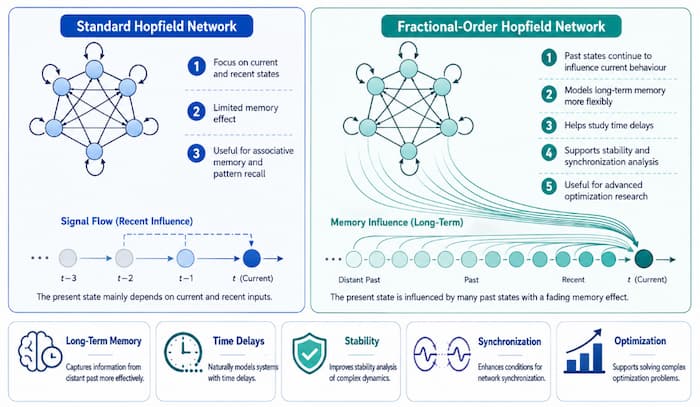
Fractional calculus helps Hopfield networks model long-term memory, time delays, and complex system behaviour.
Fractional calculus is a branch of mathematics that extends ordinary derivatives and integrals to non-integer orders. In simpler terms, it allows researchers to model systems where past states continue to influence future behaviour over time.
When fractional calculus is applied to Hopfield networks, the model can represent memory effects more flexibly than a standard network. This is useful for studying systems where behaviour does not depend only on the latest input, but also on a longer history of previous states.
| Area | Why It Matters |
| Long-term memory | Models how past states influence future outputs |
| Time delays | Helps study systems where responses are not instant |
| Stability | Checks whether the network settles correctly |
| Synchronization | Studies how complex systems align over time |
| Optimization | Supports advanced mathematical modelling |
This does not mean fractional Hopfield networks are automatically better for every AI task. Their main value is in research settings where memory, delay, and stability are important.
Integrating Non-Integer Derivatives for Memory Dynamics
In fractional-order Hopfield networks, standard derivatives may be replaced with fractional derivatives, such as Caputo-type derivatives. These derivatives allow the model to account for longer memory effects over time.
Instead of treating older information as irrelevant, fractional-order models can give past states a gradual influence on current behaviour. This makes them useful for modelling delayed neural networks, complex-valued systems, memristive networks, and other advanced mathematical systems.
For business readers, the key idea is simple: fractional calculus gives Hopfield networks a more advanced way to study memory and delay. However, this is mainly useful for technical research teams, not general business users.
What Are Key Applications in Thailand?
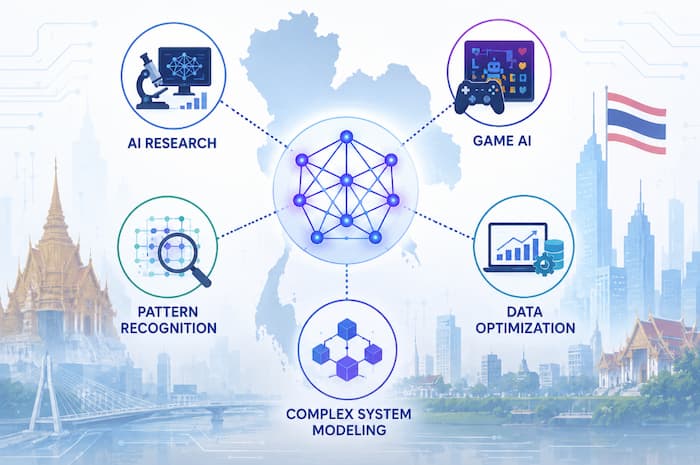
In Thailand, fractional-order Hopfield networks are mainly relevant to AI research, optimization, game AI, and advanced data modelling.
Thailand is investing more attention into AI, automation, digital transformation, and data-driven business tools. However, fractional Hopfield networks are still better described as research-level models rather than common commercial solutions.
They may have value in technical AI projects where pattern memory, time delays, and system stability matter.
| Application Area | Possible Role |
| AI research | Studying memory-based neural networks |
| Game AI | Modelling strategic decision patterns |
| Data optimization | Exploring pattern recall and stable solutions |
| Website analytics | Researching complex user behaviour |
| Automation research | Testing memory-aware AI systems |
For most businesses in Thailand, practical AI tools such as chatbots, workflow automation platforms, CRM systems, and analytics dashboards will usually be more useful in the short term.
Game Strategic Decision-Making
Game AI is one possible research use case for fractional Hopfield networks. In a turn-based strategy game, an AI system may need to evaluate different game states and predict likely enemy actions.
A model could study inputs such as player health, enemy distance, previous attack patterns, movement behaviour, available resources, and probability of attack. Hopfield networks may help recall patterns from previous game states, while fractional calculus may help model delayed decision effects.
This could support experimental game AI research, especially in simulations where earlier game states influence future behaviour. However, it should not be presented as a common industry practice unless there is clear evidence that studios are using it commercially.
Brand Pattern Recognition
In marketing, pattern recognition helps brands understand customer behaviour, campaign performance, audience segments, and purchase patterns. Fractional Hopfield networks could theoretically support advanced customer pattern analysis, especially when past behaviour affects future actions.
However, practical marketing teams usually rely on more accessible tools, such as CRM systems, analytics dashboards, recommendation engines, customer data platforms, and LLM-powered marketing assistants.
For this reason, fractional Hopfield networks should be framed as a possible future research direction for advanced marketing analytics, not a standard marketing tool for Thai brands today.
Data Optimization
Hopfield networks have been linked to optimization research because they move toward stable states. In simple terms, the network tries to settle into a solution that matches the stored pattern or reduces system energy.
Fractional-order versions may help researchers study more complex systems involving memory, delays, noisy data, or changing conditions over time.
Possible uses include noisy data recovery, delayed input modelling, pattern matching, system stability testing, and advanced prediction research. For Thai businesses, this is more suitable for technical AI teams than general marketing, sales, or operations teams.
How Can Fractional Hopfield Models Optimize AI Workflows?
Fractional Hopfield models may support workflows that require memory-based pattern recognition, stability analysis, and delayed data modelling.
AI workflows often involve repeated patterns, decision steps, data movement, and process optimization. In theory, fractional Hopfield models may support workflows where past data strongly influences future outcomes.
For example, they may be useful in research workflows involving delayed system responses, noisy data, pattern recall, or complex simulations. They can help researchers test whether a memory-based model remains stable under different conditions.
However, most real business workflows are better handled with tools like Power Automate, Zapier, Make, n8n, CRMs, APIs, and LLM agents. These tools are easier to deploy and more practical for businesses that need faster results.
The practical message is that fractional Hopfield models are useful for specialised AI research, while modern automation tools are better for daily business use.
Workflow Automation and Agentic Bots
Agentic bots are AI systems that can follow instructions, use tools, complete tasks, and support business processes. In real business environments, they may help with customer service, sales support, reporting, data entry, marketing workflows, and internal operations.
Modern agentic bots usually depend on LLMs, API connections, memory systems, workflow logic, business rules, and human approval steps.
| Component | Role |
| LLM | Understands and generates language |
| APIs and tools | Allow the bot to take action |
| Memory system | Stores useful context |
| Workflow logic | Controls process steps |
| Human approval | Reduces risk for important actions |
Fractional Hopfield networks are not usually the main technology behind agentic bots today. They may be relevant in future research on memory-aware AI systems, but practical bots for Thai businesses are more likely to use LLM-based systems.
What Role Do They Play in Thai Brand Marketing?
Fractional Hopfield networks could support advanced customer pattern analysis, but most Thai brand marketing today uses LLMs, analytics tools, CRM platforms, and automation systems.
Thai brands can use AI for content creation, customer segmentation, campaign planning, chatbot support, product recommendations, and marketing automation. These practical use cases are usually powered by LLMs, CRM tools, analytics platforms, and workflow automation.
Fractional Hopfield networks may be useful for advanced research into customer behaviour patterns, especially when past interactions influence future decisions. For example, researchers could study whether a user’s previous browsing or purchase behaviour affects later conversions.
Still, this should be explained carefully. A stronger SEO approach is to describe fractional Hopfield networks as a possible advanced research method, while making it clear that most marketing teams should start with more practical AI tools.
How to Finetune Models with Fractional Calculus Locally?

Finetuning fractional-order Hopfield models requires technical expertise, suitable datasets, mathematical modelling, and stability testing.
Finetuning fractional-order Hopfield models is not the same as finetuning an LLM. It is more mathematical and usually requires knowledge of neural network dynamics, differential equations, simulations, and stability analysis.
A basic workflow may include:
- Preparing time-dependent or delayed data.
- Defining the Hopfield network structure.
- Choosing the fractional derivative type.
- Setting the fractional order.
- Running numerical simulations.
- Testing convergence and stability.
- Adjusting parameters based on results.
This process is better suited for AI researchers, data scientists, university teams, and technical developers. Most businesses should only explore it if they have a clear research need or access to specialised expertise.
Why Partner with AI Thailand for Implementation?
Partnering with AI Thailand can help businesses understand whether advanced AI models are suitable for their goals.
AI advisory can help businesses decide whether they need advanced AI research models or simpler practical tools. For most companies, the best first step is usually not fractional Hopfield networks. It is more likely to be LLM chatbots, workflow automation, analytics dashboards, CRM automation, or custom AI assistants.
| Business Need | More Practical AI Solution |
| Customer support | LLM chatbot or helpdesk automation |
| Marketing content | AI writing assistant with brand guidelines |
| Sales replies | CRM-integrated response assistant |
| Reporting | Dashboard automation |
| Website support | AI website chatbot |
| Data analysis | Analytics and machine learning tools |
| Advanced research | Custom neural network modelling |
Fractional Hopfield networks should only be considered when there is a clear technical need for memory-based modelling, stability research, delayed data analysis, or advanced optimization.
What Training Workshops Cover These Techniques?
Training workshops should cover Hopfield network basics, fractional calculus, stability testing, simulations, and practical AI use cases.
A workshop on fractional Hopfield networks should be positioned as technical training. It is not the same as a beginner course on chatbots or business automation.
A suitable workshop could cover:
| Module | Topics |
| Hopfield basics | Associative memory, stable states, energy functions |
| Fractional calculus | Memory effects and time delays |
| Stability analysis | Convergence, synchronization, and model behaviour |
| Simulation | Python or MATLAB examples |
| Applications | Game AI, optimization, and data modelling |
| Business context | When advanced models are useful and when simpler tools are better |
This type of training is most suitable for AI researchers, data scientists, technical teams, university students, and advanced developers.
Day 1: Theory Foundations
The first day should explain Hopfield networks, associative memory, stored patterns, stable states, attractors, and energy functions. Learners should understand how a Hopfield network stores and retrieves information before moving into fractional calculus.
The session can then introduce fractional calculus in simple terms. Instead of overwhelming learners with formulas immediately, it should explain why memory and delay matter in advanced neural network research.
Day 2: Coding Fractional Dynamics

The second day can focus on simulations. Learners may build a simple Hopfield network, test pattern recall from noisy inputs, add time-delay elements, and compare standard models with fractional-order models.
If the article includes code, the code should be verified before publishing. This is important because untested code snippets can weaken trust, especially in technical SEO content.
Day 3: Finetuning and Capstone Deployment
The final day can focus on a small project, such as a game AI simulation, pattern recognition task, or delayed data modelling experiment.
Learners can prepare a dataset, test recall, adjust fractional-order parameters, review stability results, and explain the model’s limitations. The capstone should also compare the fractional Hopfield approach with simpler AI tools, so learners know when the method is actually necessary.
How Do They Support Data and Website Optimization?
Fractional Hopfield models may help study complex data patterns, but practical website optimization usually relies on analytics, SEO tools, automation platforms, and LLM assistants.
Website optimization usually involves improving content quality, user experience, page speed, conversion paths, search visibility, and customer engagement.
Most businesses use tools such as Google Analytics, Search Console, SEO platforms, heatmaps, A/B testing tools, AI chatbots, and content optimization software.
Fractional Hopfield networks may have research value for studying long-term user behaviour patterns. For example, they could help researchers explore whether earlier browsing sessions influence later conversions. However, most businesses do not need this level of modelling for normal website optimization.
Practical Integration for Thai E-Commerce
Thai e-commerce businesses should usually start with practical AI tools before considering fractional Hopfield networks.
| Goal | Practical AI Solution |
| Customer support | AI chatbot |
| Better conversions | Product recommendations |
| Less manual work | Workflow automation |
| SEO improvement | Content optimization tools |
| Customer insights | Analytics and segmentation |
| Faster replies | Agentic assistant |
| Demand planning | Predictive analytics |
Fractional Hopfield networks may be useful later for advanced research into customer behaviour, delayed decision patterns, or complex optimization. However, they are not the first solution most e-commerce businesses need.
Advanced Stability in Website Analytics
Website behaviour can be complex because users may browse, leave, return later, compare products, and convert after several sessions. Fractional-order models may help researchers study these long-term behaviour patterns.
However, most businesses can get useful insights from standard analytics tools and machine learning models. Fractional Hopfield networks should therefore be presented as an advanced research option, not a normal website analytics tool.
Limitations of Fractional Hopfield Networks
Fractional Hopfield networks are useful in research, but they have clear limits for business users.
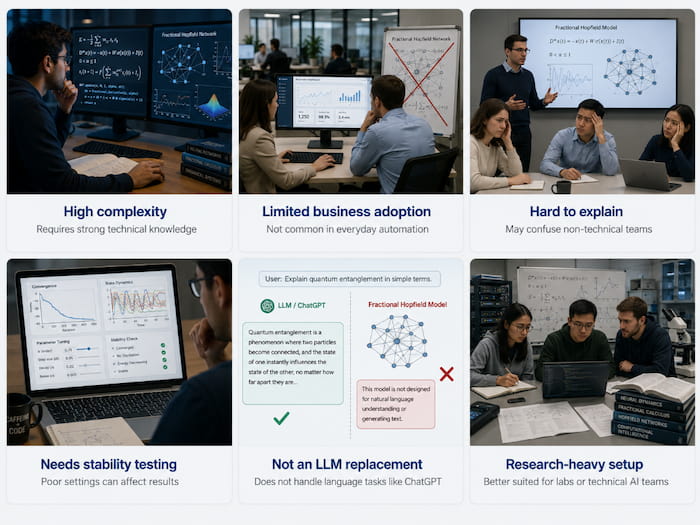
| Limitation | Why It Matters |
| High complexity | Requires strong technical knowledge |
| Limited business adoption | Not common in everyday automation |
| Hard to explain | May confuse non-technical teams |
| Needs stability testing | Poor settings can affect results |
| Not an LLM replacement | Does not handle language tasks like ChatGPT |
| Research-heavy setup | Better suited for labs or technical AI teams |
This section is important because it makes the article more balanced and trustworthy. Readers are more likely to trust content that explains both the benefits and limitations of a technology.
Fractional Hopfield Networks vs Modern LLM Agents
Fractional Hopfield networks and modern LLM agents are not the same type of AI system. They serve different purposes.
| Feature | Fractional Hopfield Networks | Modern LLM Agents |
| Main use | Memory-based modelling | Business task automation |
| Best for | Research and optimization | Chatbots and workflows |
| Business readiness | Low to moderate | High |
| Technical difficulty | High | Moderate |
| Language ability | Limited | Strong |
| Thailand use case | Research-level | Practical business use |
For most Thai businesses, LLM agents are the better starting point because they are easier to deploy and can support real tasks such as customer support, reporting, content creation, and workflow automation.
Should Thai Businesses Use Fractional Hopfield Networks Now?
Most Thai businesses should not start with fractional Hopfield networks unless they have a specific research or technical need.
They may be useful for advanced AI teams working on optimization, delayed data modelling, stability analysis, game AI simulations, or memory-based research.
For general business goals, companies should usually start with more practical AI systems such as LLM chatbots, CRM automation, workflow platforms, analytics dashboards, AI content assistants, and agentic business tools.
Conclusion
Hopfield networks remain an important part of neural network research because they show how AI systems can store, recall, and reconstruct patterns through associative memory. When combined with fractional calculus, these models become useful for studying long-term memory effects, time delays, stability, synchronization, and complex optimization problems. In Thailand, fractional-order Hopfield networks should be positioned as an advanced AI research topic with possible future applications in game AI, data modelling, website analytics, and experimental automation systems.
For most Thai businesses, practical AI value will still come first from tools that are easier to deploy, such as LLM agents, workflow automation platforms, analytics dashboards, CRM automation, customer service bots, and AI content assistants. Fractional Hopfield networks may become useful when companies need deeper research-level modelling, but they should not be presented as a mainstream business solution unless there is clear evidence to support that claim.
AI Thailand can support businesses by helping them understand which AI solutions are practical for their goals and which technologies are better suited for advanced research. Instead of forcing complex models into every business use case, AI advisory, training, and implementation support can help brands choose the right path, whether that means deploying agentic bots, improving automation workflows, strengthening data strategy, or exploring more specialised AI models like fractional Hopfield networks when there is a genuine technical need.
Frequently Asked Questions
What are Hopfield networks?
Hopfield networks are recurrent neural networks that store patterns and retrieve them from incomplete or noisy inputs. They are mainly known for associative memory and pattern completion.
What is fractional calculus in AI?
Fractional calculus is a mathematical method that uses non-integer derivatives or integrals. In AI research, it can help model long-term memory effects, delayed responses, and complex system behaviour.
Are fractional Hopfield networks used in Thailand?
They are better described as an advanced research topic rather than a mainstream business tool in Thailand. They may support future research in AI modelling, optimization, and game AI.
Can businesses use Hopfield networks for automation?
In theory, Hopfield networks can support memory-based modelling and optimization. In practice, most businesses will get faster results from LLM agents, CRM automation, workflow tools, and analytics platforms.
Are Hopfield networks better than LLM agents?
No. They serve different purposes. Hopfield networks are better suited for memory-based mathematical modelling, while LLM agents are better for language tasks, chatbots, workflow automation, and business support.
What are the limitations of fractional-order neural networks?
They are complex, research-heavy, difficult to implement, and not widely used in everyday business automation. They require strong technical expertise and careful stability testing.