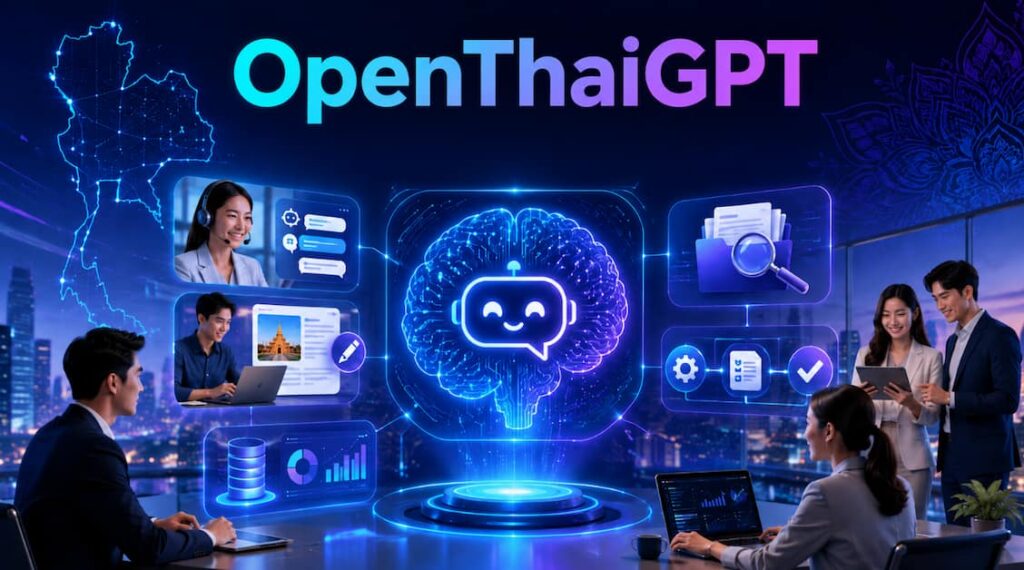
As businesses in Thailand adopt AI for customer service, marketing, website support, data handling, and workflow automation, OpenThaiGPT has become an important Thai language model project to understand.
OpenThaiGPT is a Thai-centric large language model designed to improve how AI systems understand, generate, and reason in Thai. Unlike many general-purpose AI models that are mainly optimised for English, OpenThaiGPT focuses on Thai language performance, Thai-English mixed conversations, local business terms, and Thai communication styles.
For Thai brands, this makes OpenThaiGPT useful for customer support chatbots, marketing assistants, website AI, internal document search, sales support, HR support, and workflow automation. When combined with company data, retrieval-augmented generation, tool calling, and human review, it can become the foundation for practical Thai business AI systems.
What Is OpenThaiGPT?
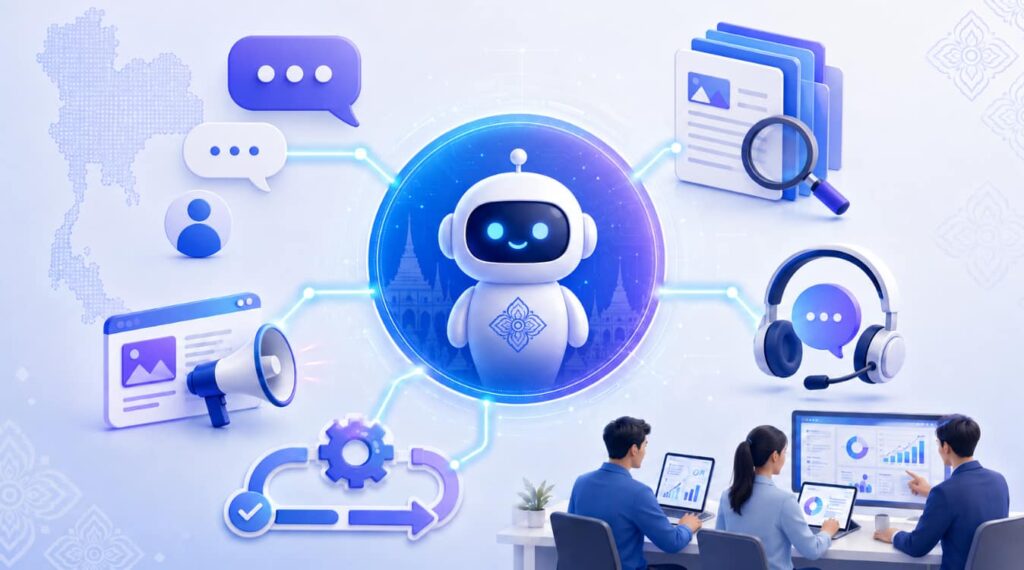
OpenThaiGPT is a Thai-focused large language model project created to make AI more useful for Thai speakers, developers, and businesses.
A large language model, or LLM, is an AI system that can understand and generate text. OpenThaiGPT applies this technology to Thai language tasks such as chatbot conversations, summarisation, question answering, content generation, reasoning, and business process support.
For businesses, OpenThaiGPT is not just another chatbot model. It can act as the foundation for Thai-first AI systems that understand local language, customer behaviour, business terms, and communication style.
Core Definition and Purpose of OpenThaiGPT
OpenThaiGPT can be defined as a Thai-centric LLM ecosystem built to improve AI performance in Thai language tasks.
Its purpose is to help organisations create AI systems that work better in Thai business environments. This is especially useful for companies serving Thai-speaking customers, managing Thai documents, or creating Thai marketing content.
OpenThaiGPT can support Thai businesses in areas such as:
- Customer service and FAQ automation
- Thai marketing content creation
- Website chatbot support
- Internal document search
- Sales reply drafting
- HR policy assistance
- Workflow automation and request routing
The key benefit is localisation. OpenThaiGPT gives businesses a stronger starting point for Thai-language AI than models mainly trained and evaluated for English-first use.
How Does OpenThaiGPT’s Architecture Work?
OpenThaiGPT uses the transformer architecture common in modern large language models. This allows it to understand prompts, follow instructions, generate responses, and handle complex text-based tasks.
OpenThaiGPT 1.6 72B is based on Qwen2.5-72B-Instruct, giving it a strong foundation for language understanding, reasoning, coding, and instruction-following. OpenThaiGPT then adapts this foundation for Thai language performance through Thai-focused training and evaluation.
For non-technical readers, the architecture can be understood in simple layers:
|
Layer |
What It Does |
|
Base model foundation |
Provides general language, reasoning, and instruction-following ability |
|
Thai language adaptation |
Improves performance for Thai prompts and Thai conversations |
|
Instruction tuning |
Helps the model follow user requests more accurately |
|
Evaluation and testing |
Measures performance on Thai language and reasoning tasks |
|
Business deployment |
Connects the model with documents, tools, APIs, chatbots, and workflows |
This means OpenThaiGPT is not simply a translated chatbot. It is a Thai-focused AI model that can be adapted for real Thai language use cases.
Key Model Components That Make OpenThaiGPT Useful
OpenThaiGPT is useful because it combines a strong model foundation with Thai-specific optimisation. The model can support both general language tasks and business-specific applications when it is connected to the right systems.
Important components include:
|
Component |
Why It Matters |
|
Strong base model |
Supports general language understanding, reasoning, and instruction-following |
|
Thai instruction data |
Helps the model respond more naturally to Thai prompts and Thai users |
|
Larger model scale |
Supports more complex tasks, but requires stronger computing resources |
|
Smaller model options |
Useful for testing, lighter tasks, or lower-cost deployment |
|
RAG compatibility |
Allows answers to be based on approved company documents |
|
Tool-calling potential |
Supports agentic bots that can retrieve data or trigger workflow actions |
Businesses should not treat OpenThaiGPT as a complete solution by itself. The model is the foundation. A practical business AI system still needs clean data, clear workflows, integrations, testing, monitoring, and safety rules.
How Is OpenThaiGPT Optimized for the Thai Language?
Thai language optimisation is the main reason OpenThaiGPT is relevant.
Many general AI models can respond in Thai, but they may still struggle with informal Thai, mixed Thai-English messages, local terms, cultural nuance, and natural customer service tone. OpenThaiGPT is designed to reduce this gap by focusing more directly on Thai language use.
This is useful because Thai business communication often includes:
- Casual or shortened customer messages
- Thai-English mixed sentences
- Local product or service terms
- Polite customer service language
- Industry-specific Thai vocabulary
- Thai documents, policies, and reports
For businesses, this makes OpenThaiGPT especially useful in customer-facing and internal workflows where Thai language accuracy matters.
What Are the Main Applications of OpenThaiGPT?
OpenThaiGPT can support many Thai business AI applications, especially where language accuracy and local context matter.
|
Application |
Business Use |
|
Customer support chatbots |
Answer FAQs, service questions, booking enquiries, and support requests |
|
Marketing assistants |
Create captions, ad copy, blog outlines, product descriptions, and campaign ideas |
|
Website AI assistants |
Help visitors find products, services, pricing, and contact information |
|
Internal document assistants | Help employees search company policies, SOPs, manuals, and reports |
|
Sales support bots |
Draft replies, summarise leads, and personalise customer follow-ups |
|
HR assistants |
Support questions about leave, claims, onboarding, and company rules |
|
Review analysis tools |
Summarise Thai reviews, detect repeated complaints, and identify sentiment |
|
Workflow automation assistants |
Classify requests, extract details, summarise information, and trigger next steps |
The strongest business use cases combine OpenThaiGPT with company-specific information. For example, a chatbot becomes much more useful when it can search actual product pages, FAQs, pricing documents, support policies, and internal guides instead of relying only on general model knowledge.
How Can Businesses Use OpenThaiGPT for Automation?
OpenThaiGPT can support automation when connected to tools, databases, forms, and company documents.
For example, a business can use OpenThaiGPT to read customer messages, identify the request type, summarise the issue, extract important details, and suggest the next action. This helps teams reduce repetitive manual work and respond faster.
Common automation use cases include:
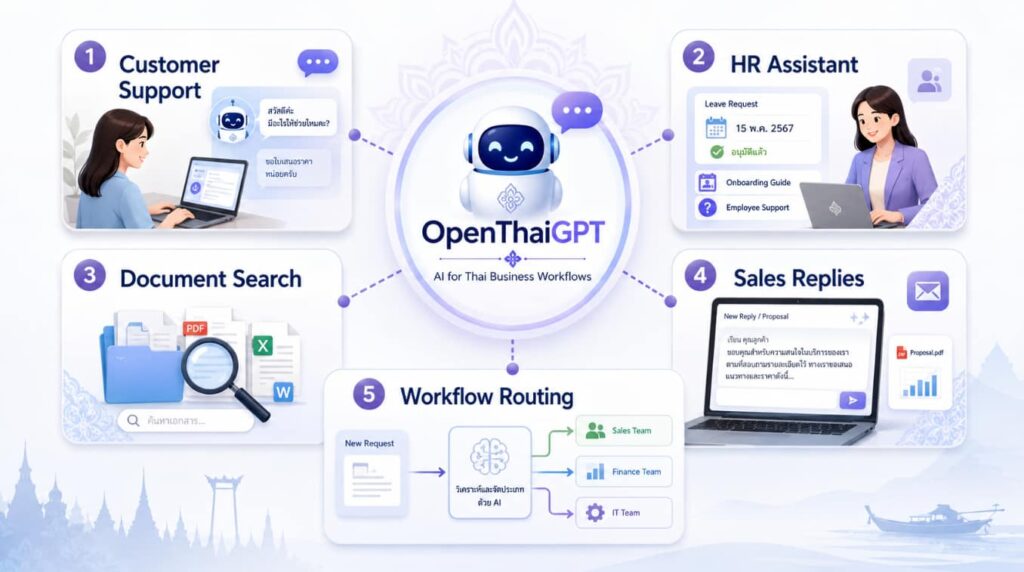
|
Use Case |
How It Helps |
|
Thai customer service chatbot |
Answers common customer questions and reduces repetitive replies |
|
Internal HR assistant |
Helps employees understand leave, claims, onboarding, and company policies |
|
Sales reply assistant |
Drafts Thai-English replies based on customer enquiries and brand tone |
|
Internal knowledge search |
Lets staff search company documents using natural Thai questions |
|
Review and feedback analysis |
Summarises customer feedback and highlights common issues |
|
Workflow routing bot |
Reads requests, identifies the task type, and sends them to the right department |
These automations are most effective when the AI is connected to accurate business data and clear workflow rules.
How Can OpenThaiGPT Support Brand Marketing?
OpenThaiGPT can help Thai brands create content faster and more consistently.
Thai marketing needs more than direct translation. It needs to sound natural, persuasive, and suitable for each platform. A TikTok caption may need a different tone from a website landing page, while a LINE message may need to sound more conversational and direct.
OpenThaiGPT can help with:
- Social media captions for Facebook, Instagram, TikTok, LINE, and LinkedIn
- Thai ad copy variations for testing
- SEO blog outlines, sections, FAQs, and meta content
- Product descriptions and selling points
- Campaign localisation from English to Thai
- Customer replies for comments, enquiries, and complaints
- Brand voice consistency across different channels
- Content repurposing for emails, captions, scripts, and website copy
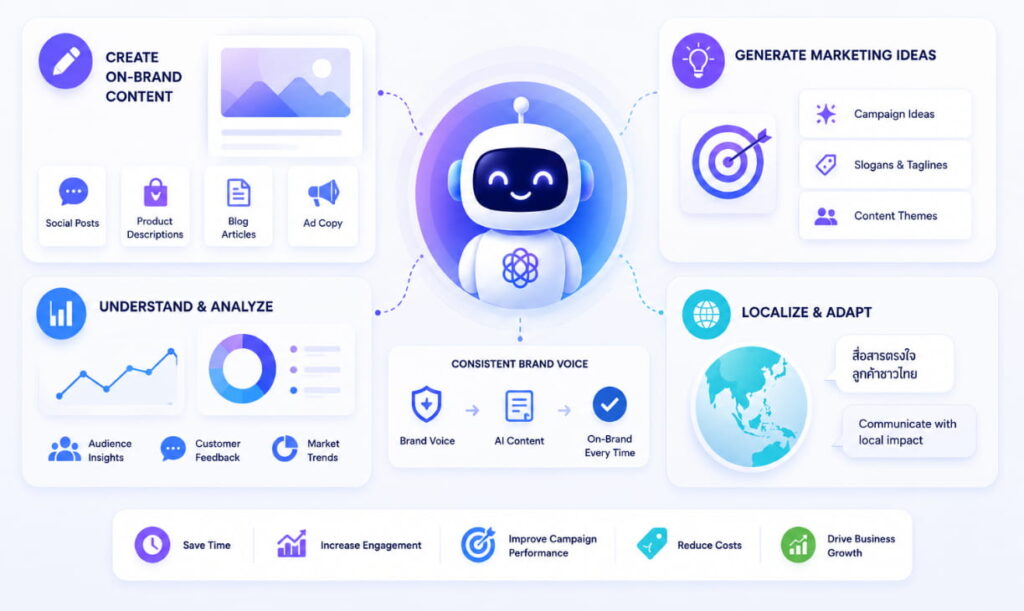
For better results, businesses should give the model clear brand guidelines, audience details, product information, approved content examples, and campaign goals.
What Role Does OpenThaiGPT Play in Data and Workflow Automation?
OpenThaiGPT can turn natural language into structured business outputs.
For example, it can read a customer message, summarise the issue, classify the request, extract key details, and suggest the next action. This makes it useful for teams that deal with large amounts of customer messages, forms, reviews, emails, or internal requests.
|
Workflow Area |
Example Use |
|
Customer enquiry handling |
Classifies questions and suggests suitable replies |
|
Form processing |
Extracts key details from form submissions |
|
Report summarisation |
Summarises feedback, tickets, surveys, or internal reports |
|
HR workflows |
Routes leave, claims, onboarding, and policy questions |
|
Sales operations |
Summarises leads and drafts follow-up messages |
|
Operational requests |
Turns repeated internal requests into structured tasks |
|
Website support |
Guides users to the right product, service, or contact point |
|
Data analysis support |
Summarises Thai reviews, survey answers, and feedback themes |
This is where OpenThaiGPT becomes especially useful for business operations. It can sit between messy human language and structured business systems.
Can OpenThaiGPT Be Fine-Tuned for Custom Business Processes?
Fine-tuning can make OpenThaiGPT more useful for specific business tasks, but it should not always be the first step.
Most businesses should start with better prompts, clear brand guidelines, RAG, structured templates, and human review before fine-tuning. Fine-tuning makes more sense when a company has enough high-quality examples and needs the model to follow a specific tone, structure, or process repeatedly.
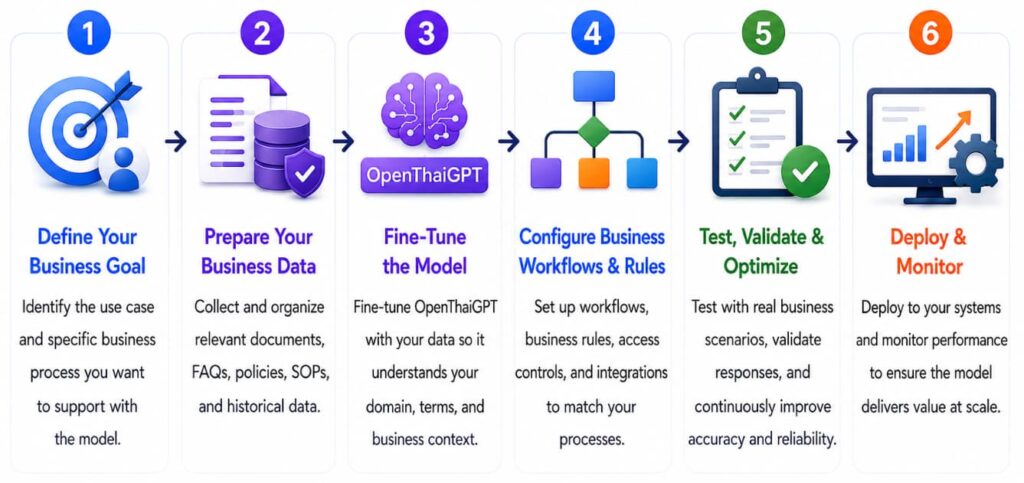
When Fine-Tuning Makes Sense
Fine-tuning may be useful when a business needs:
- Consistent brand voice across customer replies and marketing content
- Industry-specific Thai terminology
- Repeated workflow formats
- Customer service replies that match internal standards
- Structured summaries, reports, or case notes
Fine-tuning is powerful, but it should solve a clear business problem. Otherwise, prompt design and RAG may be faster, cheaper, and easier to maintain.
Step-by-Step Fine-Tuning Process
- Define the exact task.
- Collect strong input and output examples.
- Remove sensitive or private data.
- Choose the right model size.
- Fine-tune using a suitable method.
- Test with real Thai business examples.
- Compare results against the base model.
- Deploy with monitoring and human review.
How Can AI Thailand Support OpenThaiGPT Deployment?
AI Thailand can help businesses move from interest in AI to practical implementation.
Many companies know they want AI, but they may not know which model to use, what data to prepare, or how to connect AI to real workflows. This is where AI advisory and implementation support become important.
AI Thailand can support OpenThaiGPT deployment through:
|
Service Area |
Business Value |
|
AI advisory |
Identifies the best use case, model, workflow, and deployment approach |
|
Brand AI support |
Aligns AI outputs with brand tone and customer expectations |
|
Marketing AI workflows |
Builds repeatable workflows for captions, ads, blogs, and campaign content |
|
Website AI assistants |
Supports chatbot and website assistant deployment |
|
Data preparation |
Organises documents, FAQs, product data, and knowledge bases for RAG |
|
Team training |
Teaches employees how to use AI clearly and safely |
|
Workflow automation |
Connects AI outputs to forms, spreadsheets, CRMs, ticketing systems, or internal tools |
The goal should not be to deploy AI just for the sake of using AI. The goal should be to solve a real business problem, such as reducing repetitive customer enquiries, improving response speed, or making internal knowledge easier to access.
What Are the Technical Requirements for OpenThaiGPT?
OpenThaiGPT 1.6 72B is a large model, so businesses need to plan infrastructure carefully. Larger models can give stronger outputs, but they also require more computing resources and higher operating costs.
|
Requirement |
Why It Matters |
|
GPU resources |
Needed to run larger models efficiently |
|
Model serving framework |
Helps deliver responses quickly and reliably |
|
Vector database |
Supports RAG and internal document search |
|
Clean company data |
Improves accuracy and reduces confusion |
|
API integrations |
Connects the model to business systems |
|
Access control |
Protects internal and customer information |
|
Monitoring |
Tracks answer quality, errors, usage, and safety issues |
|
Human review |
Reduces risk for customer-facing or sensitive tasks |
For most businesses, the technical setup should match the use case. A simple FAQ chatbot does not need the same infrastructure as a high-volume automation system.
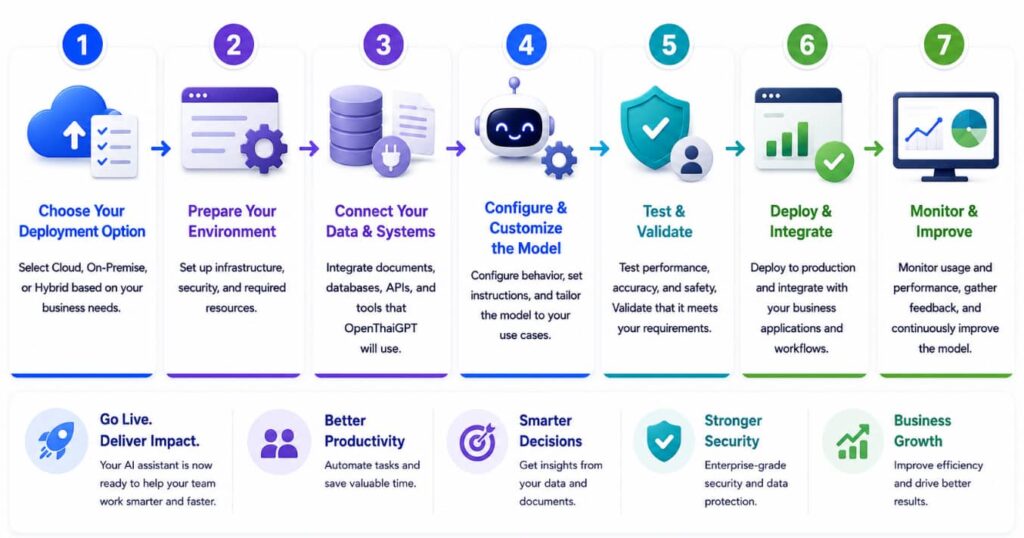
How Do You Deploy OpenThaiGPT Step by Step?
A practical OpenThaiGPT deployment should start small, prove business value, and scale only after testing.
What OpenThaiGPT Training and Workshops Are Available?
Training helps teams use OpenThaiGPT properly and safely. A good training programme should focus on practical business use, not just technical theory.
Useful training areas include:
|
Training Area |
What Teams Learn |
|
OpenThaiGPT basics |
What the model can and cannot do |
|
Prompting for Thai business tasks |
How to write better prompts |
|
RAG implementation |
How to connect AI to company documents |
|
Chatbot planning |
How to design useful Thai customer service bots |
|
Marketing AI workflows |
How to generate and review Thai content faster |
|
Workflow automation |
How to connect AI outputs to business processes |
|
AI safety |
How to reduce hallucinations, privacy risks, and misuse |
|
AI evaluation |
How to test AI before using it in real workflows |
The best workshops should include hands-on examples using real business scenarios.
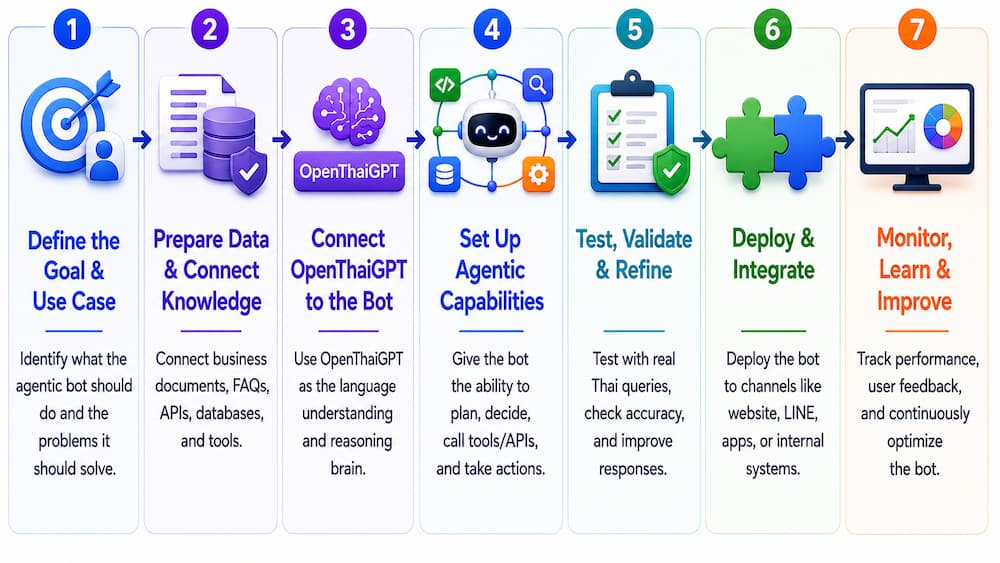
How Do You Integrate OpenThaiGPT with Agentic Bots?
OpenThaiGPT can be integrated with agentic bots by combining the model with business data, tools, and workflow rules.
A basic chatbot only replies. An agentic bot can understand the task, retrieve information, call tools, and help complete a process.
For example, a Thai customer support agentic bot could understand a customer message, identify the issue type, search the company knowledge base, check order details through an API, draft a response, create a ticket, and escalate complex cases to a human.
What Advisory Services Complement OpenThaiGPT?
OpenThaiGPT becomes more valuable when supported by the right advisory, data, automation, and deployment services.
|
Advisory Service |
How It Helps |
|
Brand advisory |
Aligns outputs with brand voice and communication standards |
|
Marketing support |
Helps create campaign ideas, captions, blogs, and customer replies faster |
|
Website AI support |
Supports Thai website assistants and customer-facing chatbots |
|
Data advisory |
Prepares documents, FAQs, product data, and knowledge bases for RAG |
|
Workflow automation |
Connects OpenThaiGPT to business systems and reduces manual admin work |
|
Training |
Helps teams use AI safely and consistently |
|
Deployment support |
Helps businesses test, monitor, improve, and scale AI systems |
The strongest advisory approach starts with business goals. Instead of asking, “How do we use OpenThaiGPT?”, businesses should ask what problem they want AI to solve, what information the AI should use, which workflows can be automated safely, and how success will be measured.
Conclusion
OpenThaiGPT gives Thai businesses a stronger foundation for building AI systems that understand local language, customer needs, and business context. It can support customer service, marketing, internal document search, sales support, and workflow automation when connected to the right data and tools.
AI Thailand can help businesses plan and deploy OpenThaiGPT-based solutions through AI advisory, data preparation, chatbot development, workflow automation, implementation support and training. With the right strategy, OpenThaiGPT can help Thai-first businesses reduce repetitive work, improve communication, and create more practical AI systems.
Frequently Asked Questions About OpenThaiGPT
What is OpenThaiGPT?
OpenThaiGPT is a Thai-centric large language model project designed to improve AI performance in Thai language understanding, generation, reasoning, and business applications.
What is OpenThaiGPT 1.6?
OpenThaiGPT 1.6 72B is a 72-billion-parameter Thai language model designed for general-purpose tasks with stronger reasoning capabilities.
What is OpenThaiGPT based on?
OpenThaiGPT 1.6 72B is based on Qwen2.5-72B-Instruct. Earlier OpenThaiGPT 1.5 models were based on Qwen v2.5 and fine-tuned for Thai language use.
What are the main applications of OpenThaiGPT?
OpenThaiGPT can support Thai customer service chatbots, website assistants, marketing content, internal document search, review analysis, sales support, HR support, and workflow automation.
How is OpenThaiGPT different from general AI models?
OpenThaiGPT is designed for Thai language and Thai-related use cases. It is more relevant for businesses that need AI to understand Thai phrasing, local context, Thai-English mixed language, and Thai customer communication.
Can OpenThaiGPT be fine-tuned for business use?
Yes. OpenThaiGPT can be adapted for specific business use cases, especially when a company needs a consistent brand voice, industry terms, or structured response formats.
Can OpenThaiGPT support agentic bots?
Yes. OpenThaiGPT can support agentic bots when combined with tool calling, RAG, APIs, and workflow automation.
How can AI Thailand help with OpenThaiGPT?
AI Thailand can help businesses identify use cases, prepare data, design Thai AI workflows, build chatbots, connect automation tools, train teams, and deploy OpenThaiGPT-based systems safely.