
Generative AI in E-commerce: Elevating Customer Experience
As an e-commerce brand seeking AI Thailand’s advisory for data, marketing, and workflow automation, you can use generative AI to transform shopper journeys. Gen AI tools like ChatGPT can help craft dynamic product descriptions, personalised recommendations, and context-aware support through agentic bots.
From finetuning models to deploying virtual assistants, generative AI can help brands create a stronger eCommerce customer experience that supports loyalty, customer satisfaction, and sales growth.
Key Takeaways
- Generative AI supports personalised product recommendations and virtual try-ons, helping improve customer engagement in e-commerce.
- Real-time GenAI chatbots provide faster query resolution and conversational shopping support.
- Agentic bots and finetuned models create context-aware, brand-specific experiences through tailored content and automation.
- Strong results depend on accurate data, ethical AI practices, testing, and customer trust.
How Does Generative AI Enhance E-commerce Customer Experience?
Generative AI enhances e-commerce customer experience by enabling more personalised interactions across product discovery, content, customer support, and post-purchase assistance. Through AI Thailand’s advisory services, brands can explore finetuning models, deploying agentic bots, and improving customer-facing workflows.
It tackles common pain points such as cart abandonment, low conversion rates, and slow customer support. Personalised recommendations guide shoppers to relevant products, while virtual try-ons create immersive previews that help customers feel more confident before purchasing.
Brands also gain from conversational commerce and predictive analytics, which can support inventory management, demand forecasting, and better marketing decisions. When applied with accurate data and proper testing, AI personalisation can improve customer trust and operational efficiency.
Personalised Product Recommendations
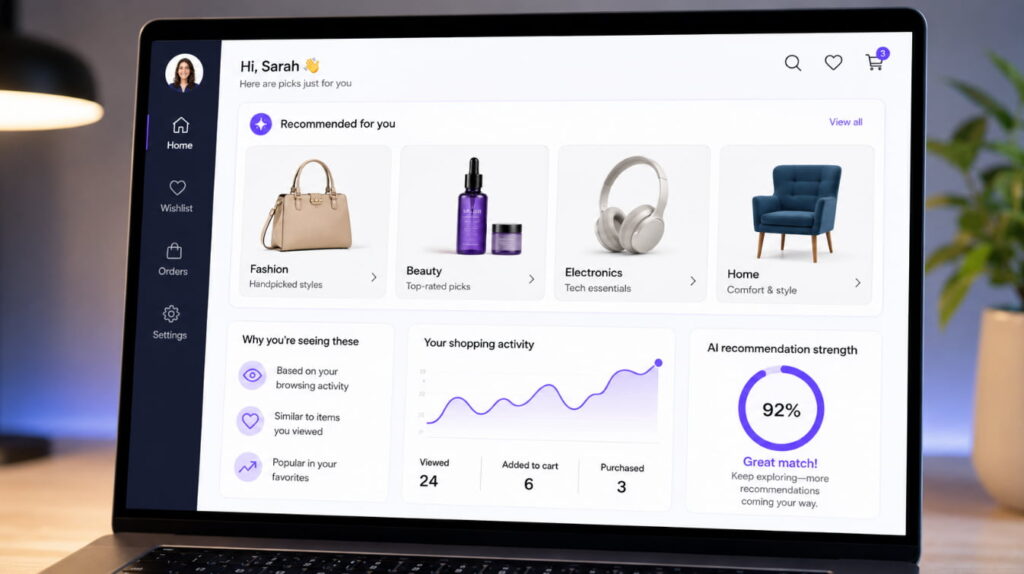
Personalised product recommendations powered by Gen AI analyse customer behaviour to suggest more relevant items. Amazon is a well-known example of how machine learning can support recommendation systems at scale.
Gen AI supports hyper-personalisation by generating tailored suggestions based on browsing history, past purchases, real-time preferences, and product interest. This approach can integrate with PIM systems such as Inriver PIM to pull accurate product data and keep recommendations consistent across platforms.
Implementation usually follows a structured path:
- Collect customer and product data through PIM integration.
- Train models with predictive analytics to forecast preferences.
- Finetune outputs for product relevance and brand tone.
- A/B test recommendations and monitor engagement metrics.
When supported by accurate data and proper testing, personalised recommendations can improve product discovery, support revenue uplift, and reduce cart abandonment through more precise targeting.
AI-Powered Virtual Try-On and Visualisation

AI-powered virtual try-on uses Gen AI and AR/VR visualisation tools to create more immersive shopping experiences. IKEA’s room planning and AR tools show how visualisation can help customers preview products before purchase.
This technology can create realistic product previews, allowing customers to visualise items in their own space or on themselves. This is especially useful for categories such as fashion, furniture, beauty, home décor, and accessories, where appearance and fit strongly affect purchase decisions.
A practical rollout may include:
- Integrating visual generation or AR tools.
- Rendering lifelike product previews.
- Testing image accuracy and quality.
- Tracking metrics such as time-on-site, engagement, and conversion improvements.
Brands like Nestlé have also used AI-powered digital twins to scale product visuals for e-commerce and digital media. Ethical AI remains important because visuals should represent products accurately and protect customer trust.
What Do Real-Time Chatbots Solve for Shoppers?
Real-time chatbots solve shopper pain points such as order tracking delays, slow responses, unclear product information, and generic support replies. These tools mark a shift from static FAQs to intelligent systems that can support query resolution, fraud detection, and personalisation in e-commerce.
eBay’s AI-powered shopping assistance highlights how AI can streamline product discovery and customer support. Instead of delayed responses and generic answers, shoppers can receive tailored guidance on recommendations, inventory checks, and order updates.
These bots can connect with backend processes for real-time updates on logistics, stock, and supply chain status. This supports smoother customer interactions and may reduce cart abandonment through proactive assistance.
Instant Query Resolution with GenAI Bots
GenAI bots provide instant query resolution using tools like ChatGPT and speech-to-text tools such as OpenAI Whisper or Azure OpenAI’s Whisper model for voice inputs. They can handle enquiries on product descriptions, pricing, availability, shipping, returns, and order status with greater speed and consistency.
To optimise performance, brands should:
- Finetune bots with business context.
- Integrate semantic search to better understand shopper intent.
- Use evaluation frameworks for performance monitoring.
- Follow data privacy and security requirements.
- Monitor responses continuously for quality control.
These steps help bots support order tracking, fraud detection, and customer service more effectively. Practical training using customer feedback also supports ethical AI deployment and reduces support burdens in e-commerce.
Conversational Shopping Assistance
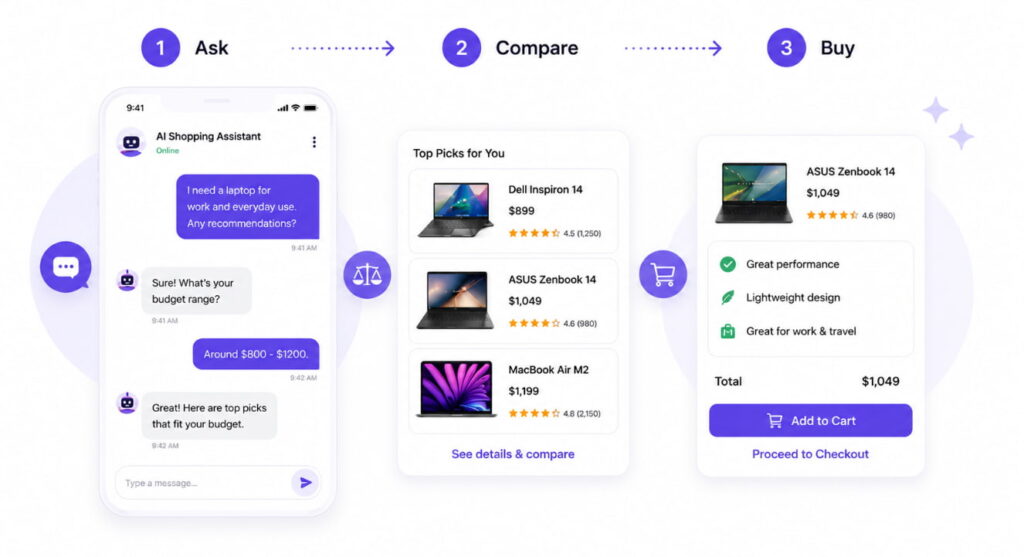
Conversational shopping assistance via Gen AI chatbots guides users through voice shopping and complex queries. These agentic systems support multi-turn dialogues, helping shoppers compare products, ask follow-up questions, and move towards purchase.
Custom bots often perform better than general tools because they understand brand-specific jargon, product data, customer journeys, and support policies. Mattel’s AI-driven customer engagement shows how brands can use AI to support recommendations and product discovery.
When integrated with PIM, product images, and predictive analytics, conversational assistants can support customer trust, marketing strategies, and demand forecasting.
How Does GenAI Create Tailored Content?
GenAI creates tailored content such as dynamic product descriptions, product images, ad copy, and SEO-friendly category text. In e-commerce, it automates visual content creation and descriptions while keeping content relevant to customer preferences.
AI Thailand’s finetuning support can help capture a unique brand voice, improving personalisation without relying fully on manual content creation. This is especially useful for large product catalogues where consistency matters.
Practical examples include generating product images for seasonal variants or crafting descriptions that highlight features based on customer feedback. This type of tailored content can improve product discovery, support brand loyalty, and reduce friction in the buying journey.
Dynamic Product Descriptions and Images
Dynamic product descriptions generated by Gen AI adapt to user preferences, while PIM integration like Inriver PIM helps maintain consistency across platforms. These tools support semantic search, product recommendations, and real-time content adjustments based on browsing history.
|
Tool |
Price |
Key Features |
Best For |
|
OpenAI image tools |
Usage-based, varies by model and settings |
Image generation |
Product visuals |
|
ChatGPT |
Plan-based or API usage-based |
Text generation |
Product descriptions |
|
Kleep AI Studio |
Custom |
AR images |
Immersive visuals |
|
GANs |
Open-source |
Hyper-realistic images |
Advanced visuals |
|
Phrasee |
Enterprise |
Marketing copy |
Campaign copy |
For beginners, AI image tools and ChatGPT can support product visuals and descriptions when tested in small campaigns first. Advanced users may explore GANs for lifelike product images, while AR tools suit brands seeking immersive product experiences. In all cases, human review remains important for accuracy, brand consistency, and customer trust.
What Role Do Agentic Bots Play in CX?
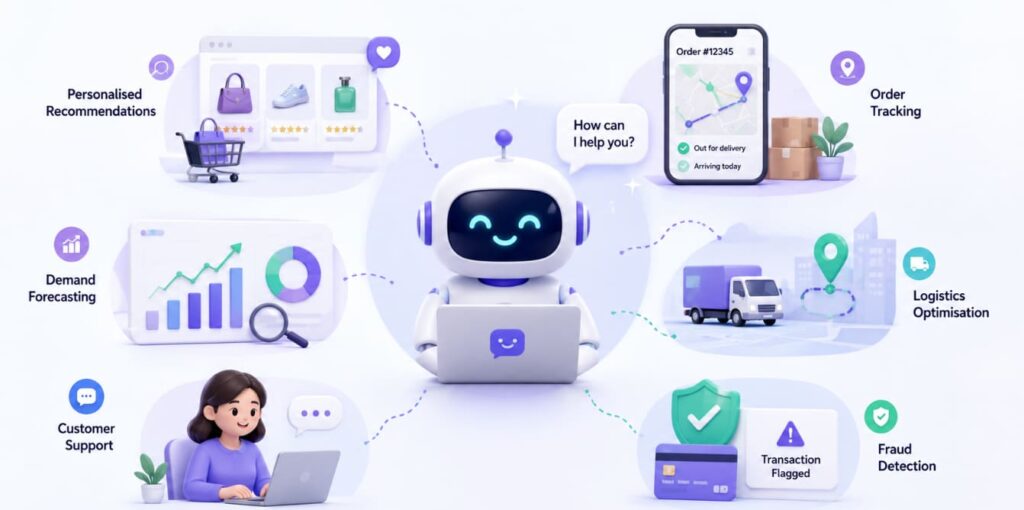
Agentic bots act as virtual assistants with business context. Unlike basic chatbots, these systems can manage queries from initial contact through workflow integration. They improve customer experience by anticipating needs and executing multi-step actions more smoothly.
According to McKinsey, agentic AI could increase procurement efficiency by 25% to 40%. This applies specifically to procurement, not all e-commerce operations, so brands should avoid presenting it as a general efficiency figure.
In e-commerce, agentic bots can connect with inventory management, logistics optimisation, personalised recommendations, fraud detection, and order tracking. By handling complex workflows, they free human agents for higher-value tasks and support more efficient customer journeys.
Context-Aware Virtual Assistants for E-commerce
Context-aware virtual assistants use Gen AI to maintain conversation history and business data. This allows them to provide proactive suggestions, improve semantic search, and deliver more relevant product recommendations.
These assistants can support voice shopping, predictive analytics, order tracking, customer feedback analysis, and personalised support. PIM integration helps ensure accurate product descriptions and visuals, while data security remains essential for customer trust.
E-commerce teams should focus on ethical AI practices, data privacy compliance, and quality control during deployment. This reduces risk while improving customer interactions.
How to Implement GenAI for E-commerce CX?
Implementing GenAI for e-commerce CX starts with AI Thailand’s advisory services, from finetuning models to deploying agentic bots. The process should begin with workshops that align GenAI with brand-specific goals such as improving product descriptions, customer support, personalisation, or inventory management.
Testing services like Tx-PEARS can validate improvements in shopping experience and conversion rates. Deployment should follow a staged approach, with focus on ethical AI, data security, and measurable results.
No-code platforms and practical workshops can also help teams test AI for voice shopping, AR/VR experiences, SEO content, demand forecasting, and workflow automation.
Finetuning Models for Brand-Specific Experiences
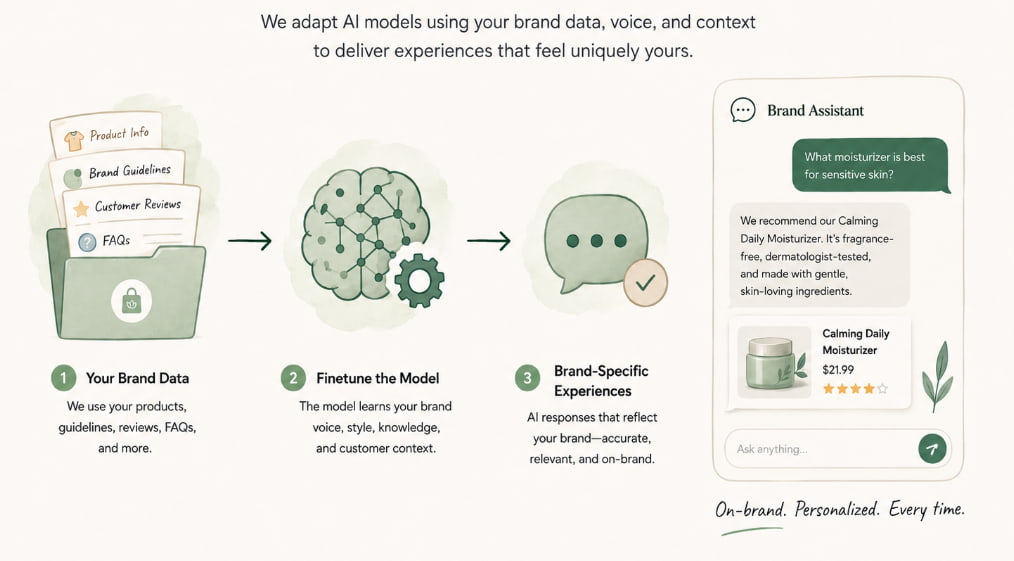
Finetuning models like those using Tx-Reusekit tailor Gen AI to brand data, helping create brand-specific e-commerce experiences. It refines AI outputs for product images, semantic search, personalised recommendations, and customer support.
A simple finetuning process includes:
- Gathering brand data via PIM export.
- Finetuning with Tx tools after setup.
- Configuring APIs for ChatGPT or AI image tools.
- Testing using Tx-PEARS for engagement and quality.
- Deploying gradually for live customer experience.
Brands should avoid overfitting by using a suitable train/test split. Time estimates vary depending on data quality, integration needs, and testing requirements.
AI Advisory Services for E-commerce Brands
AI Thailand’s AI advisory services for e-commerce brands deliver solutions from data analytics to workflow automation, supporting ethical AI and data privacy compliance.
These services include training workshops and agentic bot deployment that help brands improve customer experience through Gen AI. Brands gain practical tools for personalised recommendations, content creation, inventory management, and customer support.
Expert guidance covers risk management, data security, predictive analytics, conversational commerce, and workflow automation. This helps brands adopt AI in a practical and sustainable way.
Workflow Automation and Training Workshops
Workflow automation via AI Thailand streamlines backend processes such as logistics optimisation, order tracking, customer support routing, and content workflows. Hands-on training workshops also help internal teams build Gen AI expertise.
Common challenges include:
- Data silos, addressed through data analytics workshops.
- Skills gaps, supported by practical Gen AI training.
- Compliance risks, reduced through ethical AI audits and privacy controls.
Automation improves order tracking, quality control, customer service, and marketing workflows. Training also helps teams use AI tools more confidently for AR/VR experiences, voice shopping, semantic search, and e-commerce content.
Conclusion
Generative AI can help e-commerce brands improve customer experience through personalised recommendations, virtual try-ons, real-time chatbots, tailored content, and workflow automation. When supported by accurate data, ethical AI practices, and careful testing, these tools can make online shopping more responsive, relevant, and efficient.
At AI Thailand, we help businesses apply AI in practical ways across customer experience, marketing, data, and workflow automation. Whether your company works with e-commerce brands, retail platforms, or industrial suppliers, we focus on AI solutions that are measurable, useful, and aligned with real business goals.
Frequently Asked Questions
What is Generative AI in E-commerce: Customer Experience?
Generative AI in E-commerce: Customer Experience refers to the use of AI models that create personalised content, recommendations, and interactions to enhance how customers shop online. From product descriptions to virtual try-ons and dynamic chatbots, it helps transform static shopping into a more tailored experience.
How does Generative AI in E-commerce improve personalisation?
It analyses customer data like browsing history, purchase behaviour, and preferences to generate personalised recommendations, product visuals, and marketing messages in real time.
What are key applications of Generative AI in e-commerce?
Key applications include AI-powered virtual assistants, product recommendations, product image generation, automated listing content, conversational shopping, and predictive personalisation.
What benefits does Generative AI offer businesses?
Generative AI can support customer retention, scalable personalisation, content creation, data-driven inventory decisions, and more efficient marketing workflows.
How can brands implement Generative AI in e-commerce?
Brands can work with AI advisory services like AI Thailand to finetune models, deploy agentic bots, integrate AI into websites and marketing workflows, and train internal teams.
What challenges exist with Generative AI in e-commerce?
Common challenges include data privacy concerns, model accuracy, integration complexity, and customer trust. These can be managed through ethical AI practices, data governance, expert advisory, and continuous finetuning.