
As a Thai entrepreneur or educator exploring AI for brands, marketing, workflows, and learning, ChatGPT can help you work faster, generate better ideas, and automate routine tasks. From simple prompts to AI agents and workflow automation, this guide explains how Thai users can start using ChatGPT in practical ways.
Whether you want to create marketing content, improve customer support, prepare lesson plans, translate materials, or scale business operations, ChatGPT can become a useful everyday tool when it is used with clear prompts and proper review.
Key Takeaways
- Start with a free ChatGPT account to explore basic AI tasks such as writing, brainstorming, summarizing, and translating.
- Use clear prompts with roles, context, and output formats to get more relevant answers.
- Thai entrepreneurs can use ChatGPT for marketing, customer support, SEO content, sales ideas, and workflow planning.
- Educators can use ChatGPT to create lesson plans, quizzes, bilingual materials, and personalized learning resources.
- Businesses that want to scale can explore AI advisory, finetuning, AI bots, and automation with AI Thailand.
Getting Started with ChatGPT for Beginners
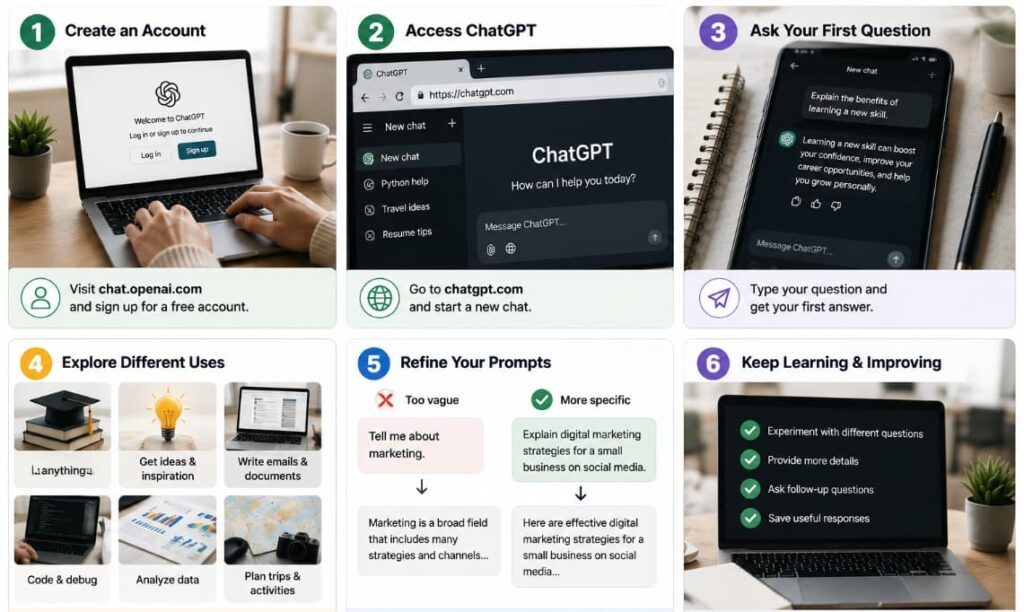
ChatGPT is a conversational AI tool that can understand prompts and generate human-like responses. For Thai entrepreneurs and educators, it offers a practical starting point for using AI without needing advanced technical skills.
Beginners can use ChatGPT to write social media captions, summarize documents, brainstorm business ideas, create lesson plans, draft emails, translate content, or answer customer questions. The tool is especially useful when users provide clear instructions and enough background information.
The free version is suitable for learning the basics. Users who need more advanced features, higher usage limits, custom GPTs, file analysis, or additional tools can consider ChatGPT Plus, which is listed by OpenAI at $20/month.
Creating Your Free ChatGPT Account
To begin, visit ChatGPT and sign up using an email, Google, Microsoft, or Apple account. After creating your account, you can start a new chat and test a simple prompt.
For example:
“Give me five marketing ideas for a small Thai café in Bangkok.”
Once ChatGPT gives an answer, improve the response by adding more details. You could ask:
“Make the ideas more suitable for university students and include TikTok content suggestions.”
This process helps you understand how prompt quality affects the final output.
Navigating ChatGPT
ChatGPT’s interface is simple. The main chat box is where you type prompts, while previous conversations are stored in the sidebar. Users can continue old conversations, copy responses, ask follow-up questions, upload files where available, and organize different tasks into separate chats.
Thai users can prompt in Thai, English, or a mix of both. For example:
“Act as a Thai marketing consultant. Create five Facebook post ideas for a Bangkok skincare brand targeting working women aged 25 to 35.”
This is stronger than asking, “Give me marketing ideas,” because it gives ChatGPT a role, audience, location, and clear task.
How Can Users Optimize Prompts for Business?
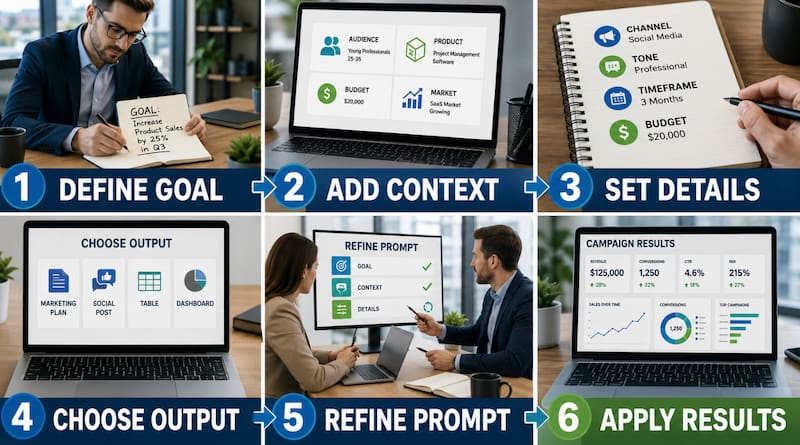
Prompt optimization is the key to getting better results from ChatGPT. A weak prompt usually produces a general answer, while a clear prompt gives ChatGPT enough direction to create something useful.
For business users, prompts should include the role, business context, target audience, task, and preferred format. This makes ChatGPT more effective for marketing, customer support, sales, operations, and content creation.
Use Clear Roles and Context
Start by telling ChatGPT what role it should take.
Examples include:
- “Act as a Thai marketing manager.”
- “Act as a customer service trainer.”
- “Act as an e-commerce consultant.”
- “Act as a business lecturer.”
- “Act as an HR manager.”
Then provide context. Mention your product, audience, platform, tone, goal, and any constraints.
For example:
“Act as a Thai marketing manager. Create five low-budget campaign ideas for a Bangkok-based online clothing store targeting women aged 20 to 30.”
This prompt gives ChatGPT a clearer direction and makes the answer more relevant.
Ask for a Specific Output Format
ChatGPT performs better when you tell it how to present the answer.
You can ask for:
- A table
- A numbered list
- A short paragraph
- A step-by-step guide
- A social media caption
- A lesson plan
- A checklist
- A script
For example:
“Create a table with three columns: campaign idea, target audience, and suggested platform.”
This makes the response easier to use in business documents, presentations, and classroom materials.
Improve Responses With Follow-Up Prompts
The first answer does not need to be the final answer. You can refine it by asking ChatGPT to adjust the tone, shorten the text, localize the examples, or make the output more practical.
Useful follow-up prompts include:
- “Make this more suitable for Thai customers.”
- “Rewrite this in a more professional tone.”
- “Turn this into a checklist.”
- “Shorten this for a social media caption.”
- “Add examples for Bangkok SMEs.”
- “Make the explanation easier for beginners.”
This process helps turn a basic response into something more useful.
Example: Optimized Prompt in Action
A basic prompt would be:
“Give me marketing ideas.”
A stronger prompt would be:
“Act as a Thai marketing executive. Create five low-budget marketing campaign ideas for a Bangkok e-commerce store selling skincare products. Target women aged 25 to 35. Include the campaign concept, platform, message angle, and call-to-action.”
The second prompt is more effective because it includes the role, location, business type, audience, and expected output.
Using ChatGPT for Thai Entrepreneurship Essentials
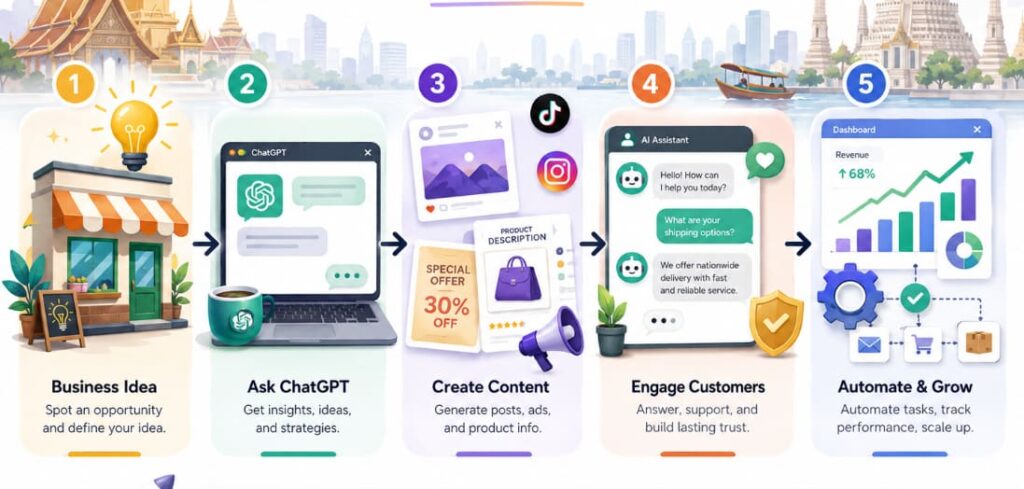
Thai entrepreneurs can use ChatGPT to support daily business tasks. It is especially helpful for small businesses that need quick drafts, ideas, summaries, and workflows without hiring extra staff for every task.
Common business use cases include:
- Social media captions
- Product descriptions
- SEO blog outlines
- Customer service replies
- Sales scripts
- Email templates
- Campaign ideas
- Competitor comparison tables
- Market research summaries
- Internal SOP drafts
ChatGPT does not replace business judgment, but it can reduce the time needed to start a task.
Generating Marketing Content and Ideas
ChatGPT can help Thai businesses create localized marketing content for platforms such as Facebook, TikTok, LINE, Instagram, and Google Search.
A practical content workflow looks like this:
- Describe your product or service.
- Define your target audience.
- Choose the platform.
- Ask for content ideas or captions.
- Refine the tone, length, and call-to-action.
For example:
“Create five TikTok video ideas for a Thai bubble tea brand in Bangkok. Target university students. Keep the tone fun, casual, and trend-aware.”
ChatGPT can also help create blog outlines, SEO title ideas, product descriptions, ad copy, email campaigns, and promotional messages. However, every output should still be reviewed for accuracy, brand voice, and cultural fit.
Automating Customer Support Workflows
ChatGPT can support customer service by helping businesses draft common replies, FAQ responses, chatbot scripts, and escalation flows.
It can help answer questions about:
- Product details
- Delivery policies
- Refund requests
- Booking instructions
- Store opening hours
- Appointment scheduling
- Complaint handling
For example, a Thai spa business could ask ChatGPT to create polite replies for booking confirmations, late arrivals, cancellation policies, and service recommendations.
|
Tool |
Typical Use |
Best For |
Notes |
|
ChatGPT Free |
Content drafts, ideas, simple replies |
Beginners and SMEs |
Good starting point |
|
ChatGPT Plus |
More advanced use, file analysis, custom GPTs |
Frequent users |
OpenAI lists Plus at $20/month |
|
Microsoft Copilot Studio |
Chatbots and workflow automation |
Microsoft-based teams |
Requires setup and planning |
|
Knowledge base tools |
Internal FAQ and support content |
Customer service teams |
Works best with clean documentation |
|
Custom AI agents |
Automated task handling |
Scaling businesses |
Needs testing and governance |
Businesses should start with simple support drafts before moving into full automation. This makes it easier to identify what customers ask most often and what information the AI needs.
What Tools Enhance ChatGPT for Educators?
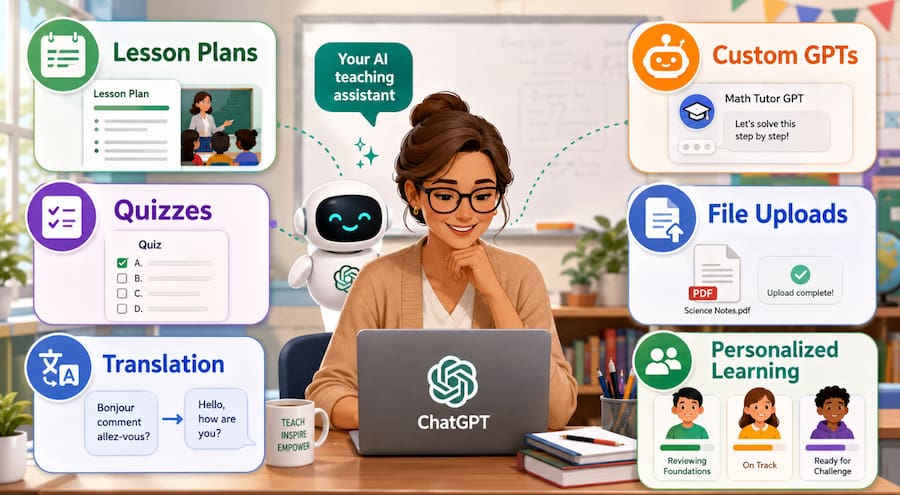
Educators can use ChatGPT to save time on lesson planning, classroom activities, quiz creation, translation, and personalized learning materials. It is especially useful when teachers need a quick first draft that can be reviewed and adapted.
ChatGPT can support educators in areas such as:
- Lesson plans
- Discussion questions
- Reading comprehension activities
- Student reflection prompts
- Rubrics
- Quizzes
- Bilingual materials
- Simplified explanations
- Classroom examples
Custom GPTs Support Repeated Teaching Tasks
Custom GPTs can help educators who often create similar materials. For example, a teacher could create a GPT to generate vocabulary exercises, business case questions, lesson summaries, quiz questions, or classroom activities.
This is useful for repeated teaching workflows, especially when the teacher wants the AI to follow a consistent format.
However, educators should still review the output before using it with students. AI can make mistakes, especially when dealing with facts, local curriculum details, or sensitive topics.
File Uploads and Analysis Tools Improve Productivity
Where available, ChatGPT can help educators analyze files, summarize documents, and turn existing content into classroom-ready materials.
For example, a teacher could upload a lesson outline and ask:
“Turn this into a 45-minute lesson plan with learning objectives, activities, and a short quiz.”
This saves time while allowing the teacher to control the final content.
|
Tool |
Key Use |
Best For |
Consideration |
|
ChatGPT Free |
Lesson ideas and drafts |
Beginners |
Output should be reviewed |
|
ChatGPT Plus |
File uploads, custom GPTs, higher limits |
Frequent users |
Paid monthly plan |
|
Copilot Studio |
Classroom or school workflow automation |
Microsoft users |
Requires setup |
|
Prompt templates |
Reusable teaching prompts |
Teachers and trainers |
Needs customization |
|
AI advisory |
Training and implementation support |
Schools and institutions |
Best for structured adoption |
ChatGPT in Education: Lesson Planning and More
ChatGPT can help Thai educators create more engaging and personalized learning materials. It can also support bilingual learning by translating English resources into Thai or simplifying complex Thai content for students.
The best approach is to treat ChatGPT as a teaching assistant, not a final authority. Teachers should review the material, adjust examples, and ensure the content is suitable for their students.
Creating Personalized Learning Materials
Educators can use ChatGPT to create materials for different learning levels.
Example prompt:
“Create a Grade 8 lesson activity on basic business budgeting. Use simple Thai examples and include three practice questions.”
If the material is too difficult, the teacher can ask:
“Make this easier for students who are new to the topic.”
If some students need a challenge, the teacher can ask:
“Create an advanced version for students who finish early.”
This helps teachers support mixed-ability classrooms without creating every resource from scratch.
Translating and Localizing Content
ChatGPT can translate English resources into Thai, but localization is more than direct translation. The examples, tone, and cultural references should make sense for Thai students.
A better prompt would be:
“Translate this lesson into Thai and localize the examples for Thai high school students. Keep the meaning accurate but make the language natural.”
Best practices include:
- Review translations manually.
- Check subject-specific terms.
- Avoid relying on AI for sensitive content without review.
- Ask ChatGPT to simplify difficult passages.
- Test whether students can understand the final version.
This keeps the content accurate while making it more accessible.
Ready to Scale? AI Advisory for Thai Brands
Once entrepreneurs and educators understand the basics of ChatGPT, the next step is applying AI to real workflows. This may include customer service automation, marketing workflows, data analysis, staff training, internal knowledge bots, and AI-assisted content production.
AI advisory helps organizations identify which AI use cases are worth implementing first. Instead of adopting AI randomly, businesses can focus on workflows where automation creates clear time savings or better customer experiences.
AI Advisory Helps Turn Ideas Into Workflows
AI advisory is useful when a business has many AI ideas but does not know where to begin.
A structured approach can help teams identify:
- Which tasks are repetitive
- Which workflows waste the most time
- Which data is already available
- Which tools are suitable
- Which risks need to be managed
- Which results should be measured
For example, an e-commerce business may start by using ChatGPT to draft customer replies. Later, it may move into automated product recommendations, review summaries, customer segmentation, or sales reporting.
AI Agents Can Support More Advanced Automation
AI agents can help businesses move beyond one-off prompting. They can be designed to follow instructions, use tools, complete tasks, and support workflows with more context.
Common use cases include:
- Customer support bots
- Internal HR assistants
- Sales lead qualification
- Appointment booking
- Knowledge base search
- Workflow routing
- Report generation
These systems should be tested carefully before deployment, especially when they handle customer data, payments, or business-critical decisions.
Advanced Services: Fine tuning, Bots, and Automation
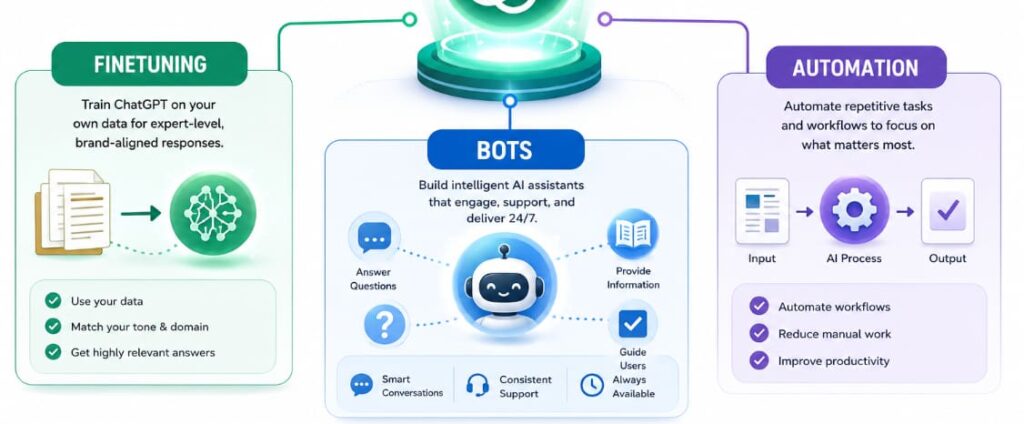
Advanced AI adoption may involve finetuning, custom bots, API integrations, and workflow automation. These are most useful when a business has clear data, repeatable tasks, and a defined goal.
For many organizations, prompt engineering and knowledge base systems are enough at the beginning. Finetuning should only be considered when standard prompting is no longer consistent enough for the business use case.
Fine tuning with Python for Businesses
Finetuning can help adapt AI models for specific business language, product information, internal processes, or industry-specific use cases.
A typical process includes:
- Collecting relevant business data.
- Cleaning and formatting the data.
- Preparing it for model training.
- Testing the model with real examples.
- Monitoring performance after deployment.
This process requires technical setup and careful data handling. Businesses should also consider whether a simpler prompt-based or retrieval-based system can solve the problem first.
Building Bots with Copilot Studio and Knowledge Bases
Bots can be built using tools such as Microsoft Copilot Studio, knowledge base platforms, or custom AI systems. These bots are useful when customers or employees ask repeated questions.
Examples include:
- “Where is my order?”
- “How do I apply for leave?”
- “What are the product specifications?”
- “How do I book an appointment?”
- “Which service package is right for me?”
A good bot needs accurate source content, clear escalation rules, secure data handling, and regular updates. Without these, the bot may give incomplete or inaccurate answers.
Real-World Best Practices
Businesses and schools should start small before scaling AI tools across the organization.
Best practices include:
- Begin with one clear workflow.
- Define what success looks like.
- Use human review for important outputs.
- Avoid sharing sensitive data without proper controls.
- Train staff on good prompt writing.
- Monitor AI performance over time.
- Update knowledge bases regularly.
This makes AI adoption safer, easier to manage, and more useful in the long term.
Conclusion
ChatGPT gives Thai entrepreneurs and educators a practical way to work faster, create better content, improve learning materials, and explore automation. The best results come from clear prompts, strong context, careful review, and a gradual move from simple use cases to more advanced workflows.
For entrepreneurs, ChatGPT can support marketing, customer service, SEO, sales enablement, and research. For educators, it can help with lesson plans, translations, quizzes, personalized materials, and classroom activities. As users become more confident, tools such as custom GPTs, workflow automation, and AI agents can help scale those benefits.
At AI Thailand, we help Thai businesses, schools, and varying industries turn AI from a general idea into practical workflows. Our team supports AI advisory, training, automation, finetuning, and agentic bot development so organizations can adopt AI with clearer strategy, safer implementation, and measurable business value.
Frequently Asked Questions
What is ChatGPT and why should Thai users adopt it?
ChatGPT is an AI language tool developed by OpenAI that can generate human-like responses for tasks such as writing, brainstorming, summarizing, translation, planning, and problem-solving. Thai entrepreneurs can use it for marketing ideas, customer service replies, and business planning, while educators can use it for lesson plans, quizzes, and classroom materials.
How can Thai entrepreneurs generate business ideas with ChatGPT?
Thai entrepreneurs can generate better ideas by giving ChatGPT specific business context.
For example:
“Suggest five e-commerce ideas for Thai street food vendors targeting Bangkok millennials. Include the product idea, target audience, and marketing channel.”
The more specific the prompt, the more useful the answer will be.
What are the best practices for educators using ChatGPT in Thai classrooms?
Educators should use ChatGPT as a draft assistant, not as a final authority. They should verify facts, adapt examples for Thai students, check age suitability, and encourage students to think critically about AI-generated responses.
How do Thai users optimize prompts for better ChatGPT results?
Thai users can optimize prompts by using a clear role, context, task, and format.
For example:
“Act as a Thai business teacher. Create a 30-minute lesson plan on entrepreneurship for diploma students. Include learning objectives, activities, and three discussion questions.”
This gives ChatGPT a clearer direction and improves the quality of the response.
Can ChatGPT help with marketing and content creation for Thai brands?
Yes. ChatGPT can help create social media captions, blog outlines, ad copy, product descriptions, email drafts, and campaign ideas. Businesses should still review the content to ensure accuracy, brand consistency, and cultural relevance.
What advanced ChatGPT features or integrations suit Thai businesses and schools?
Advanced users can explore custom GPTs, file uploads, workflow automation, AI agents, and API integrations. These tools are useful for customer service, internal training, lesson planning, reporting, and business process automation.