
Raw data often contains missing values, duplicate records, inconsistent formats, mislabeled examples, and extreme values. These issues can reduce neural network accuracy, destabilize training, and make model results difficult to trust.
Effective data preparation improves dataset quality before training begins. The process typically includes handling missing values, reviewing outliers, scaling numerical features, encoding categorical variables, and validating the final dataset.
Key Takeaways
- Investigate missing values before choosing deletion or imputation.
- Remove true duplicates, but review unusual records before treating them as errors.
- Scale numerical features to support stable neural network training.
- Encode categorical variables according to their meaning and cardinality.
- Split data before fitting preprocessing steps to prevent data leakage.
- Build repeatable pipelines so the same transformations are applied during training and deployment.
Why Is Data Cleaning Important for Neural Networks?

Neural networks learn patterns directly from the data they receive. When the dataset contains errors or inconsistent values, the model may learn misleading relationships instead of useful patterns.
Common consequences of poor data quality include:
- Unstable or slow convergence
- Biased predictions
- Overfitting to noise
- Poor performance on unseen data
- Inconsistent results between training and production
Data cleaning improves the completeness, consistency, validity, and reliability of model inputs. However, cleaning should not mean automatically deleting every unusual observation. Some extreme values represent genuine customer behaviour, rare events, or important business cases.
How Should You Handle Missing Values?
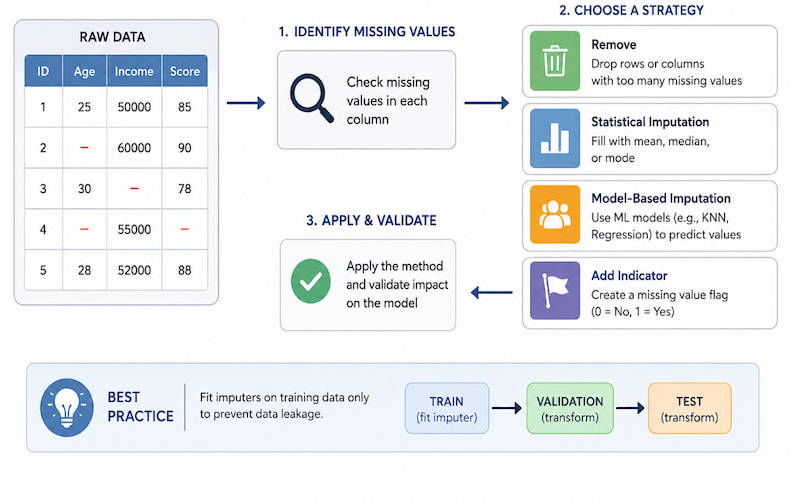
Missing values should be investigated before they are removed or replaced. The appropriate treatment depends on how much data is missing, why it is missing, and whether the affected feature is important.
Missingness is commonly described as:
- MCAR: The missing values occur independently of the observed and unobserved data.
- MAR: The missingness is related to other observed variables.
- MNAR: The missingness is related to the missing value itself or another unobserved factor.
Choose an Appropriate Treatment
Common approaches include:
- Remove rows or columns when the missing portion is small and deletion will not distort the dataset.
- Use mean or median imputation for numerical values when a simple baseline is appropriate.
- Use mode imputation for categorical variables.
- Apply KNN or model-based imputation when relationships between features can provide a more informed estimate.
- Add a missing-value indicator when the absence of a value may carry useful information.
Always compare the chosen method against a simple baseline. An advanced imputation technique is not automatically better if it introduces noise or hides meaningful missingness patterns.
Prevent Data Leakage
Fit the imputer only on the training data. The fitted transformation can then be applied to the validation and test sets.
from sklearn.impute import SimpleImputer
imputer = SimpleImputer(strategy=”median”)
X_train_imputed = imputer.fit_transform(X_train)
X_valid_imputed = imputer.transform(X_valid)
Fitting the imputer before splitting the dataset can expose the model to information from validation or test data.
How Should You Remove Duplicates and Review Outliers?
Duplicate records can give certain observations more influence during training. Exact duplicates can often be removed with Pandas:
df = df.drop_duplicates()
Near-duplicates require more care. Customer records, product names, and transactions may appear similar without representing the same event. Business rules and domain knowledge should guide the decision.
Compare Common Outlier Detection Methods
|
Method |
Suitable For |
Main Limitation |
|
Z-score |
Approximately normal numerical data |
Sensitive to non-normal distributions |
|
Interquartile range |
Skewed numerical data |
May flag valid extreme cases |
|
Isolation Forest |
Multivariable anomaly detection |
Requires tuning and interpretation |
|
DBSCAN |
Irregular cluster patterns |
Sensitive to parameter selection |
|
Domain rules |
Known operational boundaries |
Requires reliable business knowledge |
Outliers can be handled by:
- Correcting confirmed data-entry errors
- Removing invalid records
- Capping extreme values
- Applying logarithmic or power transformations
- Segmenting distinct populations
- Retaining legitimate rare cases
The objective is not to make every feature look statistically perfect. It is to distinguish errors from meaningful variation.
How Do You Normalize and Standardize Features?
Features measured on different scales can affect gradient-based optimization. A feature measured in millions may dominate one measured between zero and one, even when it is not more important.
Select the Right Scaling Method
|
Method |
Typical Use |
|
StandardScaler |
Features that benefit from a mean of 0 and standard deviation of 1 |
|
MinMaxScaler |
Features that need a defined range, commonly 0 to 1 |
|
RobustScaler |
Numerical data containing substantial outliers |
|
PowerTransformer |
Skewed data that may benefit from a more Gaussian-like distribution |
from sklearn.preprocessing import StandardScaler
scaler = StandardScaler()
X_train_scaled = scaler.fit_transform(X_train)
X_valid_scaled = scaler.transform(X_valid)
Fit the scaler on the training data only. Applying scaling before the train-test split can leak information about the complete dataset into model training.
Scaling is particularly important when features feed directly into dense neural network layers. Some architectures and data types may require different treatment, so preprocessing should be evaluated as part of the complete model pipeline.
How Can Exploratory Data Analysis Reveal Quality Issues?

Exploratory data analysis, or EDA, helps identify problems before they become embedded in the model.
A practical EDA process may include:
- Reviewing data types and expected formats
- Measuring missing-value rates
- Checking unique values and category frequency
- Finding exact and near-duplicate records
- Visualising numerical distributions
- Examining feature relationships
- Reviewing class balance and label quality
- Comparing training and production distributions
Useful tools include Pandas summaries, missing-value matrices, histograms, box plots, correlation analysis, and anomaly-detection models.
EDA should also include manual review. Automated reports can flag unusual values, but they cannot always determine whether those values are incorrect.
What Role Does Feature Engineering Play in Data Cleaning?
Feature engineering turns cleaned data into variables that a neural network can interpret effectively. It includes encoding categories, transforming skewed features, combining related variables, and removing irrelevant or redundant information.
Feature engineering should preserve the meaning of the source data. A transformation that improves a training metric but removes important business context may produce a less useful model.
How Should You Encode Categorical Data?
Categorical variables cannot usually be passed directly into a neural network. They must be converted into numerical representations.
|
Method |
Suitable For |
Consideration |
|
One-hot encoding |
Low-cardinality nominal variables |
Can create many columns |
|
Ordinal encoding |
Categories with a genuine order |
Can introduce false order if misused |
|
Target encoding |
Higher-cardinality variables |
Must be applied carefully to prevent leakage |
|
Embeddings |
High-cardinality variables in neural networks |
Require enough data to learn useful representations |
Match the Encoder to the Feature
One-hot encoding is suitable for categories such as payment method or product type when no natural order exists.
Ordinal encoding is appropriate only when the categories have a meaningful sequence, such as low, medium, and high.
Embeddings are useful for high-cardinality features such as product IDs, customer groups, or content categories. They allow the model to learn compact representations during training.
The preprocessing pipeline should also define how unseen categories will be handled in production.
How Can You Build a Repeatable Cleaning Pipeline?
Manual cleaning performed in notebooks can be difficult to reproduce consistently. A structured pipeline ensures that the same transformations are applied during training, validation, testing, and deployment.
from sklearn.compose import ColumnTransformer
from sklearn.impute import SimpleImputer
from sklearn.pipeline import Pipeline
from sklearn.preprocessing import OneHotEncoder, StandardScaler
numeric_pipeline = Pipeline([
(“imputer”, SimpleImputer(strategy=”median”)),
(“scaler”, StandardScaler())
])
categorical_pipeline = Pipeline([
(“imputer”, SimpleImputer(strategy=”most_frequent”)),
(“encoder”, OneHotEncoder(handle_unknown=”ignore”))
])
preprocessor = ColumnTransformer([
(“numeric”, numeric_pipeline, numeric_features),
(“categorical”, categorical_pipeline, categorical_features)
])
A production-ready pipeline should include:
- Defined input schemas
- Reproducible transformations
- Automated quality checks
- Versioned datasets
- Logged preprocessing parameters
- Drift monitoring
- Clear failure and review procedures
These controls are especially important when data cleaning forms part of broader Workflow & Automation systems.
How Can Cleaning Be Integrated into AI Workflows?
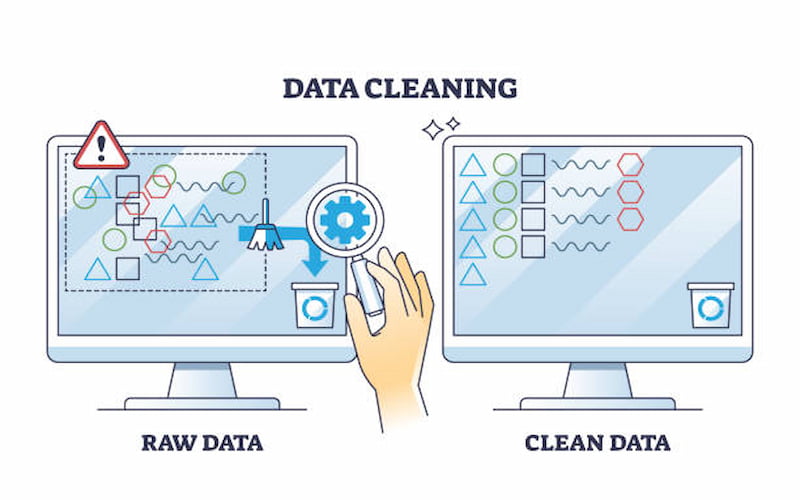
Data cleaning should operate as a controlled stage within the wider machine learning lifecycle rather than as a one-time task.
A scalable workflow may include:
- Data ingestion
- Schema and format validation
- Missing-value and duplicate checks
- Outlier review
- Feature transformation
- Dataset versioning
- Model training and validation
- Production monitoring
Orchestration tools can schedule these stages when new data arrives. Experiment-tracking platforms can record dataset versions, transformations, and model results. Drift-detection tools can identify when production data no longer resembles the training dataset.
For systems that make decisions or trigger actions autonomously, the data pipeline should also be aligned with the organisation’s Agentic AI architecture, access controls, and human-review requirements.
What Should Thai Organisations Consider When Preparing Data?
Thai datasets introduce local requirements that generic preprocessing workflows may overlook.
Process Thai-Language Data Carefully
Thai text does not consistently use spaces to separate words. Tokenisation tools such as PyThaiNLP can help divide text into suitable units for classification, sentiment analysis, search, or language-model applications.
Preprocessing may also need to address:
- Thai and English mixed within the same sentence
- Alternative spellings and informal language
- Repeated characters
- Regional vocabulary
- Product names and brand-specific terminology
- Character-encoding inconsistencies
Review Regional Differences
Customer activity in Bangkok may follow a different distribution from activity in other provinces. Applying one global outlier threshold can incorrectly classify valid regional patterns as errors.
Where relevant, analyse segments separately before defining thresholds for sales, traffic, engagement, or operational data.
Protect Personal Data

Customer datasets may contain names, contact information, location data, purchase histories, or behavioural records. Data preparation should follow Thailand’s Personal Data Protection Act and the organisation’s internal governance policies.
Depending on the use case, appropriate safeguards may include:
- Data minimisation
- Pseudonymisation
- Anonymisation
- Role-based access
- Retention limits
- Consent and lawful-basis checks
- Documentation of data flows
AI teams can use a structured PDPA and AI review to identify privacy requirements before customer data enters a training or automation pipeline.
Monitor Data Drift
Customer behaviour, seasonal demand, campaigns, and operational processes change over time. A dataset that was suitable during training may no longer represent current conditions.
Monitor feature distributions, missing-value rates, category frequencies, prediction confidence, and model performance. Alerts should lead to investigation rather than automatic retraining without review.
Best Practices for Neural Network Data Preparation
Before training a neural network:
- Define what valid data looks like.
- Split the dataset before fitting imputers, encoders, or scalers.
- Preserve untouched validation and test sets.
- Investigate why values are missing.
- Confirm whether outliers are errors or legitimate events.
- Check labels manually where possible.
- Handle class imbalance deliberately.
- Document every transformation.
- Version both raw and processed datasets.
- Test the complete pipeline on new data.
- Monitor quality after deployment.
Teams developing these skills can also use practical AI Workshops Bangkok programmes to connect data preparation methods with real organisational use cases.
Conclusion
At AI Thailand, we view data preparation as an essential part of building reliable neural networks, not simply a preliminary technical task. By combining careful investigation, repeatable preprocessing pipelines, appropriate privacy controls, and ongoing monitoring, organisations can create AI systems that perform more consistently and remain easier to manage after deployment.
Frequently Asked Questions
What is data preparation for neural networks?
Data preparation is the process of transforming raw data into reliable inputs for neural network training. It can include validation, cleaning, imputation, scaling, categorical encoding, feature engineering, dataset splitting, and quality monitoring.
What are the most common data cleaning techniques?
Common techniques include handling missing values, removing confirmed duplicates, correcting invalid formats, reviewing outliers, standardising categories, scaling numerical features, and checking label quality.
Should every outlier be removed?
No. Some outliers are errors, while others are valid rare events. Review their source, business meaning, and effect on the model before removing, capping, transforming, or retaining them.
Why is normalization important for neural networks?
Normalization or standardization places numerical features on more comparable scales. This can improve optimization stability and prevent large-scale variables from having disproportionate influence during training.
When should data be split into training and test sets?
Split the data before fitting imputers, encoders, scalers, feature selectors, or other learned preprocessing steps. This prevents information from the validation or test data from influencing training.
How can teams prevent data leakage?
Fit every learned transformation on the training set only. Apply the fitted transformation to validation, test, and production data without refitting it on those datasets.
How should unseen categories be handled?
Configure the encoder to tolerate unknown values or map them to a defined fallback category. The appropriate strategy depends on the encoder and how frequently new categories are expected.
How do you know whether cleaning improved the dataset?
Compare data-quality checks and model-validation results before and after cleaning. Review missingness, invalid values, label quality, distribution changes, validation loss, generalisation performance, and errors across important business segments.