Neural networks are supporting advances across Thailand in Thai-language AI, tourism research, document processing, forecasting, marketing and workflow automation.
Their value does not come from using the largest model available. It comes from choosing the right architecture, preparing reliable data and connecting the model to a clearly defined task.
For Thai organisations, local context is especially important. Models must process Thai script, informal language, mixed Thai-English communication and industry-specific terminology while meeting operational, financial and data-protection requirements.
Key Takeaways
- Thailand has a growing ecosystem of Thai-focused neural networks and Large Language Models.
- WangchanBERTa, OpenThaiGPT and Typhoon support different Thai-language, reasoning and document-processing tasks.
- Neural networks are already being applied to tourism research, rainfall forecasting, customer service and business automation.
- Businesses should choose models according to the problem, available data and required level of control.
- Fine-tuning is not always necessary. RAG, smaller pretrained models or conventional automation may be more suitable.
- Reliable implementation requires testing, human oversight and responsible data handling.
What Are Neural Networks and How Do They Work?

Neural networks learn patterns by adjusting connections between layers of processing nodes
A neural network is a machine learning model made from connected processing units commonly called neurons or nodes. These nodes are organised into an input layer, one or more hidden layers and an output layer.
The input layer receives information such as customer messages, sales records, images or audio. Hidden layers identify relationships within the information, while the output layer produces a prediction, classification or generated response.
During training, the model compares its output with an expected result and adjusts the weighted connections between its nodes. Repeating this process helps the model recognise patterns in new data.
Deep learning refers to neural networks with multiple processing layers. These deeper models can handle complex language, image and sequential tasks, but they generally require more data, computing power and evaluation.
Different architectures serve different purposes. Artificial Neural Networks are commonly used for structured prediction, while Convolutional Neural Networks analyse visual patterns. Recurrent Neural Networks process sequential information, and transformers support language understanding and generation.
Why Are Neural Networks Important in Thailand?
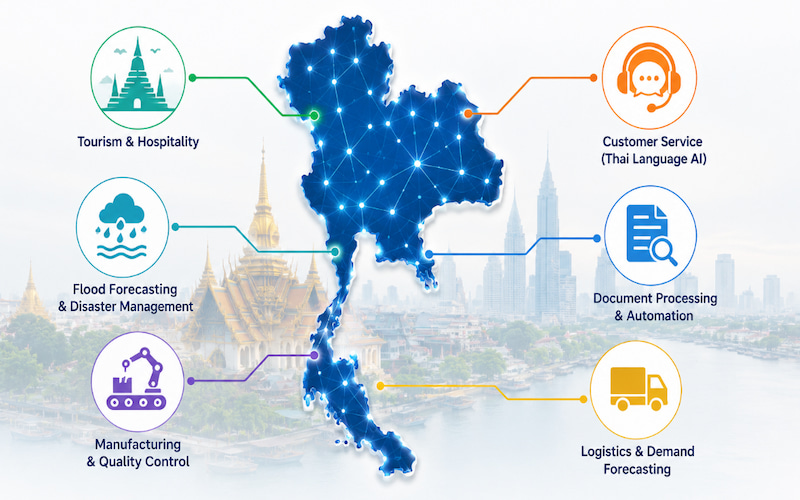
They help organisations process Thai language, local behaviour and operational data more effectively
Many widely available AI systems were developed primarily around English and other high-resource languages. Thai presents different challenges, including its writing system, flexible word boundaries, tone marks, informal spelling and frequent mixing with English.
Thai-focused models and datasets can improve performance, but organisations must still test them using their own terminology, documents and customer interactions. A model that performs well on a general benchmark may produce different results when exposed to specialist Thai-language content.
Thailand also has a history of applying neural networks to local research and public-service problems.
A study published by the Journal of Business, Innovation and Sustainability examined lifestyle tourism among visitors to Charoen Krung and Yaowarat. The researchers collected data from 462 participants and combined Structural Equation Modelling with an Artificial Neural Network.
The statistical model helped explain how destination image, travel experience and satisfaction influenced revisit intention, while the neural network assessed the relative importance of those factors. Satisfaction was identified as the strongest ANN input.
Neural networks have also been applied to Bangkok rainfall forecasting. Research published by Hydrology and Earth System Sciences used hourly data from rain-gauge stations to forecast rainfall several hours ahead and support flood-management decisions.
These examples show that neural-network applications in Thailand extend beyond chatbots and content generation.
Which Thai-Focused Neural Network Models Are Available?
WangchanBERTa, OpenThaiGPT and Typhoon support different Thai-language and multimodal tasks
Thailand has several model families designed around Thai language and local use cases.
|
Model |
Primary purpose |
Suitable applications |
|
WangchanBERTa |
Thai-language understanding |
Classification and information extraction |
|
OpenThaiGPT |
Thai-language generation and reasoning |
Assistants, summaries and question answering |
|
Typhoon |
Thai text, speech and agentic tasks |
Business assistants and workflow integration |
|
Typhoon OCR |
Thai-English document understanding |
Forms, invoices, reports and tables |
WangchanBERTa is a pretrained Thai-language transformer released through the VISTEC-depa Thailand Artificial Intelligence Research Institute. It is particularly suitable for tasks such as text classification, intent detection and named-entity recognition.
OpenThaiGPT is an open-source Thai-focused LLM project designed for Thai-language generation, reasoning and integration with external systems. Potential uses include customer support, internal knowledge search and content assistance.
Typhoon has expanded from Thai-language generation into speech, document processing, reasoning and agentic AI. Its document models are particularly relevant for organisations processing invoices, government forms and reports containing both Thai and English.
These models do not serve identical purposes. A business that needs to classify customer enquiries may benefit from an encoder model, while a company building an interactive assistant may require an LLM connected to approved company information.
What Are the Main Neural Network Applications in Thailand?
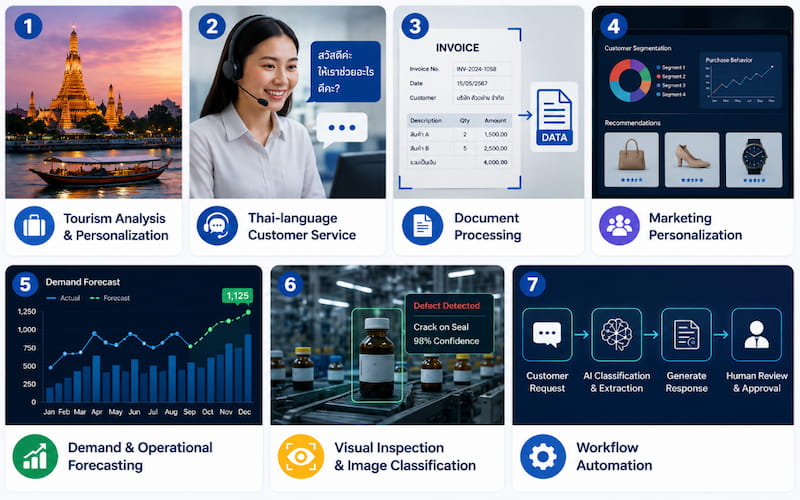
Neural networks can support seven practical applications across Thai industries
- Tourism analysis
Tourism businesses can analyse bookings, reviews and visitor preferences to forecast demand and recommend more relevant experiences. - Thai-language customer service
Transformer models can classify customer intent, retrieve approved information and draft Thai-language responses. - Document processing
Vision-language and OCR models can extract information from invoices, contracts, application forms and scanned records. - Marketing personalization
Neural networks can analyse customer behaviour and campaign engagement to support segmentation, recommendations and content selection. - Demand forecasting
Predictive models can estimate sales, hotel bookings, inventory requirements, delivery volumes and energy usage. - Visual inspection
Manufacturers, retailers and construction businesses can use image models to identify defects or classify visual records. - Workflow automation
Neural networks can classify requests, summarise records and generate draft responses within a controlled business process.
The model should support the business strategy rather than replace it. Poor tracking, incomplete data or unclear objectives will limit the value of even an advanced neural network.
How Should Thai Businesses Choose and Implement a Neural Network?
Businesses should select the simplest reliable solution and test it through a controlled pilot
The correct approach depends on the task, available data and how the output will be used.
|
Business requirement |
Recommended starting point |
|
Forecast structured data |
ANN or established forecasting model |
|
Classify Thai messages |
Thai transformer encoder |
|
Search company documents |
LLM with RAG |
|
Extract information from forms |
OCR or vision-language model |
|
Analyse images |
CNN or vision transformer |
|
Build a task-focused assistant |
LLM, RAG and workflow controls |
|
Work with limited data |
Pretrained model or rule-based system |
|
Keep sensitive information onsite |
Smaller locally hosted model |
A practical implementation process includes five steps:
- Define one measurable problem. Start with a specific task such as reducing document-processing time or improving enquiry classification.
- Review the available data. Remove duplicated, outdated or unnecessary information before development begins.
- Select the simplest suitable approach. A smaller model or standard automation may be more practical than a large generative system.
- Test a controlled pilot. Evaluate the model using realistic Thai, English and mixed-language inputs.
- Monitor business performance. Measure time saved, correction rates, operating costs, user adoption and serious errors.
Businesses that need help preparing data, selecting models or developing RAG systems can explore our AI Services in Thailand.
For more information about a locally focused language model, refer to our blog about OpenThaiGPT and its business applications.
Businesses comparing AI Agencies in Thailand should ask how each provider will test the model, monitor failures and measure business value after deployment.
What Challenges Affect Neural Network Adoption in Thailand?
Data quality, hallucinations, costs, privacy and maintenance remain the main barriers
Thai-language datasets may contain inconsistent spelling, informal expressions, mixed-language sentences or limited industry-specific terminology. These issues can reduce model accuracy if the data is not properly prepared.
Generative models can also produce confident but incorrect responses. RAG, citations, business rules and human review can reduce this risk, but they cannot remove it entirely.
Cost is another consideration. Large models may require specialised infrastructure and ongoing technical support. Smaller models can offer better value when the task is narrow and predictable.
Privacy becomes especially important when a system processes customer, employee, financial or health-related information. Organisations need to understand what information enters the model, where it is stored and who can access it.
For guidance on responsible data processing, refer to our blog about PDPA and AI.
What Trends Will Shape Neural Networks in Thailand?

Thailand will see more specialised, multimodal and workflow-connected AI systems
Thai organisations are likely to move away from using one large model for every purpose. Instead, they may combine smaller language models, document systems, forecasting tools and business rules.
Multimodal AI will also become more useful. Models that process text, speech, images and document layouts can support customer conversations, scanned records and visual inspections within one workflow.
Agentic AI is another important development. These systems can perform several connected actions using language models, retrieval, APIs and business rules.
Businesses planning this type of automation can explore our workflow automation solutions. For a deeper explanation, refer to our blog about Agentic AI Architecture.
Teams preparing for AI adoption can also explore our AI training and workshops in Thailand to build practical knowledge around models, RAG, automation and responsible data use.
Conclusion
Neural networks give Thai organisations new ways to analyse information, forecast demand, process documents, personalise services and automate repetitive work. However, meaningful results depend on selecting an appropriate model, preparing reliable data and connecting the system to a process where its output can be reviewed and measured.
At AI Thailand App, we help organisations move from AI ideas to practical implementation. We work with teams to assess suitable use cases, evaluate data readiness, design controlled pilots and integrate AI into real business workflows. Our goal is to make neural-network adoption useful, measurable and appropriate for each organisation’s operational needs.
Frequently Asked Questions
What is a neural network?
A neural network is a machine learning model that learns patterns by adjusting connections between layers of processing nodes.
Which Thai neural-network models are available?
Examples include WangchanBERTa, OpenThaiGPT and Typhoon. They support different tasks, including classification, language generation, reasoning, speech and document processing.
How are neural networks used in Thai businesses?
They can support forecasting, customer service, document extraction, marketing personalization, visual inspection and workflow automation.
Does every business need to fine-tune a model?
No. Many organisations can begin with a pretrained model, structured prompts or RAG. Fine-tuning is more suitable when a model needs specialist behaviour or terminology.
What data is required?
The required data depends on the task and may include text, images, audio, transactions or historical business records. Relevance and quality are generally more important than volume.
How should a Thai business begin?
Start with one specific problem, define a measurable KPI and test the approach through a controlled pilot before wider deployment.