Educational developers can use neural networks to create adaptive learning tools, analyse student data, automate selected workflows, and support more personalised learning experiences.
These models process information through connected layers, activation functions, forward propagation, and backpropagation. However, successful implementation depends on choosing the right architecture, preparing reliable data, and connecting the model to a clearly defined educational need.
What Should Educational Developers Know Before Using Neural Networks?
- Choose the architecture according to the task and data type.
- Prepare student metrics, images, and text consistently before training.
- Use TensorFlow or PyTorch to build, train, and evaluate models.
- Fine-tune pre-trained models when suitable instead of always training from scratch.
- Deploy models through secure APIs and monitor their performance.
- Keep educators involved when model outputs affect students or assessments.
Which Neural Network Is Best for Educational Applications?

The right architecture depends on the information the model must process.
Feedforward networks work well with structured data such as quiz scores, attendance, and learner attributes. Convolutional neural networks, or CNNs, are designed for visual data such as scanned worksheets and diagrams. Recurrent neural networks, or RNNs, can process ordered information such as student activity over time.
Architecture choice affects accuracy, training requirements, response time, and the amount of data needed. Developers should begin with the educational objective rather than selecting the most advanced model available.
Feedforward Networks, CNNs, and RNNs Support Different Tasks
|
Network Type |
Key Features |
Educational Uses |
Main Limitation |
|
Feedforward |
Dense layers and fixed-size inputs |
Quiz scoring, outcome prediction, structured student records |
Does not naturally process sequential data |
|
CNN |
Identifies spatial and visual patterns |
Handwriting, diagrams, scanned assignments |
Requires sufficient labelled image data |
|
RNN |
Processes ordered and sequential inputs |
Progress tracking, activity histories, lesson sequencing |
May struggle with longer sequences |
|
Hybrid CNN-RNN |
Combines visual and sequential processing |
Video lessons and multimodal learning content |
More complex to train and maintain |
Transformer-based models may also be more suitable than traditional RNNs for modern language applications such as essay analysis, tutoring assistants, and curriculum search.
What Data Should Educational Neural Networks Use?
Educational neural networks can use student metrics, images, text, audio, and interaction histories.
Structured data may include grades, attendance, completion rates, response times, and course activity. Images may come from handwritten assignments, diagrams, or scanned worksheets. Text may include essays, feedback, student questions, and curriculum documents.
The dataset should match the model’s intended purpose. Collecting more information than necessary can increase complexity and privacy risk without improving performance.
Educational Data Requires Careful Preprocessing
A practical preprocessing workflow includes:
- Collect relevant data: Gather only the information needed for the educational task.
- Clean the dataset: Review missing values, duplicate records, incorrect labels, and unusual outliers.
- Transform the inputs: Normalise numerical values, encode categories, resize images, or tokenise text.
- Split the dataset: Create separate training, validation, and test sets.
- Prevent data leakage: Avoid placing information from the same learner or activity in both training and evaluation data.
- Document the process: Record data sources, labels, transformations, and known limitations.
An 80/10/10 or 70/15/15 split can provide a starting point, but the appropriate ratio depends on dataset size and evaluation needs.
Setting a random seed can improve reproducibility. Developers should also save preprocessing steps, model settings, and dataset versions so results can be reviewed later.
How Can Educational Neural Networks Be Trained Efficiently?

TensorFlow and PyTorch provide tools for loading data, creating neural networks, training models, and evaluating results.
Before building a complex model, developers should create a simple baseline. This helps determine whether the neural network produces a meaningful improvement over basic rules or traditional machine learning methods.
TensorFlow and PyTorch Support Complete Training Workflows
A standard training process includes:
- Install the selected framework and confirm the available computing resources.
- Load the prepared training, validation, and test data.
- Define the model’s layers and activation functions.
- Select a suitable loss function and optimiser.
- Train the model using backpropagation and gradient descent.
- Monitor validation performance for signs of overfitting.
- Save the best model and evaluate it on the test set.
ReLU is commonly used in hidden layers, while sigmoid or softmax may be used in output layers depending on the task.
Settings such as the number of epochs, learning rate, and batch size should be adjusted according to the model and dataset. Fixed values should not be treated as universal requirements.
How Can Neural Networks Be Integrated into EdTech Platforms?
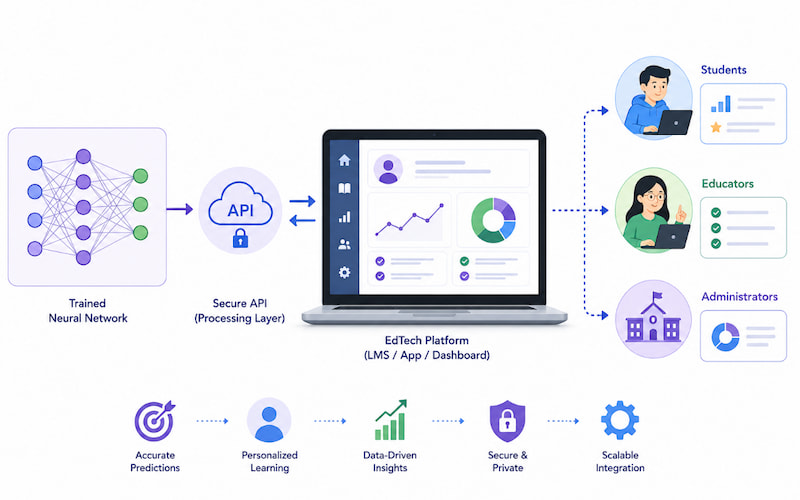
A trained model must be connected to an educational platform before it can support students or educators.
The model may run directly inside the platform or through a separate prediction service. The integration should define what data is sent, what result is returned, how errors are handled, and when human review is required.
APIs Connect Models to Adaptive Learning Systems
Developers can expose a trained model through a REST API using tools such as Flask or FastAPI.
A basic deployment process includes:
- Save the trained model and preprocessing components.
- Create a prediction endpoint for validated student inputs.
- Apply the same preprocessing used during training.
- Return a clearly structured prediction or recommendation.
- Add authentication and access controls.
- Test accuracy, response time, and error handling.
- Monitor model performance after deployment.
The response-time target should reflect the use case. A live learning recommendation may require faster processing than a weekly performance report.
How Can Fine-Tuning Improve Educational Models?
Fine-tuning adapts an existing pre-trained model to a specific educational task.
A language model may be fine-tuned for essay classification, curriculum support, or student questions. A vision model may be adapted for handwriting or worksheet recognition.
This approach can reduce training requirements because the model already contains useful language or visual features. However, its accuracy still depends on the quality of the educational dataset and evaluation process.
Pre-Trained Models Can Be Adapted to Student Outcomes
A typical fine-tuning process includes:
- Select a model that matches the input type and task.
- Prepare a representative educational dataset.
- Add or adjust the model’s output layer.
- Freeze selected early layers where appropriate.
- Train with a controlled learning rate.
- Monitor validation performance.
- Evaluate the model on unseen data.
Developers should examine more than overall accuracy. Performance may vary across subjects, writing styles, learner groups, languages, and image conditions.
How Can Agentic Bots Work as Educational Assistants?

Agentic bots combine AI models with instructions, tools, data sources, and controlled actions. In education, they may support tutoring, curriculum search, feedback preparation, or administrative tasks.
These assistants should have clearly defined responsibilities. They must know which sources they can use, which actions they are allowed to perform, and when a teacher or administrator should take over.
Learning Context Helps Bots Produce More Relevant Answers
Retrieval-augmented generation, or RAG, can connect an assistant to approved course materials, policies, lesson notes, and curriculum documents.
A practical setup may include:
- Define the assistant’s subject, learner level, tone, and limitations.
- Add approved educational documents to a searchable knowledge base.
- Retrieve relevant information before generating an answer.
- Connect tools only when permissions are clear.
- Protect personal student information.
- Test incomplete, ambiguous, and incorrect questions.
- Review unsupported answers and retrieval errors.
Read our blog about Agentic AI architecture to understand how models, tools, context, and APIs work together in a broader AI system.
Educational teams developing Thai-language assistants can also refer to our blog about OpenThaiGPT and its applications.
What Role Does Workflow Automation Play in Education?
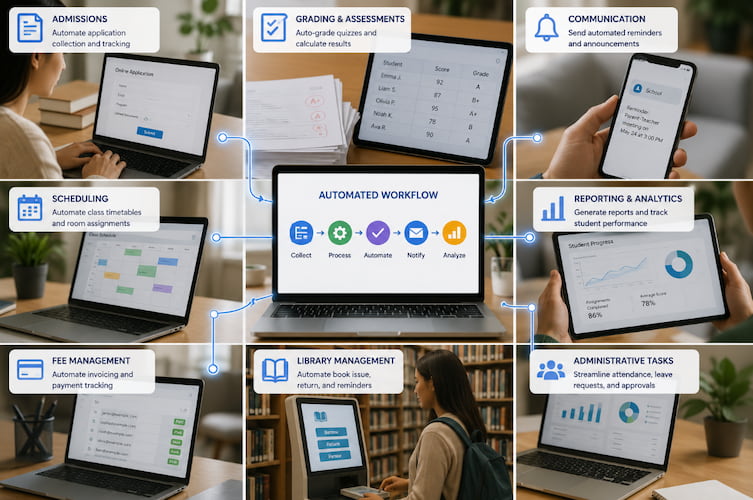
Workflow automation connects model outputs to repeatable educational processes.
It can support grading, feedback delivery, progress reporting, content tagging, document routing, and student service requests. However, automation is most suitable when the process is clear, repetitive, and measurable.
Tasks involving formal assessment, student welfare, or important academic decisions should retain human oversight.
Automated Grading Can Improve Feedback Workflows
Neural networks can assist with grading by classifying answers, identifying rubric-related patterns, or processing handwritten work.
A reliable workflow should:
- Train the model against clearly defined rubrics.
- Compare model results with educator assessments.
- Route uncertain cases to human review.
- Record the model version and final decision.
- Test performance across different learner groups.
- Review the system when the curriculum changes.
AI Thailand’s workflow automation services help organisations map repetitive processes and connect AI tools to practical operational workflows.
For projects using sensitive student information, read our guide to PDPA and AI before designing data collection and access controls.
How Can Educational Brands Scale Neural Network Solutions?
Scaling requires more than adding computing power. Educational brands must also scale their data pipelines, model monitoring, access controls, support processes, and evaluation methods.
A focused pilot is usually the safest starting point. Test one measurable use case with a limited group before expanding the system to more students, courses, or locations.
Cloud Infrastructure Should Follow Proven Demand
Before scaling a neural network system, confirm that:
- The model performs reliably on unseen data.
- The educational benefit can be measured.
- The data pipeline is consistent.
- Performance changes can be detected.
- User permissions are clearly defined.
- The model can be rolled back if an update fails.
- Staff know how to investigate errors.
Distributed training, cloud deployment, caching, and batching can support larger workloads, but they also increase cost and technical complexity.
For educational projects that need synthetic data or data augmentation, refer to our blog about Variational Autoencoders and their use cases.
How Can AI Advisory Support EdTech Development?
AI advisory can help educational organisations define the problem, assess data readiness, choose an architecture, plan evaluation, and identify privacy or integration risks.
This is particularly useful when teams are comparing different tools or AI Agencies in Thailand. The selection should be based on technical capability, educational understanding, data governance, documentation, and ongoing support rather than model demonstrations alone. AI Thailand’s advisory service focuses on translating organisational requirements into practical AI roadmaps.
Educational developers may also need practical training in data preparation, model deployment, AI governance, and workflow design. AI Thailand provides AI training and workshops in Thailand for technical teams, managers, and organisations adopting AI in day-to-day operations.
Teams building custom prediction, RAG, or fine-tuning systems can explore AI Thailand’s Data and ML Solutions, which cover data pipelines, model adaptation, retrieval systems, and dashboards.
Conclusion
Educational developers should begin with one specific learning or operational problem. They can then select an architecture that matches the data, establish a baseline, prepare representative datasets, evaluate the model, and integrate it with suitable human oversight.
Neural networks can support adaptive learning, visual analysis, feedback, prediction, and automation. Their value depends less on model complexity and more on whether the system solves a genuine educational need accurately and responsibly.
At AI Thailand App, we help educational organisations turn AI ideas into practical pilots through advisory, data preparation, model planning, workflow integration, and team training. Our AI Services in Thailand can help developers assess their data, choose suitable tools, and plan a realistic path from early testing to deployment. AI Thailand’s site also includes dedicated resources and solutions for education-focused AI adoption.
Frequently Asked Questions
What are the basic steps for implementing a neural network in education?
Define the educational task, collect and preprocess relevant data, choose an appropriate architecture, train the model, evaluate it on unseen data, and deploy it through a secure platform or API.
Which neural network framework is best for beginners?
TensorFlow with Keras provides a structured development process, while PyTorch offers flexibility for custom models. The best choice depends on the team’s experience and deployment requirements.
How should educational datasets be prepared?
Clean missing or incorrect data, normalise numerical features, encode categories, process images or text consistently, and separate the data into training, validation, and test sets.
What are common neural network applications in education?
Common applications include personalised learning paths, automated feedback, handwriting recognition, student support prediction, curriculum search, and progress analysis.
How can educational models avoid overfitting?
Use validation data, early stopping, regularisation, representative training samples, and data augmentation where appropriate. Developers should also avoid making the model unnecessarily complex.
How can neural networks be deployed at scale?
Models can be deployed through APIs, cloud platforms, dedicated serving systems, or edge devices. Scalable deployment also requires monitoring, authentication, version control, and a rollback process.