
Introduction
Thailand is at an important turning point in its economic development. The country’s digital economy is expected to become a much bigger part of future growth, contributing significantly to national GDP by 2030. GDP, or Gross Domestic Product, refers to the total value of goods and services produced by a country. In simple terms, this means digital technology will play a larger role in Thailand’s economy.
However, this opportunity comes with a major challenge: Thailand does not currently have enough workers with the digital skills that modern businesses need. This shortage is known as the digital talent gap, which happens when companies need people skilled in areas such as artificial intelligence, data analytics, cybersecurity, cloud computing, and digital marketing, but there are not enough qualified workers available. This remains relevant today as businesses continue to struggle to fill AI, data, cybersecurity, and cloud-related roles across industries such as e-commerce, FinTech, retail, marketing, and traditional businesses undergoing digital transformation.
The impact is significant. When companies cannot find skilled digital workers, projects are delayed, innovation slows, hiring costs rise, and businesses may fall behind regional competitors such as Singapore. Companies may also struggle to adopt newer technologies such as machine learning, automation, generative AI, and AI advisory tools. This guide explains Thailand’s digital talent gap, the business problems it creates, the digital skills currently in short supply, and the training solutions that can help close the gap.
Digital Talent Gap in Thailand: Key Statistics
Thailand’s digital talent shortage is not just a small hiring issue. It is a growing national challenge. The country’s digital workforce is growing at around 8% per year, but demand for digital talent is increasing at about 15% per year. This means businesses need skilled digital workers much faster than Thailand can currently produce them.
Thailand produces roughly 10,000 qualified digital professionals each year, but the economy needs around 50,000. This creates a shortfall of about 40,000 workers every year.
|
Metric |
Value |
What It Means |
|
Digital Workforce Growth |
8% per year |
Thailand’s supply of digital workers is growing slowly |
|
Digital Talent Demand Growth |
15% per year |
Business demand is rising much faster |
|
AI/Data Roles Unfilled |
40% |
Many important digital roles cannot be filled |
|
Projected Shortfall |
150,000 professionals by 2025 |
Thailand may lack a large number of skilled digital workers |
|
IMD Digital Ranking |
#36 globally |
Thailand trails stronger digital economies such as Singapore |
Thailand’s position behind Singapore is important. Singapore is one of the region’s strongest digital economies and has better access to technology talent. This gives Singapore-based businesses an advantage because they can adopt new technology faster, improve customer experiences more quickly, and attract more digital investment.
For Thai businesses, this means the talent gap can lead to slower growth and weaker competitiveness.
Why Generative AI Makes the Problem More Urgent
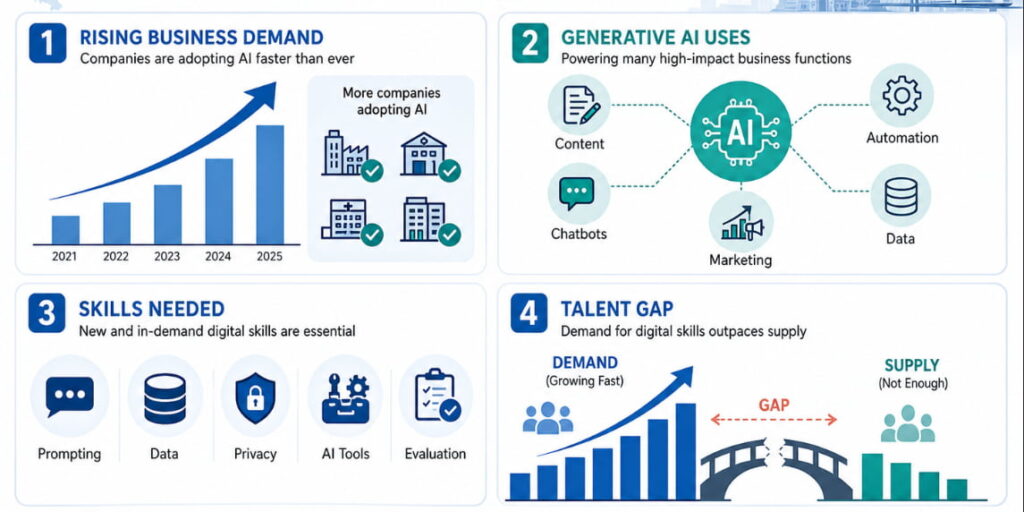
The rise of generative AI has made the talent shortage even more serious.
Generative AI refers to AI tools that can create new content, such as text, images, reports, code, marketing materials, and chatbot responses. Examples include AI writing tools, image generators, customer service bots, and AI assistants. Many companies want to use generative AI to improve marketing, customer service, content creation, and business operations. However, these tools still need people who understand how to use them properly.
To use generative AI well, workers need to understand:
- How to write effective prompts
- How to check whether AI answers are accurate
- How to protect customer data
- How to connect AI tools with business processes
- How to avoid bias, privacy issues, and incorrect outputs
PwC Thailand reports that around 30% of enterprises have gaps in generative AI capabilities. This means many companies want to use AI, but they do not yet have enough skilled workers to apply it effectively.
For example, a company may want to use AI to automate customer support. However, without workers who understand AI setup, data privacy, and chatbot testing, the project may fail or be delayed.
Current Shortages in AI and Data Skills
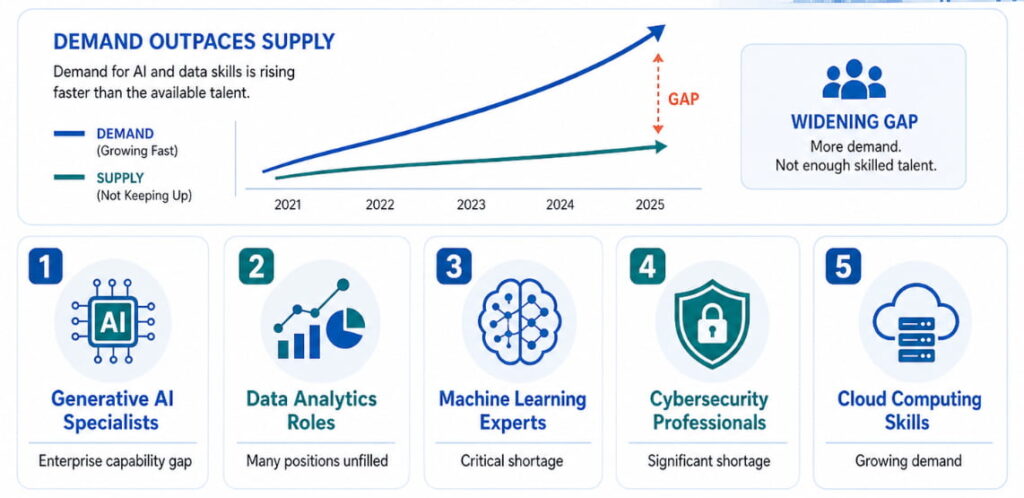
Thailand’s digital skills shortage is especially serious in AI, data analytics, machine learning, cloud computing, and cybersecurity.
Artificial Intelligence, or AI, refers to computer systems that can perform tasks that usually require human intelligence. These tasks include recognising patterns, making predictions, answering questions, or generating content.
Data analytics means studying data to find useful insights. For example, a business can use data analytics to understand which products sell best, which customers are likely to return, or which marketing campaigns are working.
Machine learning is a type of AI where computers learn from data instead of being programmed step by step. For example, an online shopping platform may use machine learning to recommend products based on what a customer previously viewed or bought.
|
Skill Area |
Shortage Level |
Business Impact |
|
Generative AI Specialists |
30% enterprise capability gap |
Delays AI-powered marketing, automation, and customer service |
|
Data Analytics Roles |
Many positions unfilled |
Businesses lack customer and market insights |
|
Machine Learning Experts |
Critical shortage |
AI projects and prediction systems are delayed |
|
Cybersecurity Professionals |
Significant shortage |
Companies face higher risk of cyberattacks and data breaches |
|
Cloud Computing Skills |
Growing demand |
Businesses struggle to manage online systems and digital infrastructure |
These shortages create real business problems. Without data analysts, companies may make decisions based on guesswork instead of evidence. Without machine learning experts, businesses may struggle to build AI systems. Without cybersecurity professionals, companies may be more vulnerable to hacking, fraud, or data leaks.
How the Digital Talent Gap Affects Thai Businesses
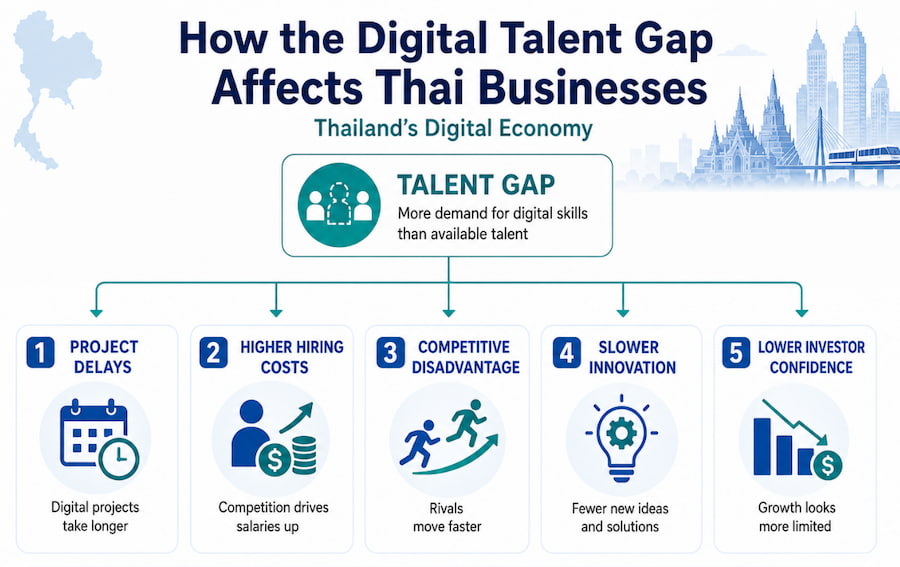
The digital talent gap affects Thai businesses in several ways. It does not only make hiring harder. It also affects performance, competitiveness, and long-term growth.
|
Impact Area |
Explanation |
Effect |
|
Project Delays |
Companies lack skilled teams to complete digital projects |
Digital transformation may be delayed by up to 18 months |
|
Higher Hiring Costs |
Skilled workers are limited, so companies compete for them |
Salaries for digital roles may rise by around 30% |
|
Competitive Disadvantage |
Regional competitors may move faster |
Thai firms may lose market share |
|
Slower Innovation |
Businesses cannot adopt new technology quickly |
Fewer new products, services, and improvements |
|
Lower Investor Confidence |
Talent shortages limit growth potential |
Investors may prefer markets with stronger digital talent |
Digital transformation means using digital tools to improve how a company works, serves customers, manages data, and makes decisions.
For example, an e-commerce company may want to use AI to recommend products to customers. To do this, it needs data scientists, machine learning engineers, and digital marketers who understand customer behaviour. If the company cannot find these people, the project may be delayed. During this delay, competitors with stronger digital teams may launch better features and attract more customers.
This shows that the digital talent gap is not just an HR issue. It can directly affect revenue, customer satisfaction, market share, and business survival.
Training Solutions for Digital Skills
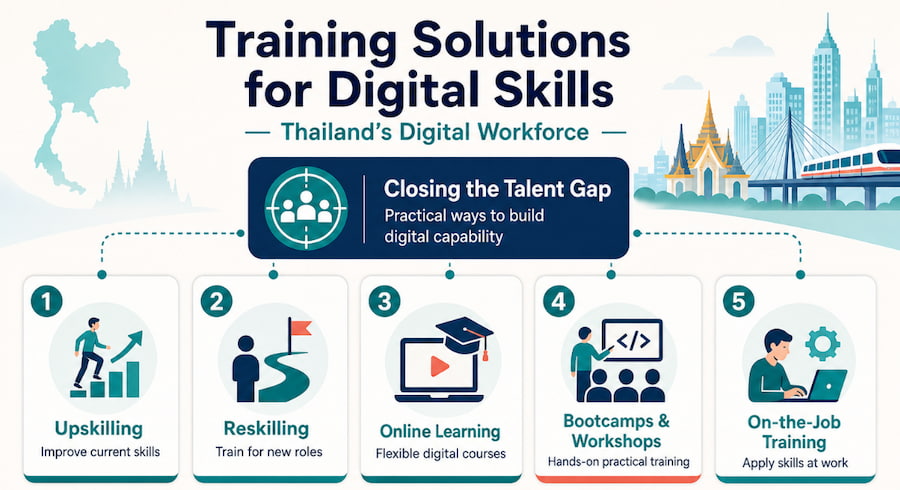
Training is one of the most practical ways to close Thailand’s digital talent gap. Instead of only trying to hire new digital workers, companies can train their existing employees. This is important because skilled digital workers are expensive and difficult to find.
There are two important types of training:
Upskilling means helping employees improve their current skills. For example, a marketing executive may learn how to use AI tools for campaign planning.
Reskilling means training employees for a different type of role. For example, an operations staff member may learn data analytics and move into a reporting or automation role.
Training Platform Comparison
|
Platform |
Key Features |
Best For |
|
Coursera |
University-backed courses, AI and data certificates |
Individuals who want recognised credentials |
|
LinkedIn Learning |
Short video lessons and LinkedIn profile integration |
Professionals who want quick learning |
|
Microsoft Learn |
Cloud, AI, Azure, and developer training |
Companies using Microsoft tools |
|
Udacity |
Career-focused nanodegrees with projects |
Career switchers and structured learners |
|
Local Thai Bootcamps |
Hands-on training and local networking |
Startups and teams needing practical skills quickly |
Each platform has different strengths. Coursera is useful for learners who want certificates. LinkedIn Learning is good for short, flexible learning. Microsoft Learn is useful for companies using Microsoft cloud systems. Local bootcamps are helpful for hands-on training in Thailand’s business environment.
AI-Focused Workshops and Certifications
AI-focused workshops help workers understand how AI works and how it can be used in real business situations.
These programmes are useful because AI is no longer only for technology companies. It is now used in marketing, banking, retail, healthcare, logistics, education, and customer service.
|
Programme |
Format |
Best For |
|
Google AI Certificate |
Online and project-based |
Beginners who want AI fundamentals |
|
Microsoft Azure AI |
Cloud-based learning |
Teams using Microsoft cloud systems |
|
LinkedIn Learning Generative AI |
Short video courses |
Professionals who need quick AI exposure |
|
Local Thai Bootcamps |
In-person, hands-on training |
Job seekers and local teams |
These programmes can help employees learn the basics of AI, machine learning, generative AI, cloud tools, and practical business applications.
For example, a marketing team may take a generative AI course to learn how to use AI for campaign ideas, content drafts, and customer segmentation. A customer service team may learn how AI chatbots work. An IT team may learn how to connect AI tools with cloud systems.
The Role of AI Advisory in Upskilling
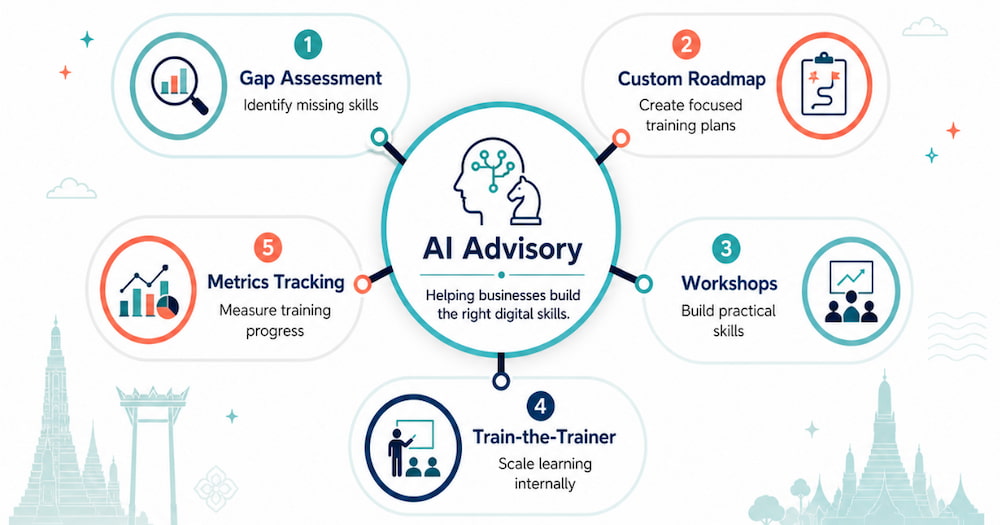
AI advisory services help companies identify what digital skills they need and how to train their teams effectively. A normal online course may be too general. For example, a company may not need a full data science programme. It may only need practical training on customer analytics, dashboards, AI-powered marketing, or workflow automation. This is where AI advisory becomes useful. It helps businesses understand their exact skill gaps and create a training plan that matches their real needs.
|
Advisory Service |
Purpose |
Business Value |
|
Gap Assessment |
Identifies missing skills |
Shows what training is most urgent |
|
Custom Roadmap |
Creates a focused training plan |
Helps companies use resources wisely |
|
Workshops |
Provides hands-on learning |
Builds practical skills |
|
Train-the-Trainer |
Trains internal employees to teach others |
Makes learning scalable |
|
Metrics Tracking |
Measures progress |
Shows whether training is working |
AI advisory is especially useful because it connects training directly to business goals. Instead of learning random digital skills, employees learn what is most relevant to their company’s operations, customers, and strategy.
Gap Assessment: Finding the Real Skills Problem
A gap assessment compares the skills employees currently have with the skills the organisation needs.
This is important because companies may not always know where their true skill gaps are. For example, a business may think it needs advanced AI training, but the real issue may be that employees do not know how to organise data, build dashboards, or interpret reports.
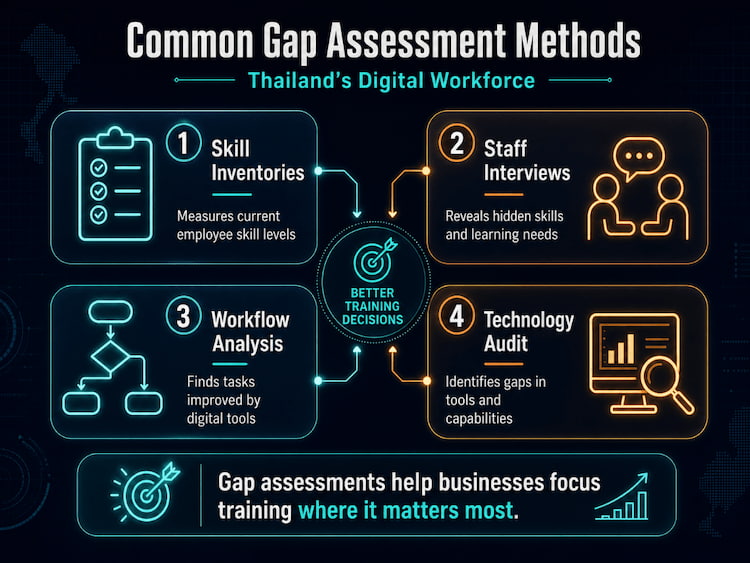
Common Gap Assessment Methods
|
Method |
What It Finds |
|
Skill Inventories |
Current employee skill levels |
|
Staff Interviews |
Hidden skills, learning needs, and workflow problems |
|
Workflow Analysis |
Tasks that can be improved using digital tools |
|
Technology Audit |
Gaps between current tools and needed capabilities |
A good gap assessment helps companies avoid wasting money on unnecessary training. It allows them to focus on the skills that will create the greatest impact.
For example, a FinTech company may discover that its employees understand basic customer service but lack skills in data privacy, fraud detection, and customer analytics. The training programme can then be designed around those specific needs.
Combining Workshops with On-the-Job Training
The most effective digital training combines workshops with real workplace practice. A workshop can teach employees the basic concepts. However, employees only become confident when they apply those concepts to real tasks.
For example, employees may first attend a workshop on AI marketing tools. After that, they may use AI to analyse customer feedback, create campaign ideas, or improve website content. This combination works better because it connects learning with daily work.
Why This Method Works
|
Training Method |
Benefit |
|
Workshops |
Teach the theory and basic tool usage |
|
On-the-job practice |
Helps employees apply skills to real tasks |
|
Group projects |
Encourages teamwork and problem-solving |
|
Feedback sessions |
Helps employees improve through guidance |
|
Train-the-trainer model |
Allows trained employees to teach others |
The train-the-trainer model is especially useful for long-term success. It means selected employees receive deeper training so they can later train their colleagues. This helps companies build internal learning capacity instead of depending only on external trainers.
Measuring Training Success
Training should be measured carefully. It is not enough to simply count how many employees attended a workshop.
Companies need to know whether employees actually improved and whether the training helped the business.
Measurement Framework
|
Stage |
What to Measure |
|
Before Training |
Current skill level, confidence, and task performance |
|
During Training |
Attendance, participation, assessment scores, project progress |
|
After Training |
Skill improvement, task speed, project results, and business impact |
Useful KPIs
|
KPI |
What It Measures |
Target |
|
Skill Adoption Rate |
Employees who reach the required skill level |
Above 80% |
|
Project Speed Improvement |
Whether trained tasks become faster |
Above 25% |
|
Certification Pass Rate |
Employees who pass assessments |
Above 70% |
|
Application Rate |
Employees using skills at work |
Above 60% |
The most important question is: can employees use what they learned to improve their actual work?
For example, if a data analytics course helps a marketing team create better reports and make faster campaign decisions, then the training is successful.
Custom Training for Brands and Marketing Teams
Marketing teams increasingly need digital skills because modern marketing depends on data, automation, personalisation, and online customer behaviour.
In the past, marketing mainly focused on creative ideas, advertisements, and promotions. These are still important, but modern marketers also need to understand analytics, AI tools, customer journeys, and campaign performance.
Marketing-Specific Training Areas
|
Focus Area |
Skills Developed |
Business Use |
|
Marketing AI |
AI content tools, campaign automation, personalisation |
Create smarter campaigns |
|
Brand Data Analytics |
Customer segmentation, lifetime value, campaign measurement |
Make better marketing decisions |
|
User Experience Optimisation |
A/B testing, heatmaps, conversion improvement |
Improve websites and apps |
Customer segmentation means dividing customers into groups based on shared characteristics, such as age, interests, buying behaviour, or spending habits.
A/B testing means comparing two versions of something to see which performs better. For example, a company may test two different website headlines to see which one gets more clicks.
User experience, or UX, refers to how easy and pleasant it is for customers to use a website, app, or digital service.
These skills help marketing teams make decisions based on evidence instead of assumptions.
Hands-On Data and Website Training
Hands-on data and website training teaches employees how to collect, understand, and use digital data.
For example, a company may want to know:
- How many people visit its website
- Which pages users view the most
- Where users leave the website
- Which marketing campaigns bring in customers
- Which website changes increase sales or enquiries
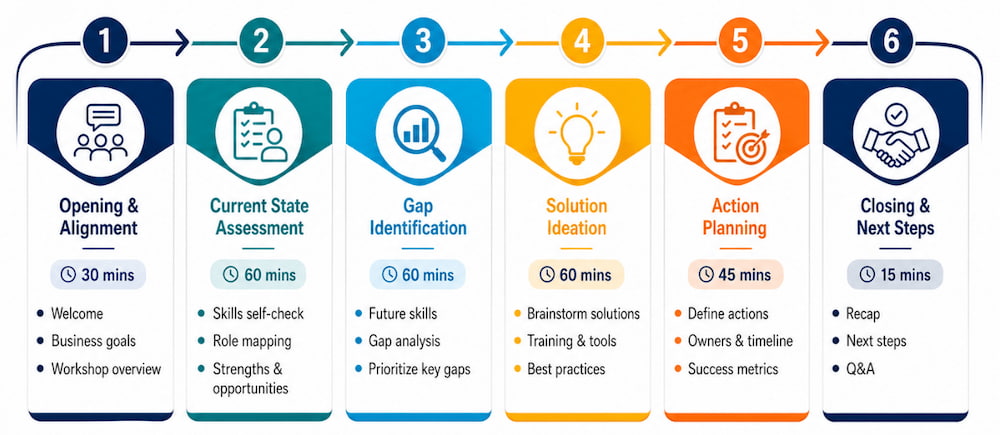
Workshop Structure
|
Phase |
Content |
Outcome |
|
Data Setup |
Google Analytics and data tracking |
Reliable website data |
|
Website Integration |
Connecting analytics tools to the website |
Better tracking |
|
Dashboard Building |
Creating visual reports |
Easier decision-making |
|
Testing Methods |
A/B testing and performance checks |
More accurate conclusions |
A dashboard is a visual report that shows important data in one place. For example, a marketing dashboard may show website visits, conversions, sales, and campaign performance.
This type of training helps employees turn data into useful business actions.
Workflow Automation Training
Workflow automation means using digital tools to complete repetitive tasks automatically.
This is useful because many employees spend time on manual work that could be automated, such as updating spreadsheets, sending reminders, sorting customer enquiries, or creating reports.
Examples of Tasks That Can Be Automated
|
Task |
Automation Example |
|
Approval Emails |
Automatically send requests to managers |
|
Data Entry |
Move form responses into spreadsheets |
|
Reporting |
Generate weekly reports automatically |
|
Customer Enquiries |
Sort enquiries by topic or urgency |
|
Reminders |
Send automatic follow-up messages |
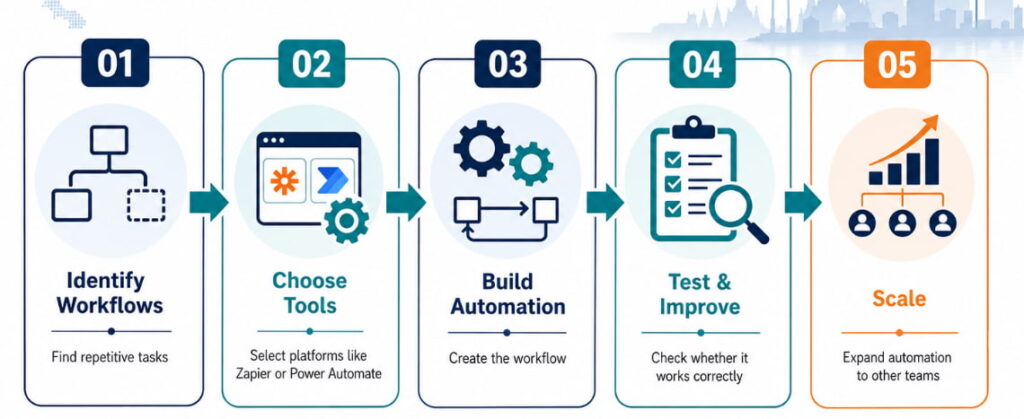
Automation Training Framework
|
Phase |
Purpose |
|
Identify Workflows |
Find repetitive tasks |
|
Choose Tools |
Select platforms like Zapier or Power Automate |
|
Build Automation |
Create the workflow |
|
Test and Improve |
Check whether it works correctly |
|
Scale |
Expand automation to other teams |
Automation does not replace all workers. Instead, it helps employees save time so they can focus on more valuable tasks such as strategy, analysis, customer service, and problem-solving.
Model Finetuning and Agentic Bots
More advanced AI training may include model finetuning and agentic bots.
Model fine tuning means adjusting an AI model so it works better for a specific company or task. A general AI tool may understand normal language, but it may not understand a company’s products, policies, or tone of voice. Finetuning helps make the AI more suitable for that business.
Agentic bots are AI assistants that can complete tasks with less human guidance. Unlike basic chatbots that only answer simple questions, agentic bots can use business information, connect with tools, follow instructions, and support workflows.
Workshop Areas
|
Training Area |
Purpose |
|
Dataset Preparation |
Prepare company-specific information |
|
Model Selection |
Choose the right AI model |
|
Bot Construction |
Build an AI assistant with business context |
|
Testing |
Check accuracy, safety, and reliability |
These tools can support customer service, HR, sales, internal knowledge search, and operations. For example, a company could build an AI assistant that answers employee questions about leave policies, retrieves product information for sales staff, or helps customer service teams respond faster.
Deploying Business-Context Virtual Assistants
A business-context virtual assistant is an AI assistant that understands company-specific information.
It may know:
- Product details
- Company policies
- Customer history
- FAQs
- Sales processes
- Internal procedures
This makes it more useful than a general chatbot because it can answer based on the company’s actual information.
Five-Step Deployment Process
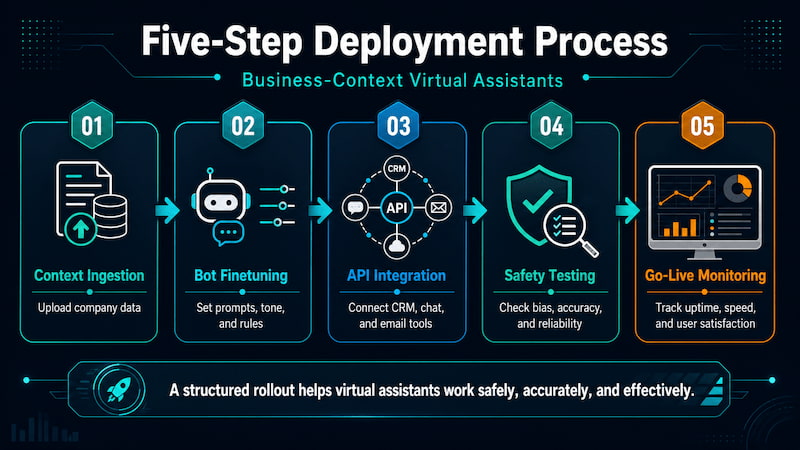
|
Step |
Explanation |
|
Context Ingestion |
Upload company information into the system |
|
Bot Finetuning |
Train the bot to use the right tone and rules |
|
API Integration |
Connect the bot to tools like Slack, LINE, CRM, or email |
|
Safety Testing |
Check for mistakes, bias, and inappropriate answers |
|
Go-Live Monitoring |
Track performance after launch |
API stands for Application Programming Interface. It allows different software systems to connect and share information.
For example, a virtual assistant can use an API to connect with a CRM system and retrieve customer information. It can also connect with Slack or Microsoft Teams so employees can ask questions directly from their work chat.
After launch, companies should monitor the assistant’s uptime, response speed, accuracy, escalation rate, and user satisfaction.
Measuring ROI on Digital Talent Investments
ROI, or Return on Investment, measures whether the money spent on training creates enough value.
For digital skills training, ROI can come from:
- Faster project completion
- Fewer mistakes
- Higher productivity
- Better employee retention
- Lower hiring costs
- Improved customer experience
- Better marketing performance
ROI Formula
ROI = (Productivity Gains + Retention Savings – Training Costs) / Training Costs
Example
For a 10-person team with a 500,000 baht training investment:
|
Item |
Value |
|
Productivity Improvements |
1,500,000 baht |
|
Retention Savings |
500,000 baht |
|
Training Costs |
500,000 baht |
Using the formula:
ROI = (1,500,000 + 500,000 – 500,000) / 500,000
ROI = 300%
This means the company gains three times the value of its training investment.
However, ROI should not only be measured financially. Companies should also look at employee confidence, faster decision-making, improved teamwork, and stronger innovation.
Conclusion
Thailand has strong potential to grow its digital economy, but the digital talent gap remains a major challenge. Businesses need more workers with skills in AI, data analytics, cybersecurity, automation, cloud computing, and digital marketing. This shortage affects more than recruitment. It delays digital projects, increases hiring costs, slows innovation, and weakens Thailand’s ability to compete with stronger digital economies in the region.
Training is one of the most practical ways to close this gap. Companies can use online courses, certifications, local bootcamps, hands-on workshops, and AI advisory services to build stronger digital capabilities. The most effective approach is targeted training. Businesses should first assess their skill gaps, then create a clear training plan, combine workshops with real workplace practice, and measure results using KPIs.
As AI becomes more common in business, companies that invest in digital talent now will be better prepared to compete, innovate, and grow in Thailand’s digital economy.
Frequently Asked Questions
What is Thailand’s digital talent gap?
Thailand’s digital talent gap refers to the shortage of workers with skills in AI, data analytics, machine learning, cybersecurity, cloud computing, digital marketing, and automation.
Why does the digital talent gap matter?
It matters because businesses need digital skills to compete, improve customer experience, automate work, use AI, and make better decisions. Without these skills, companies may face delays, higher costs, and weaker competitiveness.
Why is the gap happening?
The gap is happening because demand for digital skills is growing faster than the supply of trained workers. Thailand produces fewer digital professionals than the economy needs each year. New technologies such as generative AI have also increased demand.
How can training help?
Training helps companies build skills internally. Instead of only hiring new workers, businesses can upskill or reskill their existing employees. This can be more affordable, faster, and more sustainable.
What is AI advisory?
AI advisory helps businesses identify their digital skill gaps, create training roadmaps, and choose the right AI or digital tools for their needs.
Who can benefit from digital skills training?
Business leaders, marketers, data teams, HR teams, operations teams, customer service teams, website teams, and employees who want to improve their careers can all benefit.
How quickly can companies see results?
Some results can appear within weeks if employees apply the skills immediately. Larger improvements may take three to six months, while full ROI may be measured over a year.