
Unlocking GANs for Thai Brands
Generative Adversarial Networks, or GANs, can help Thai brands create realistic visuals, improve product images, generate synthetic data, and test campaign ideas faster. They are especially useful for businesses that rely on strong visual content, such as retail, e-commerce, marketing, design, education, and manufacturing.
GANs are powerful, but they should be used for the right purpose. They work best for image generation, image enhancement, product mockups, and synthetic data. For chatbots or agentic bots, businesses usually need large language models, APIs, retrieval systems, and automation tools instead. AI Thailand can help brands understand this difference and apply GANs where they create real business value.
What Are Generative Adversarial Networks?
GANs are AI models that create realistic synthetic content
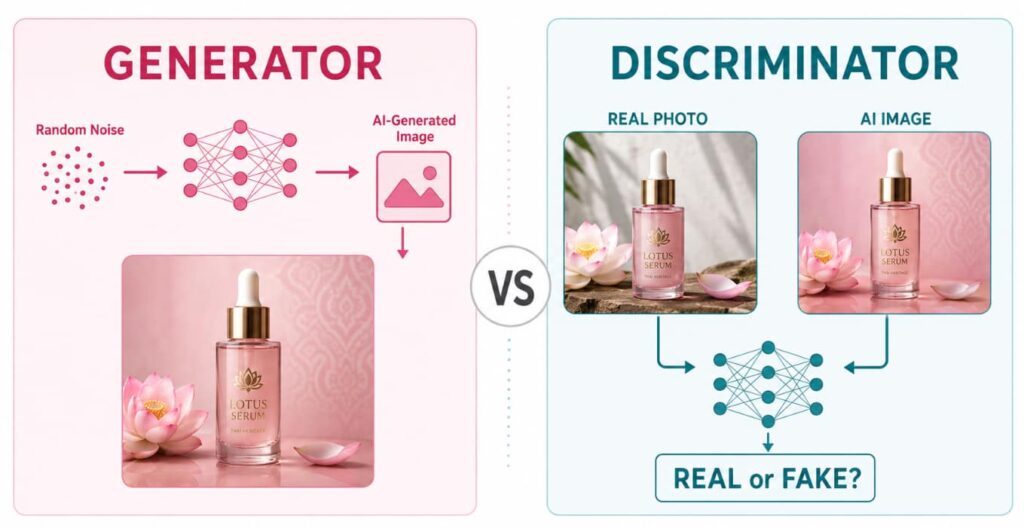
Generative Adversarial Networks are deep learning models made up of two parts: a Generator and a Discriminator. The Generator creates synthetic content, while the Discriminator checks whether the content looks real or fake.
This process is called adversarial training. As training continues, the Generator learns how to create outputs that become harder for the Discriminator to reject. This is why GANs are often used for visual AI tasks such as image generation, image enhancement, and synthetic data creation.
For Thai businesses, GANs can support campaign mockups, product visualisation, e-commerce image testing, document-style data generation, and AI-assisted design workflows.
Core Components: Generator vs Discriminator
|
Component |
Role |
Business Example |
|
Generator |
Creates synthetic content |
Produces product image mockups |
|
Discriminator |
Checks if the content looks real |
Reviews whether visuals resemble real product photos |
|
Training Data |
Provides real examples |
Product photos, campaign images, design references |
|
Output |
Final AI-generated result |
Mockups, enhanced images, synthetic visuals |
GANs need clean data and careful review. Poor training can lead to distorted images, repetitive visuals, or outputs that do not match the brand’s style.
How Do GANs Generate Realistic Data?
GANs learn by comparing generated outputs with real examples
GANs generate realistic data through repeated training. The Generator creates a synthetic image or data sample, and the Discriminator compares it with real examples. The feedback helps the Generator improve over time.
A simple GAN workflow includes:
- Prepare a clean dataset.
- Train the Discriminator to recognise real examples.
- Train the Generator to create synthetic examples.
- Compare generated outputs with real data.
- Improve the model through repeated training.
- Review the final output before using it.
For example, if a Thai e-commerce brand trains a GAN on product images, the model may learn patterns such as product shape, lighting, background style, and texture. The output can then be used as a draft visual or design concept, but it should still be checked by a human before publication.
Top GAN Use Cases in Thailand’s Industries
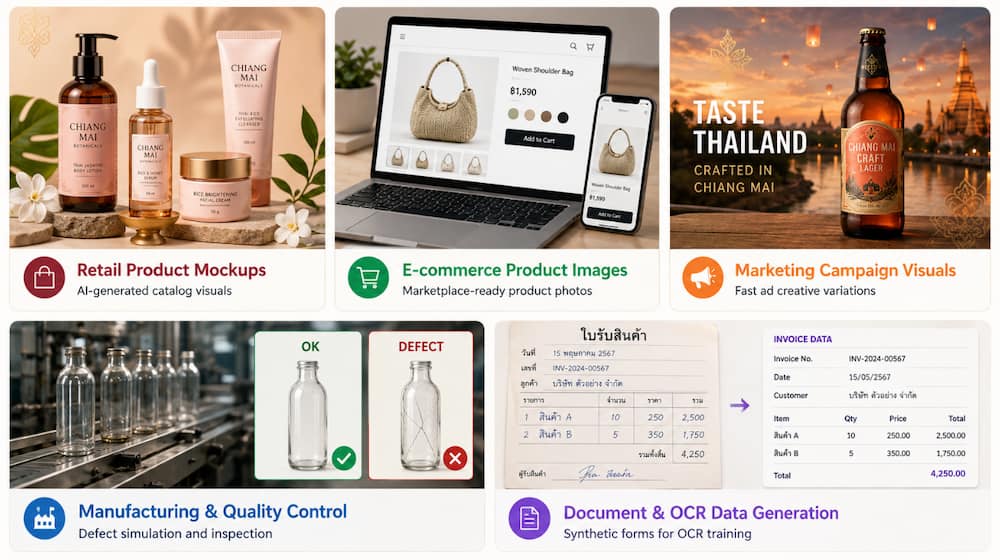
GANs can help Thai businesses that need better visuals, more training data, or faster creative testing. They are especially useful when a company has a clear image-related or data-related problem.
|
Industry |
GAN Use Case |
|
Retail |
Product mockups and image variations |
|
E-commerce |
Product listing visuals and background testing |
|
Finance |
Synthetic data for model testing |
|
Manufacturing |
Defect simulation and visual inspection support |
|
Education |
Handwriting or document-style data |
|
Marketing |
Campaign concepts and image enhancement |
Marketing: Synthetic Images for Campaigns
Thai brands can use GANs to create early-stage campaign visuals before spending on full photoshoots or manual design production. This helps teams explore different product backgrounds, seasonal themes, lifestyle settings, and localised Thai campaign concepts.
For example, a fashion brand could test different product scenes before choosing the final creative direction. A hospitality brand could explore promotional visuals before producing final campaign assets. An e-commerce brand could test background variations for product listings.
These outputs should be treated as drafts. Designers and marketers still need to review them for product accuracy, brand fit, image quality, and cultural relevance.
How Can Brands in Thailand Implement GANs?
Thai brands should start with a clear use case and the right data
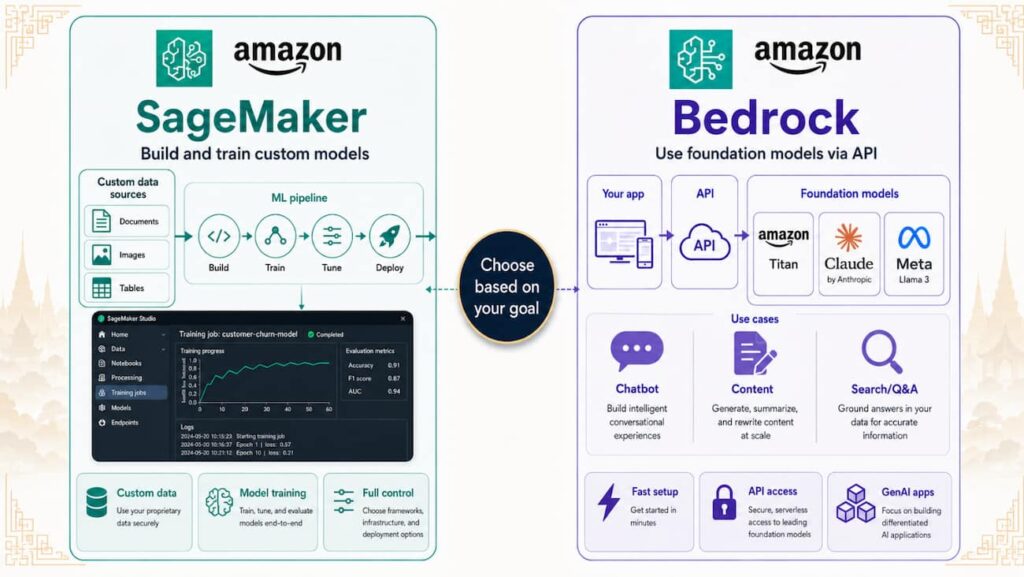
Brands should first identify the exact problem they want to solve. A company should not use GANs just because the technology sounds advanced. A better starting point would be a clear need, such as creating product mockups, improving low-resolution visuals, or generating synthetic data for testing.
A practical implementation process includes:
- Define the business problem.
- Check whether GANs are the right solution.
- Prepare clean and legally usable data.
- Choose a suitable GAN model.
- Train or fine-tune the model.
- Test output quality.
- Add human review.
- Integrate approved outputs into workflows.
For custom GAN training, SageMaker or similar ML platforms are usually more suitable because they support custom model development and experimentation. Bedrock is more relevant for LLM and foundation model workflows, such as AI assistants and agentic systems.
Thai businesses should also consider PDPA when using customer images, employee information, personal data, or identifiable visual assets. Even if the final output is synthetic, the original training data may still create privacy risks.
What GAN Training Services Are Available in Thailand?
AI Thailand can support businesses with GAN advisory, training, and workflow planning
AI Thailand can help businesses decide whether GANs are suitable for their goals. This may include use case planning, dataset guidance, model selection, workflow design, proof-of-concept planning, and team training.
For many brands, a feasibility workshop is a better starting point than a full custom GAN project. It helps the business understand whether it has the right data, budget, and use case before investing in model training.
|
Service |
Focus |
|
GAN advisory |
Use case discovery and AI strategy |
|
Team workshops |
GAN concepts and business applications |
|
Dataset guidance |
Data quality, relevance, and legal readiness |
|
Workflow integration |
Connecting GAN outputs to business processes |
Good training should also explain when GANs are not the right tool. Some problems are better solved with LLMs, automation tools, analytics platforms, or traditional machine learning.
AI Thailand’s GAN Fine-Tuning for Business Processes
AI Thailand can help businesses apply GANs to marketing, e-commerce, document processing, and design workflows. For marketing, GANs can support campaign mockups, product image enhancement, background variations, and creative testing.
For data projects, GANs can help create synthetic examples for testing or model development. For design teams, GANs can support early-stage visual exploration before designers refine the final asset.
Instead of making fixed ROI claims, brands should measure actual results, such as time saved, number of usable drafts, image quality, reduced editing work, campaign production speed, or improved testing output.
Marketing: ScrabbleGAN for Text Overlays
ScrabbleGAN is linked to handwriting and text image generation. In Thai marketing, similar techniques may support Thai-language visual concepts, packaging mockups, typography testing, or signage previews.
However, AI-generated text can be unreliable. It may include spelling mistakes, distorted characters, or unreadable words. This is especially important for Thai script, where readability and accuracy matter.
For this reason, GAN-generated text visuals should mainly be used for concept exploration. Designers should review and refine the final text before any marketing asset is published.
Data: IAM Dataset Augmentation
The IAM handwriting dataset is useful in handwriting recognition research, but it does not directly represent Thai handwriting or Thai-language documents.
For Thai OCR or document-processing use cases, businesses need data that reflects Thai script, local handwriting styles, real forms, and local document formats. GANs can help create synthetic examples, but the data must be reviewed carefully.
If the original documents contain personal information, businesses must also consider PDPA requirements and avoid exposing sensitive data during training or testing.
Automation: GAN Agents as Virtual Assistants
GANs do not usually work as virtual assistants on their own. Virtual assistants and agentic bots are normally built with LLMs, APIs, retrieval systems, business rules, and automation tools.
GANs can support these systems indirectly by generating visuals or synthetic data. For example, an LLM-based marketing assistant could read a campaign brief and then trigger a GAN-based workflow to create product mockups.
This is a more accurate way to connect GANs with agentic bots. The bot manages the workflow, while the GAN supports the visual generation task.
How Can GANs Support Agentic Bots in Thailand?
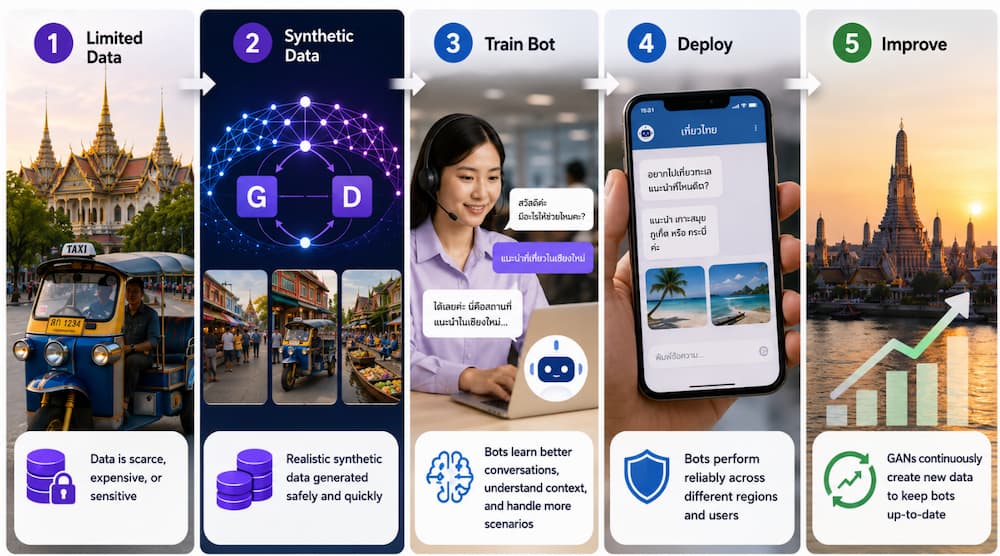
GANs support agentic bots through visual generation, not reasoning
GANs should be seen as a supporting tool inside a wider agentic workflow. The agentic bot handles reasoning, instructions, and business actions. The GAN handles image or data generation when needed.
A simple workflow could be:
- A team submits a campaign brief.
- An LLM assistant organises the requirements.
- The system checks brand rules and product details.
- A GAN or image model creates visual concepts.
- A designer reviews the output.
- Approved visuals move into the campaign workflow.
This avoids the inaccurate claim that GANs directly power agentic bots. In real business use, GANs work best as one part of a larger AI system.
What GAN Workshops and Training Options Are Available in Thailand?
GAN workshops should teach both technical basics and business use cases
AI Thailand can offer workshops that explain how GANs work, where they are useful, and where they are not. Good training should cover the Generator, Discriminator, dataset preparation, image generation, common problems, output review, and responsible AI use.
Training should also help teams compare GANs with other AI tools. For example, GANs may be useful for image generation, while LLMs are better for reasoning, text, chatbots, and workflow instructions.
AI Thailand Workshops: Hands-On DCGAN Training
A hands-on DCGAN workshop can help teams understand image generation in practice. It can cover GAN basics, dataset preparation, training flow, mode collapse, and business use cases such as product visuals or campaign mockups.
This type of workshop is useful for marketers, data teams, and managers who want to understand what GANs can realistically do before investing in a larger project.
AWS DeepComposer for GAN Music Generation
AWS DeepComposer should no longer be presented as a current GAN training option because AWS ended support for the service on 17 September 2025.
Current alternatives include SageMaker notebooks, PyTorch tutorials, TensorFlow GAN resources, cloud ML labs, and custom internal workshops. If DeepComposer is mentioned, it should only be described as a historical example, not an active training tool.
Online SageMaker Labs for Flexible GAN Practice
SageMaker labs and similar cloud ML environments can help teams practise GAN training without buying local GPU hardware. They are useful for small prototypes, remote learning, and early experiments.
Teams should still monitor cloud costs and avoid using sensitive data unless there is a clear legal basis. Starting with a small test project is safer than launching a large custom GAN model immediately.
What Challenges Do Thai Businesses Face When Adopting GANs?
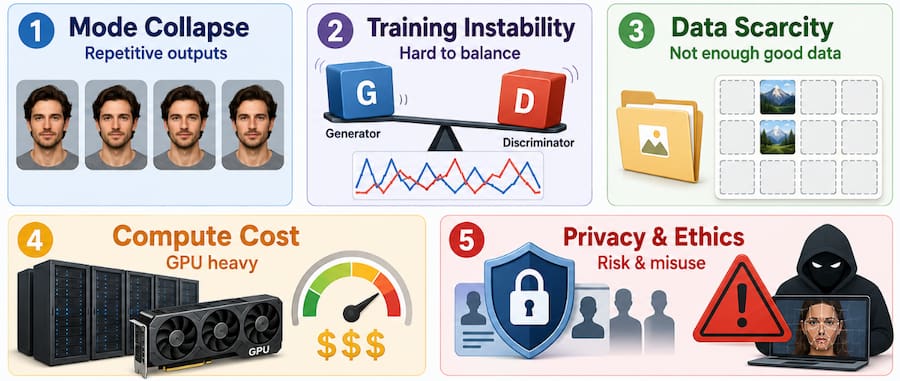
Thai businesses may struggle with training stability, data quality, cost, and compliance
GAN adoption can be challenging because the Generator and Discriminator must improve together. Poor balance can lead to distorted, repetitive, or unrealistic outputs.
Other common issues include weak datasets, high compute costs, copyright concerns, PDPA risks, and poor output quality. These challenges do not mean GANs are unusable, but they do mean businesses should start with a realistic pilot project.
Mode Collapse and Its Fixes
Mode collapse happens when the Generator keeps producing similar outputs. For example, a product visual model may keep creating the same background or layout.
Businesses can reduce this by improving dataset diversity, adjusting the model, using better training methods, and reviewing outputs manually.
Training Instability Solutions
Training instability happens when the Generator and Discriminator do not learn in balance. This can cause poor image quality, failed model improvement, or unrealistic visuals.
Solutions may include adjusted learning rates, better preprocessing, improved training schedules, and more suitable GAN methods. Most custom GAN projects need technical expertise, especially when high-quality output is required.
Overcoming Data Scarcity
Thai-specific use cases may lack enough good data. A business may not have enough Thai handwriting samples, product images, local campaign visuals, or niche industry data to train a useful model.
Businesses can start with a narrow use case, clean existing datasets, improve data collection, or use transfer learning where appropriate. They should also avoid scraping personal images, copyrighted content, or customer data without checking legal and ethical risks.
Managing Compute Costs
GAN training can be expensive because it may require GPU resources. Thai SMEs should start with a small proof of concept before investing in larger infrastructure.
A pilot project should have a clear goal, such as generating usable product mockups, improving images for one product category, or testing whether synthetic data improves a model.
How Can Workflow Automation Use GANs?
GANs become more useful when connected to real business workflows
GANs create more value when they are connected to marketing, design, e-commerce, or approval workflows. A GAN that generates images without a review or publishing process will not create much business impact.
AI Thailand can help businesses connect GAN outputs to campaign planning, product mockups, image updates, design approvals, and internal review systems.
Best Practices for Implementation
Businesses should start with one clear use case, use clean and legal data, include human review, and track real performance.
Useful metrics include:
- Time saved
- Number of usable drafts
- Review time
- Image quality
- Production speed
- Reduced manual editing
These metrics help businesses decide whether a GAN project is worth scaling.
Real-World Example: Campaign Image Generation
A Thai marketing team could upload product images, brand guidelines, and a campaign brief. An AI assistant organises the brief, while a GAN or image model creates visual variations. Designers then review the results and refine the best options.
This does not replace the creative team. It helps them move faster from idea to draft and gives them more options during the early planning stage.
What Is the Future of GANs in Thailand’s AI Ecosystem?
GANs will remain useful, but they will work alongside other AI technologies
GANs will continue to support image generation, image enhancement, synthetic data, and design testing. However, they are now part of a wider AI ecosystem that includes LLMs, diffusion models, multimodal AI, retrieval systems, and automation tools.
For Thai brands, the goal is not to use GANs for everything. GANs are best for visual and synthetic data tasks, while LLMs are better for reasoning, text, chatbots, and agentic workflows. Businesses that understand this difference will be better prepared to apply AI effectively.
Conclusion
Generative Adversarial Networks can help Thai brands improve visual content, generate synthetic data, enhance product images, and speed up creative testing. They are most useful when businesses have a clear visual or data-related problem and when outputs are reviewed carefully before use. With the right use case, GANs can support marketing, e-commerce, document processing, data testing, and creative workflows.
AI Thailand can help businesses apply GANs in a practical and responsible way. Through advisory, training, dataset planning, model selection, and workflow integration, AI Thailand can guide Thai brands toward AI projects that support real business goals instead of simply following trends. This makes GAN adoption more realistic, safer, and more useful for companies that want to turn AI into measurable business value.
Frequently Asked Questions
What are Generative Adversarial Networks in Thailand?
Generative Adversarial Networks in Thailand refer to the use of GAN technology by Thai businesses and AI teams for image generation, product visualisation, image enhancement, synthetic data, and design workflows.
How can businesses in Thailand use Generative Adversarial Networks?
Businesses can use GANs for campaign mockups, product visuals, synthetic datasets, image enhancement, design testing, and AI-assisted workflow support.
Where to get training on Generative Adversarial Networks in Thailand?
AI Thailand can provide GAN training and advisory covering GAN basics, DCGANs, cGANs, dataset preparation, responsible AI, and business implementation planning.
What advisory services are available for Generative Adversarial Networks in Thailand?
AI Thailand can support use case discovery, dataset planning, model selection, workflow integration, staff training, and responsible AI implementation.
Are there applications of Generative Adversarial Networks in Thailand’s marketing sector?
Yes. GANs can help Thai brands create campaign mockups, product visual concepts, image variations, design drafts, and image enhancement workflows.
How does AI Thailand support deployment of Generative Adversarial Networks in Thailand?
AI Thailand can help businesses identify useful GAN use cases, prepare datasets, choose suitable tools, test outputs, and integrate AI-generated visuals into marketing, design, or automation workflows.