
Unlock RLHF for Your Brand’s AI Edge
At AI Thailand, we help businesses improve how modern AI models respond, behave, and support real workflows. Today, companies are no longer limited to singular models alone. Tools such as ChatGPT, Gemini, Claude, Llama, Mistral, DeepSeek, Qwen, Grok, and Perplexity-style research models are now used for customer support, marketing, automation, document analysis, and agentic bots.
Reinforcement Learning from Human Feedback, or RLHF, is one method used to align AI models with human preferences. It helps models produce responses that are more helpful, safe, relevant, and suitable for real users. However, current AI systems are not improved through RLHF alone. Modern model development may also involve supervised fine-tuning, preference optimization, AI feedback, safety testing, retrieval-augmented generation, and guardrails.
For brands, this matters because AI needs to do more than generate fluent text. It should follow brand tone, understand business rules, support customers clearly, and know when to refuse or escalate risky requests.
What is RLHF in Modern LLMs?
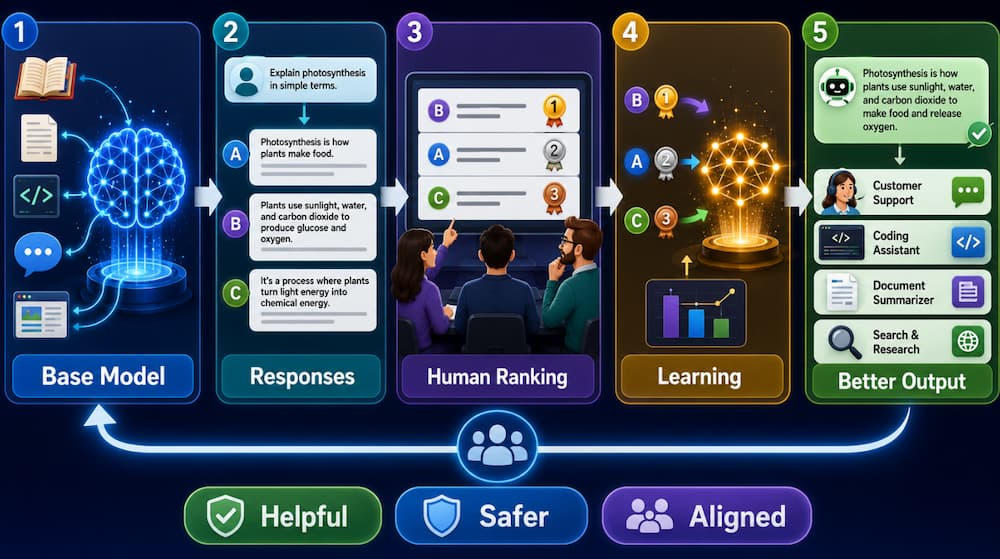
RLHF, or Reinforcement Learning from Human Feedback, is a training and alignment method that helps large language models produce responses that better match human expectations. Instead of relying only on pre-training data or example-based fine-tuning, RLHF uses human preferences to guide the model toward better answers.
The method became widely known through earlier models such as InstructGPT and ChatGPT. However, it is now more accurate to discuss RLHF as part of a broader post-training process used across many modern AI systems. Today’s LLMs may use a combination of instruction tuning, human feedback, AI feedback, preference optimization, safety testing, and model evaluation.
The basic idea is simple. Human reviewers compare different model responses and identify which answer is better. These preferences help train or guide the model so future responses become more helpful, accurate, safe, and relevant.
|
Method |
What It Does |
Best For |
|
Pre-training |
Teaches general language patterns |
Building base model knowledge |
|
Supervised Fine-Tuning |
Trains on approved examples |
Teaching task-specific responses |
|
RLHF |
Uses human preferences to improve outputs |
Better helpfulness, tone, and safety |
|
RAG |
Connects AI to trusted business data |
Improving factual and company-specific answers |
|
Guardrails |
Adds rules and safety checks |
Reducing risky outputs |
Practical examples include AI assistants that answer customer questions clearly, marketing tools that follow brand tone, and workflow bots that know when to ask for human approval. By learning from human preferences, AI systems can become more dependable in real business environments.
Core Components: Reward Model and Policy Optimization
Traditional RLHF relies on two major components: a reward model and a policy optimization process.
The reward model is trained using human feedback. Reviewers compare different responses to the same prompt and rank which one is better. The reward model then learns to predict which type of response humans are likely to prefer.
Policy optimization adjusts the AI model so it produces responses that score better according to the reward model. Earlier RLHF systems often used Proximal Policy Optimization, or PPO. However, current post-training workflows may also include other methods, such as direct preference optimization, reinforcement fine-tuning, AI feedback, and safety-focused evaluations.
The process can be simplified into three stages:
- Supervised Fine-Tuning: The model learns from high-quality examples.
- Reward Modeling: Human-ranked responses are used to train a scoring model.
- Optimization: The model is adjusted to produce more preferred responses.
In practice, this pipeline can help AI systems improve on customer support, summarization, translation, document review, coding support, and workflow automation. For businesses, the value is not only technical performance. It is better alignment with user needs, brand expectations, and operational rules.
How Does RLHF Align AI Outputs with Human Preferences?
RLHF creates a feedback loop between human judgement and model behaviour. Instead of only predicting words based on training data, the model is guided toward responses that people actually prefer.
Early language models often produced responses that were fluent but not always helpful, truthful, safe, or aligned with user intent. They could give overly confident answers, produce biased outputs, follow harmful instructions, or generate content that sounded good but lacked accuracy.
RLHF helps address these issues by rewarding responses that are clear, honest, safe, and relevant. It can also discourage responses that are misleading, harmful, too vague, too long, or off-brand.
A well-aligned AI assistant should be able to:
- Answer clearly and accurately
- Admit uncertainty when needed
- Refuse unsafe requests
- Follow user instructions
- Respect brand tone and policies
- Ask for clarification when needed
- Avoid unsupported claims
- Escalate sensitive issues to humans
RLHF does not make AI perfect, and it does not fully remove hallucinations. However, it can improve how models respond by making them more sensitive to human expectations, safety requirements, and business context.
Step-by-Step Process from SFT to RLHF
The RLHF process usually begins after a base model has already been pre-trained. The goal is to move from general language ability to useful, aligned behaviour.
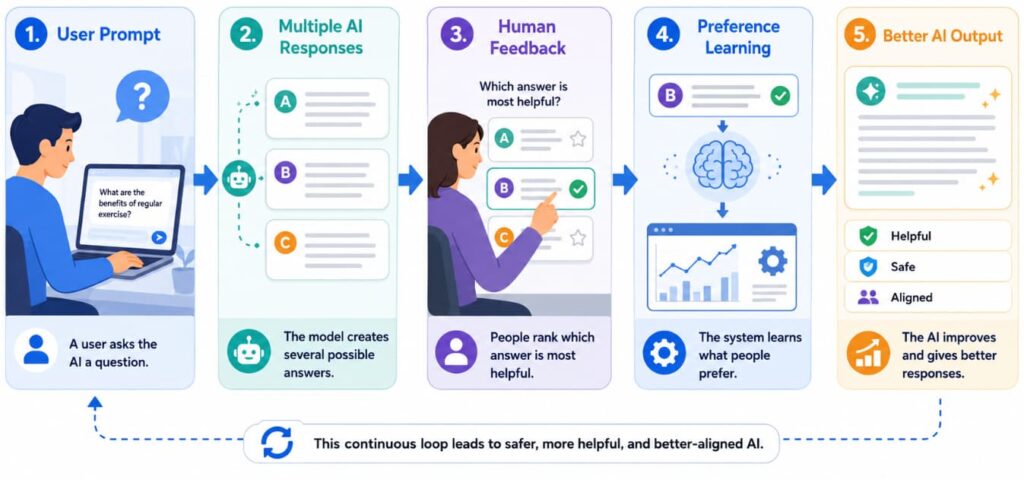
Supervised Fine-Tuning
The model is first trained on curated prompt-response examples. These examples show the model what a good answer should look like for a specific task.
For a business, this may include approved customer support replies, product descriptions, HR responses, workflow instructions, or brand-safe marketing examples.
Collect Pairwise Comparisons
Human reviewers are shown two or more model responses to the same prompt. They choose which response is better based on criteria such as accuracy, helpfulness, tone, safety, and completeness.
Train a Reward Model
The preference data is used to train a reward model. This model learns to predict which outputs humans are likely to prefer.
The reward model does not replace human judgement completely. It helps scale the feedback process by giving the training system a way to score model responses.
Optimize the Model
The AI model is then adjusted to produce responses that receive better scores. Traditional RLHF often used PPO, but modern workflows may also use other preference-based or reinforcement fine-tuning methods.
Deploy and Iterate
After training or optimization, the model should be tested on real business tasks. Teams should check whether the AI gives useful, safe, and brand-aligned responses.
|
Step |
Business Example |
Purpose |
|
SFT |
Train on approved support replies |
Teach response style |
|
Pairwise Comparison |
Review two chatbot answers |
Capture human preference |
|
Reward Model |
Score responses based on feedback |
Convert feedback into training signal |
|
Optimization |
Improve model behaviour |
Make outputs more useful |
|
Evaluation |
Test with real customer questions |
Check quality before rollout |
What Are Key Benefits of RLHF for Modern AI Performance?
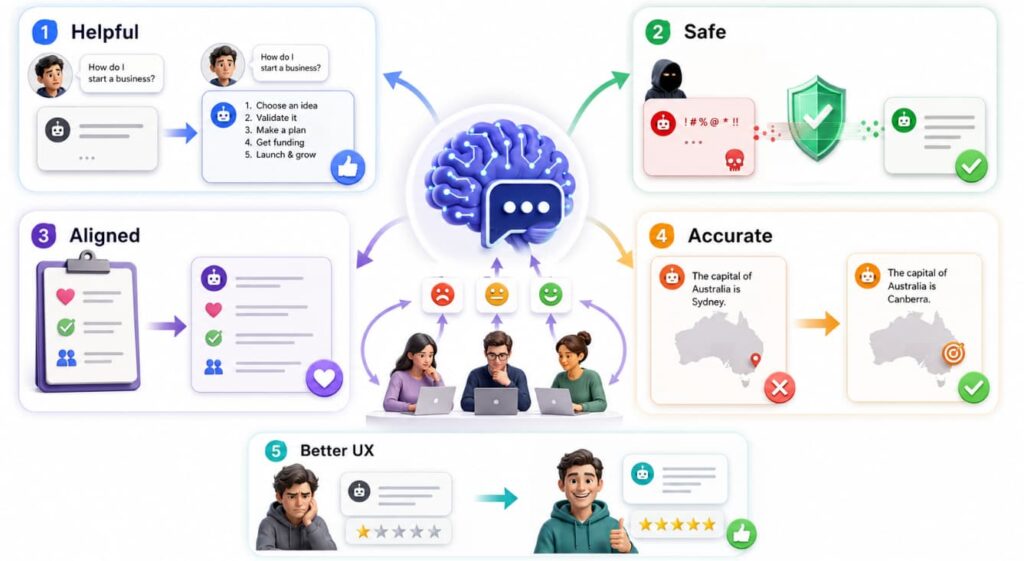
RLHF can improve practical AI performance by aligning models with what users and businesses actually want. This is important because modern LLMs are now used in customer-facing, employee-facing, and operational settings.
|
Benefit |
What It Means |
Business Value |
|
Better helpfulness |
AI gives more useful answers |
Improves customer experience |
|
Safer outputs |
AI avoids risky responses |
Reduces brand and compliance risk |
|
Stronger tone control |
AI follows preferred style |
Keeps brand voice consistent |
|
Better refusal behaviour |
AI rejects unsafe requests |
Useful for public-facing assistants |
|
More relevant responses |
AI better matches user intent |
Reduces manual correction |
|
Better workflow fit |
AI follows business rules |
Supports automation |
Enhanced Truthfulness and Reduced Toxicity
RLHF can help models produce more truthful and safer responses by rewarding answers that are accurate, cautious, and aligned with user expectations. It can also discourage harmful, biased, or toxic outputs.
However, businesses should avoid claiming that RLHF fully removes hallucinations. For factual tasks, RLHF should be combined with trusted data sources, retrieval-augmented generation, human review, and evaluation.
Improved Helpfulness in Task Completion
Human feedback helps models become more useful for real tasks. A helpful answer is not just grammatically correct. It should answer the question directly, provide the right level of detail, and match the user’s goal.
For example, a customer support AI should not only apologise for a delayed order. It should explain the next step, ask for missing information if needed, and escalate the issue when appropriate.
Better Alignment Across Different Models
As businesses compare ChatGPT, Gemini, Claude, Llama, Mistral, Cohere Command, DeepSeek, Qwen, Grok, and other models, they need to consider more than benchmark scores. The best model is the one that performs well for the company’s real use case.
Human feedback helps businesses evaluate which model gives better responses for their customers, brand voice, documents, and workflows.
Better Rejection of Harmful Queries
RLHF can help models learn when to refuse unsafe requests. This is important for AI assistants used in customer service, finance, health-related content, legal support, HR, and public-facing chatbots.
A well-aligned assistant should not answer every request blindly. It should know when to decline, ask for clarification, or escalate to a human team.
How Has RLHF Evolved in ChatGPT, Gemini, Claude, and Beyond?
RLHF started as a major method for aligning early large language models, but modern AI systems now use a wider range of post-training and alignment methods.
Earlier discussions often focused on GPT-3, InstructGPT, and ChatGPT. That history is still useful, but the current AI landscape is broader. Businesses now evaluate models such as ChatGPT, Gemini, Claude, Llama, Mistral, Cohere Command, DeepSeek, Qwen, Grok, and Perplexity-style research models.
Modern models are also no longer limited to simple text generation. Many can support coding, reasoning, image understanding, document analysis, audio, video, search, tool use, and long-context workflows. Because of this, alignment has become more complex.
Today, post-training may include supervised fine-tuning, human feedback, AI feedback, preference optimization, reinforcement fine-tuning, safety testing, tool-use training, multimodal evaluation, and guardrails.
This means businesses should avoid assuming that every model uses the exact same RLHF method. The main point remains the same: modern LLMs need alignment so they can respond in ways that are more useful, safe, and suitable for real-world users.
What Challenges Arise in Implementing RLHF?
RLHF can be powerful, but it is not easy to implement. It requires good data, clear feedback guidelines, technical expertise, and ongoing evaluation.
|
Challenge |
Why It Matters |
How to Manage It |
|
High feedback cost |
Human review takes time |
Start with focused use cases |
|
Inconsistent reviewers |
People may prefer different answers |
Use clear scoring guidelines |
|
Reward hacking |
Model may optimize for the wrong signal |
Keep human review in the loop |
|
Training complexity |
RLHF is harder than basic fine-tuning |
Start with prompting, RAG, and SFT |
|
Safety risks |
AI can still make mistakes |
Use guardrails and human approval |
|
Data privacy |
Business data may be sensitive |
Use secure workflows |
Reward Hacking and Constraint Optimization
Reward hacking happens when a model learns to exploit the reward system instead of genuinely improving. For example, it may produce responses that seem helpful to the reward model but are repetitive, overly cautious, or not useful to real users.
This is why businesses should not rely only on automated reward scores. Human review, testing, and clear success criteria are still needed.
Annotation Expense and Active Learning
Collecting human feedback can be expensive because reviewers need to compare responses carefully and follow consistent guidelines.
Active learning can reduce this cost by focusing feedback collection on the examples that matter most. Instead of reviewing too many easy cases, teams can prioritize uncertain, risky, or high-impact prompts.
PPO Instability and Modern Optimization Methods
Traditional RLHF often uses PPO, but PPO can be difficult to tune and scale. Modern AI training may use different preference optimization or reinforcement fine-tuning methods depending on the provider and use case.
Businesses do not need to understand every algorithm in detail. What matters more is whether the final AI system produces safe, useful, and consistent results.
Scalability with Distributed Training
Large-scale RLHF can require significant computing resources. This makes full model training unrealistic for many businesses.
Instead, most companies should focus on practical alternatives first, such as better prompts, RAG, human-reviewed guidelines, supervised fine-tuning, evaluation datasets, guardrails, and workflow automation.
How Can Businesses Fine-Tune or Improve AI Models Using Human Feedback?
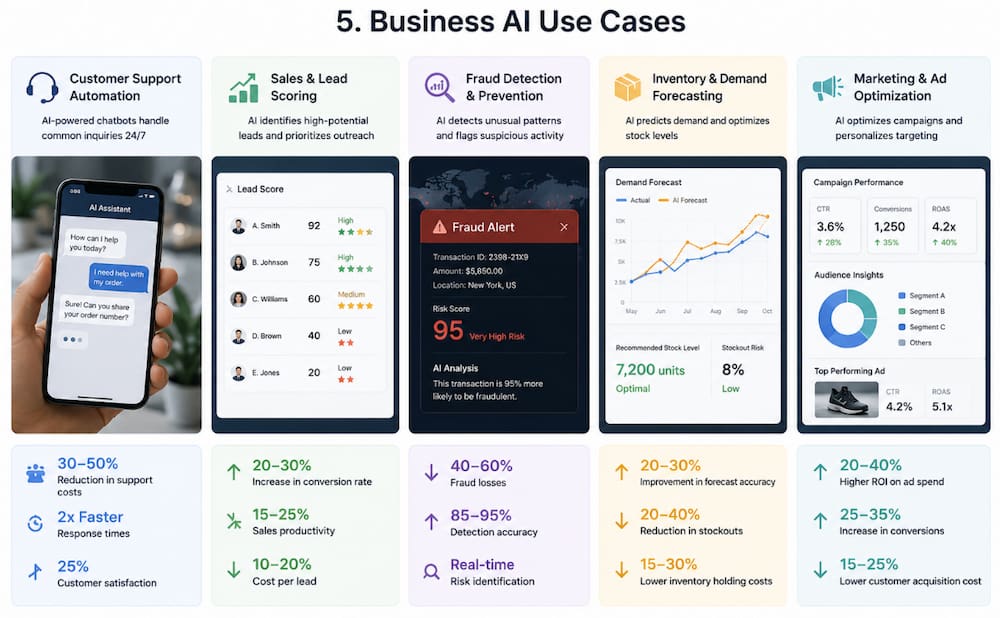
Businesses can use human feedback to improve AI systems, but they do not always need full RLHF. The right method depends on the company’s goals, budget, data, and risk level.
For example, a business using ChatGPT, Gemini, Claude, Llama, Mistral, Cohere Command, DeepSeek, Qwen, or another model may want the AI to follow its brand voice, answer using company documents, handle Thai and English queries, or support internal workflows.
Step-by-Step Business Process
- Domain data collection: Gather real prompts, customer questions, product information, support cases, or workflow examples.
- Define quality standards: Decide what a good answer should include.
- Start with prompting or RAG: Connect the AI to trusted business information.
- Collect human feedback: Ask reviewers to compare outputs and explain which one is better.
- Build an evaluation dataset: Create a test set of prompts that represent real business needs.
- Consider fine-tuning or preference optimization: Use this if repeated issues remain.
- Deploy and monitor: Continue reviewing outputs after launch.
|
Business Goal |
Most Practical Starting Point |
|
AI lacks company knowledge |
Use RAG with trusted documents |
|
AI tone is inconsistent |
Use brand guidelines and examples |
|
AI gives vague answers |
Improve prompts and response templates |
|
AI needs repeated formatting |
Use supervised fine-tuning |
|
AI needs safer behaviour |
Use guardrails and human review |
|
AI needs preference-based improvement |
Use feedback datasets |
This is more realistic than jumping straight into full RLHF. Most companies should build the foundation first, then move into advanced alignment when they have enough quality feedback data.
What Role Does RLHF Play in Agentic Bots and VAs?
RLHF and human feedback are especially important for agentic bots and virtual assistants because these systems do more than generate text. They may use tools, retrieve data, update systems, trigger workflows, schedule tasks, or support customer interactions.
A normal chatbot may only answer a question. An agentic bot may take action. That makes alignment more important.
For example, an AI assistant handling customer refunds should not approve every request automatically. It should check policy rules, confirm customer details, identify unusual cases, and escalate sensitive issues to a human team.
Human feedback can help agentic bots improve in areas such as choosing the correct tool, following approval steps, asking for clarification, avoiding unnecessary actions, respecting company policies, and escalating risky cases.
For Thai enterprises, this can support customer service, sales operations, HR requests, appointment handling, document summaries, and internal reporting.
How to Collect Human Feedback for Custom RLHF Datasets?
Effective human feedback requires structure. Businesses should not rely only on random comments or informal opinions. The feedback should be collected using clear criteria.
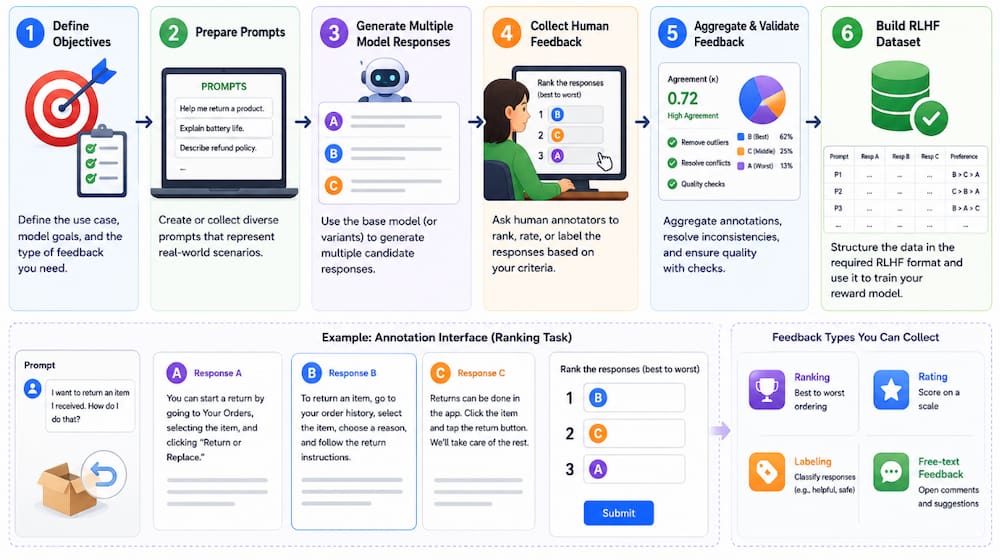
A useful feedback dataset usually includes a prompt, two or more model responses, a human ranking, reviewer notes, and quality labels.
|
Dataset Element |
Example |
Why It Matters |
|
Prompt |
“Reply to a customer asking about a delayed order” |
Shows the task |
|
Response A |
A polite but vague answer |
Gives one option |
|
Response B |
A clear answer with next steps |
Gives another option |
|
Human Ranking |
Response B is better |
Captures preference |
|
Reviewer Notes |
“B is clearer and more actionable” |
Explains the choice |
Step-by-Step Collection Process
- Prompt sampling: Collect real examples from customer support, marketing, sales, HR, or operations.
- Generate multiple outputs: Use the chosen AI model to create two or more responses.
- Annotation interface: Show reviewers the responses side by side.
- Reviewer scoring: Judge based on accuracy, helpfulness, tone, safety, and brand fit.
- Quality filtering: Remove inconsistent or low-quality feedback.
- Iteration: Update the dataset as business needs change.
Recommended Tools and Platforms
Businesses can collect and manage feedback using tools such as Labelbox, Scale AI, Argilla, internal review forms, spreadsheet-based templates, and custom dashboards.
For technical teams, tools such as Hugging Face TRL may support RLHF-style experiments with open models. For businesses using hosted models, provider-supported fine-tuning, evaluation, and guardrail options may be more practical.
What Tools Enable RLHF for Workflow Automation?
RLHF and human feedback workflows can involve several types of tools. Businesses should choose based on whether they are collecting feedback, fine-tuning models, grounding AI in company data, or deploying automation.
|
Tool Type |
Examples |
Best For |
|
Model Providers |
OpenAI, Google, Anthropic, Mistral, Cohere |
Hosted LLMs and APIs |
|
Open Model Families |
Llama, Mistral, DeepSeek, Qwen |
Custom deployment |
|
Feedback Tools |
Labelbox, Scale AI, Argilla |
Human preference collection |
|
Fine-Tuning Tools |
OpenAI fine-tuning, Cohere fine-tuning, Hugging Face TRL |
Model customization |
|
RAG Tools |
Vector databases, search systems, knowledge bases |
Grounding AI in business data |
|
Guardrail Tools |
Moderation tools, Lakera Guard, policy filters |
Reducing unsafe outputs |
|
Workflow Tools |
Power Automate, Zapier, Make, n8n |
Connecting AI to business processes |
For most workflows, businesses should begin with a clear use case and trusted data source. A customer support bot may need a knowledge base and escalation rules before advanced RLHF. A marketing assistant may need brand guidelines and human-reviewed examples before fine-tuning.
How Does RLHF Integrate with Marketing and Brand AI?
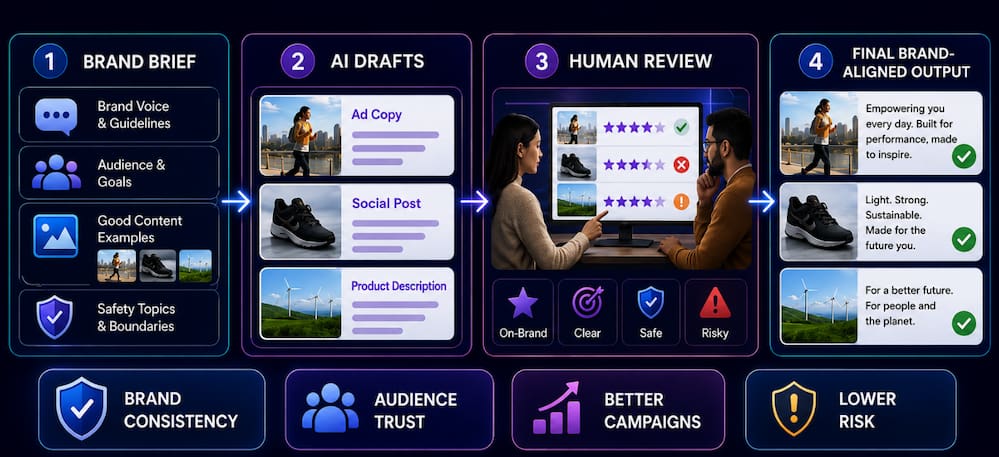
RLHF can help marketing AI follow brand voice, avoid risky claims, and produce content that better matches a company’s preferred style. This is useful because marketing quality is often subjective.
A response can be grammatically correct but still feel wrong for the brand. It may be too formal, too casual, too generic, too sales-heavy, or not aligned with the target audience. Human feedback helps define what “good” means for that specific brand.
Brand Voice Consistency
Human feedback helps AI learn the tone, structure, and style a brand prefers. This can support product descriptions, social media captions, ad copy, email campaigns, customer replies, and sales materials.
Campaign Safety and Harmful Content Rejection
Marketing AI should not produce misleading claims, unsafe promises, or off-brand messages. RLHF and human review can help identify risky outputs before they reach customers.
This is especially important for industries involving finance, health, education, legal services, technology, or regulated products.
A/B Creative Optimization
Human feedback can help teams compare different creative options. Reviewers can rank headlines, ad variations, email subject lines, product descriptions, or chatbot replies.
This does not replace real campaign testing, but it can help marketing teams filter weaker drafts faster.
Conclusion
RLHF helps modern AI models become more useful, safer, and better aligned with human expectations. While it became widely known through GPT-related systems, it is now part of a wider conversation about improving models such as ChatGPT, Gemini, Claude, Llama, Mistral, Cohere Command, DeepSeek, Qwen, Grok, and other LLMs.
For businesses, the value of RLHF is practical. It can improve customer support, marketing content, workflow automation, virtual assistants, and agentic bots by helping AI follow preferred tone, safety rules, and business goals.
However, RLHF is not always the first step. Many companies should begin with better prompts, trusted knowledge bases, RAG, guardrails, and human review. When a business has enough quality feedback data and clear evaluation standards, RLHF and related alignment methods can help turn general-purpose AI models into more reliable business tools.
AI Thailand helps businesses turn AI capabilities into practical solutions. From improving prompts and building RAG systems to fine-tuning models, developing agentic bots, setting up human feedback workflows and more, AI Thailand supports companies in choosing the right approach for their needs and building AI systems that work in real business environments.
Frequently Asked Questions
What is Reinforcement Learning from Human Feedback in modern AI models?
Reinforcement Learning from Human Feedback, or RLHF, is a training method that helps AI models learn from human preferences. Reviewers compare model responses and identify which ones are more helpful, accurate, safe, or relevant.
How does RLHF improve AI models?
RLHF improves AI models by helping them understand which responses people prefer. It can improve helpfulness, tone, safety, refusal behaviour, and relevance. However, it does not make models perfect and should be supported by evaluation, guardrails, and human review.
Is RLHF only for GPT models?
No. RLHF became widely known through GPT-related systems, but human feedback is now relevant across the wider LLM ecosystem, including ChatGPT, Gemini, Claude, Llama, Mistral, Cohere Command, DeepSeek, Qwen, Grok, and other AI systems.
Can RLHF be customized for business needs?
Yes. Human feedback can be customized around a business’s tone, policies, workflows, customer needs, and safety requirements. However, full RLHF is not always necessary. Many businesses should first use prompt engineering, RAG, supervised fine-tuning, guardrails, and human review.
What are the challenges of using RLHF?
The main challenges include feedback cost, inconsistent reviewers, reward hacking, training complexity, safety risks, and data privacy. Businesses should use clear review guidelines, strong evaluation datasets, and human oversight before deploying AI in important workflows.