In Thailand’s fast-growing AI landscape, businesses are looking for smarter ways to use data, automate workflows, and build more adaptive digital systems. Variational Autoencoders, or VAEs, can support these goals by helping AI systems generate new data, detect unusual patterns, and improve model workflows.
A VAE uses an encoder to compress data into a probabilistic latent space. A decoder then reconstructs or generates outputs from that latent representation. Unlike standard autoencoders, VAEs are useful for generation, anomaly detection, data augmentation, model finetuning, and agentic bot integration.
Key Takeaways
- VAEs use an encoder, decoder, and latent space to compress, reconstruct, and generate data.
- Unlike standard autoencoders, VAEs use probability distributions, making them more suitable for generative AI tasks.
- Reconstruction loss and KL divergence help VAEs balance output accuracy with a useful latent space.
- Businesses can use VAEs for marketing automation, anomaly detection, synthetic data, model finetuning, and agentic bots.
What Are Variational Autoencoders?
Variational Autoencoders are generative machine learning models that learn compact representations of data. They are based on autoencoders but add probabilistic modelling, which makes them more flexible.
A standard autoencoder mainly compresses and reconstructs data. A VAE learns a distribution in latent space, allowing it to sample from that space and generate new outputs that resemble the training data.
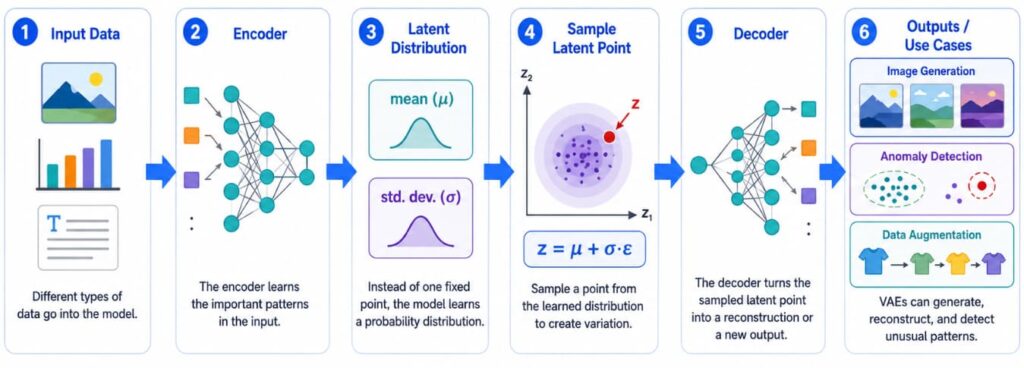
In simple terms, a VAE works by passing data through five stages:
- The encoder receives input data.
- The encoder compresses it into a probabilistic latent space.
- The model samples from the latent space.
- The decoder reconstructs or generates an output.
- Training improves both reconstruction and generation.
VAEs are useful in unsupervised learning because they can learn patterns without needing large amounts of labelled data. This makes them helpful for businesses that want to explore AI workflows but do not always have complete or perfectly labelled datasets.
Core Components of a VAE
A VAE has three main components: the encoder, latent space, and decoder. Each component plays a different role in helping the model understand and generate data.
|
Component |
What It Does |
Why It Matters |
|
Encoder |
Compresses input data into a probability distribution |
Identifies important patterns |
|
Latent space |
Stores compressed probabilistic representations |
Enables sampling, interpolation, and generation |
|
Decoder |
Reconstructs or generates output |
Produces usable outputs from compressed data |
The encoder does not create only one fixed compressed version of the input. It produces parameters for a distribution, such as a mean and variance. The decoder then uses sampled latent variables to create the output.
According to Kingma and Welling’s Auto-Encoding Variational Bayes paper, this probabilistic encoder-decoder structure helps VAEs learn useful latent representations and generate new samples.
How Do VAEs Differ from Standard Autoencoders?
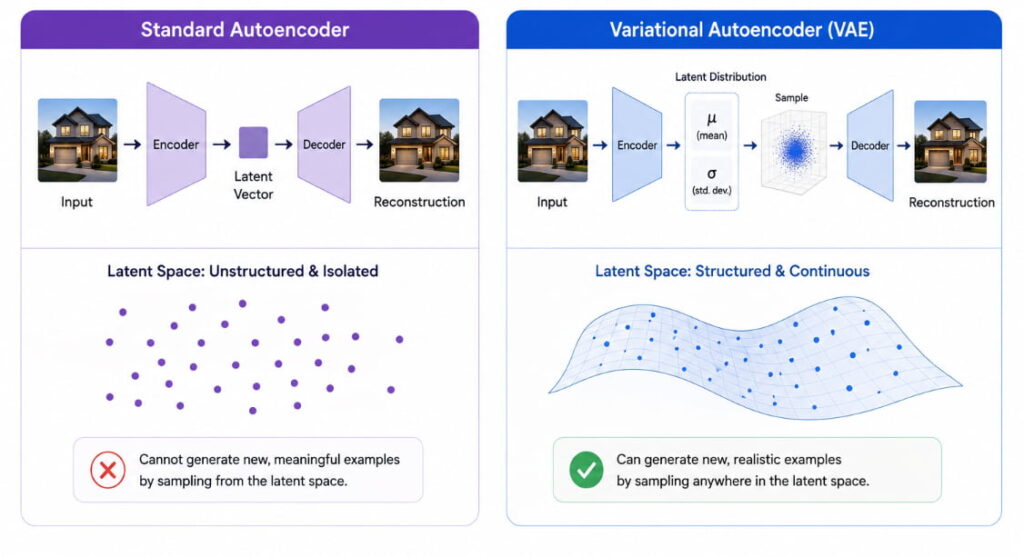
Standard autoencoders are mainly used for compression and reconstruction. VAEs are more useful when the goal includes generation, sampling, or anomaly detection.
A standard autoencoder creates a fixed latent representation. A VAE creates a distribution, which gives it more flexibility. This means the model can sample from the latent space instead of simply rebuilding the same type of output.
|
Feature |
Standard Autoencoder |
Variational Autoencoder |
|
Latent representation |
Fixed point |
Probability distribution |
|
Main purpose |
Compression and reconstruction |
Generation, reconstruction, and anomaly detection |
|
Output variety |
Limited |
More diverse |
|
Sampling ability |
Weak |
Strong |
|
Business use |
Data compression |
Synthetic data, AI workflows, and marketing variation |
If a company only needs compression, a standard autoencoder may be enough. If it needs synthetic data, creative variations, or anomaly detection, a VAE is often more suitable.
Why Does Latent Space Matter?
The latent space is where the VAE stores compressed patterns from the data. A useful latent space allows the model to generate new samples, reconstruct existing data, identify unusual data points, and interpolate between outputs.
For example, in marketing, latent space can help generate variations of product visuals, campaign images, or customer-like behaviour samples. In anomaly detection, it can help identify inputs that do not match the normal patterns learned during training.
This is one reason VAEs are useful for business AI systems. They do not only store data in a smaller form. They also organise learned patterns in a way that can support generation and decision-making.
Reparameterization Trick and KL-Divergence Loss
VAEs use the reparameterization trick and KL-divergence loss during training.
The reparameterization trick allows the model to sample from the latent space while still being trainable through backpropagation. This is commonly written as:
z = μ + σ × ε
Here, μ represents the mean, σ represents the standard deviation, ε represents random noise, and z is the sampled latent variable used by the decoder.
KL-divergence loss keeps the latent distribution close to a standard normal distribution. Reconstruction loss measures how accurately the decoder rebuilds the input. Together, these help the VAE generate useful outputs without overfitting too closely to the training data.
|
Training Element |
Purpose |
|
Reconstruction loss |
Measures output accuracy |
|
KL divergence |
Keeps latent space organised |
|
ELBO |
Balances reconstruction and regularisation |
|
Reparameterization trick |
Enables sampling during training |
What Are the Main Use Cases for VAEs?
VAEs are useful because they combine compression, reconstruction, and generation. This makes them suitable for both technical model development and business-facing AI workflows.
Common VAE use cases include:
- Image generation and creative variation
- Anomaly detection
- Data augmentation
- Feature engineering
- Workflow automation
- Brand-specific model finetuning
- Agentic bot support
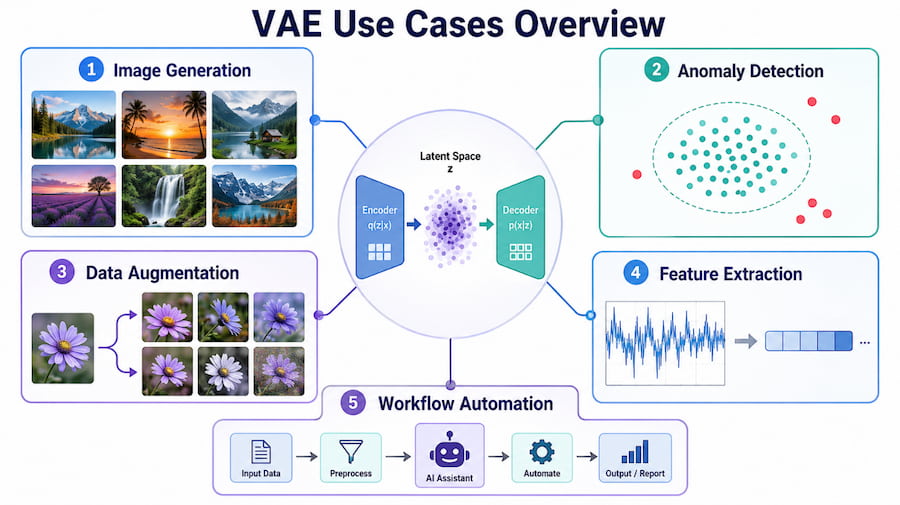
These use cases are especially useful when businesses have limited labelled data or need AI systems that adapt to changing patterns.
Image Generation and Creative Variation
VAEs can generate images by sampling from latent space and passing the sampled value through the decoder. This makes them useful for creative AI workflows, especially when a business needs variations based on existing visual patterns.
For marketing teams, VAEs can support product image variation, campaign visual testing, synthetic visual datasets, brand-style experimentation, and creative asset prototyping.
A VAE should not replace human creative judgement. Instead, it can help teams produce more options for review and refinement. This can save time during early testing or ideation, while still allowing designers and marketers to decide what is suitable for public use.
Anomaly Detection with VAEs
Anomaly detection is one of the most practical business use cases for VAEs. The model learns what normal data looks like. When it receives unusual data, the reconstruction error may be higher.
This can support business areas such as:
|
Area |
Possible Anomaly |
|
Manufacturing |
Defective product images or abnormal production patterns |
|
Finance |
Unusual transaction behaviour |
|
E-commerce |
Unexpected customer activity |
|
Marketing |
Abnormal engagement or visual content patterns |
|
Operations |
Workflow data that does not match normal behaviour |
This is useful because many businesses do not have enough labelled examples of every possible anomaly. A VAE can still help by learning the normal pattern first, then flagging inputs that are difficult to reconstruct.
How Can VAEs Support Data Augmentation in Marketing?
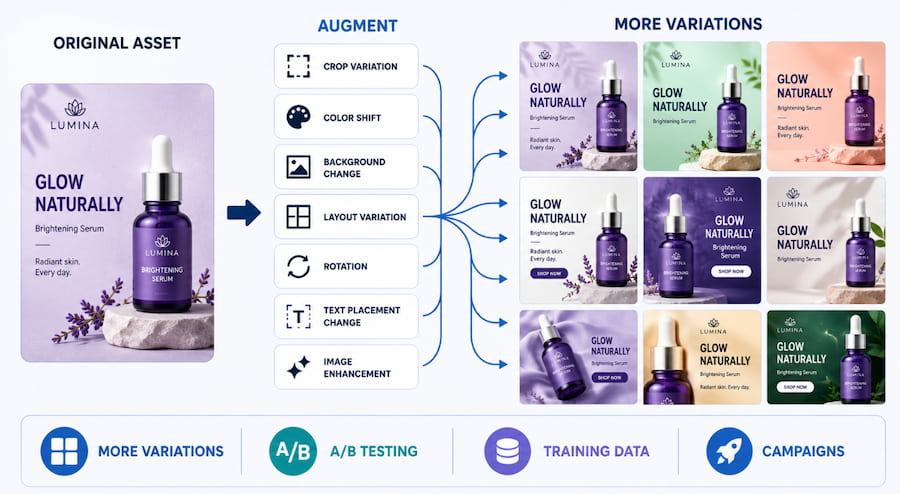
Marketing teams often work with limited datasets. VAEs can help by creating synthetic data that resembles the original dataset.
For example, a business could train a VAE on product visuals, campaign images, or brand-approved design elements. The model can then generate similar variations for testing, segmentation, or creative planning.
A simple marketing data augmentation workflow may include:
- Collect approved brand assets.
- Train a VAE or conditional VAE on the dataset.
- Sample from latent space to generate variations.
- Review generated outputs for quality and brand consistency.
- Use approved outputs for internal testing or campaign planning.
Human review remains important before any generated output is used publicly. VAEs can support marketing teams, but they should not replace brand checks, design review, or compliance review.
What Role Do VAEs Play in Workflow Automation?
VAEs can support workflow automation by turning complex business data into compact latent representations. These representations can then be used by dashboards, AI tools, or agentic bots.
For example, a customer support workflow may use a VAE to detect unusual query patterns. A marketing workflow may use a VAE to create synthetic customer data for testing. An operations workflow may use a VAE to flag process behaviour that does not match normal patterns.
This makes automation systems more adaptive. Instead of relying only on fixed rules, businesses can use learned data patterns to support smarter decisions.
Model Finetuning for Brand-Specific Processes
Finetuning allows a VAE to become more relevant to a specific business. The model can be adapted using brand data, campaign assets, customer behaviour, or workflow data.
A practical fine tuning process includes:
- Select a relevant base VAE architecture.
- Prepare business-specific data.
- Train the model while monitoring reconstruction loss.
- Adjust the KL term to improve latent space quality.
- Validate generated outputs or anomaly scores.
- Deploy the model with monitoring.
This is useful for businesses that want AI tools to match their actual operations rather than produce generic outputs. For example, a brand may finetune a VAE to create campaign variations that reflect its visual identity, or an operations team may use it to detect unusual workflow data.
How Can Businesses Integrate VAEs with Agentic Bots?
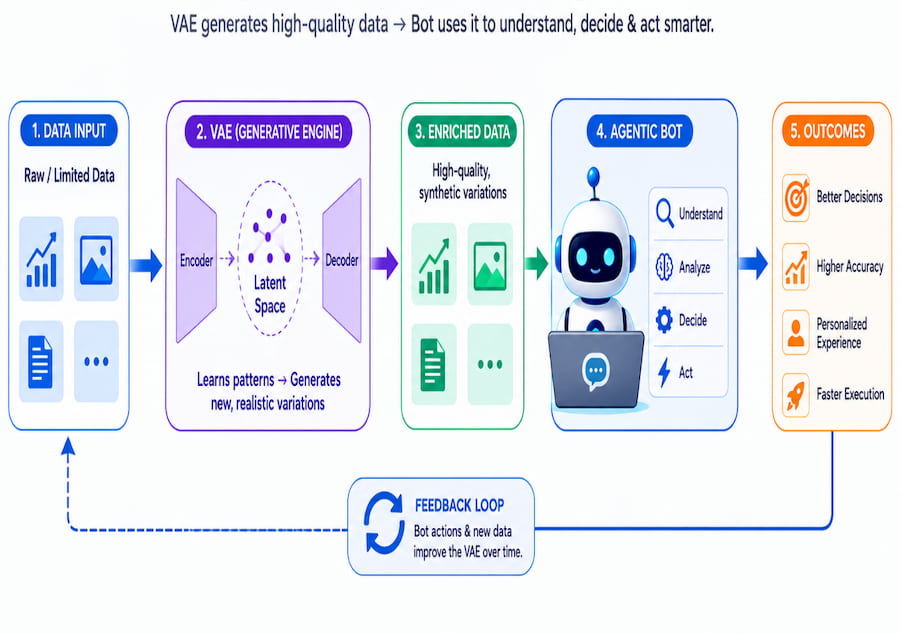
Agentic bots can use VAEs through an inference API. The bot sends data to the VAE endpoint, and the model returns a latent vector, reconstructed output, generated variation, or anomaly score.
|
Layer |
Role in the Integration |
|
Agentic bot |
Sends requests and uses VAE outputs in workflows |
|
API endpoint |
Connects the bot to the model |
|
VAE model |
Encodes, decodes, or scores data |
|
Monitoring system |
Tracks model performance and drift |
|
Business workflow |
Uses outputs for automation or decision support |
This setup helps businesses create bots that do more than respond to prompts. The bot can use model outputs to identify unusual patterns, simulate scenarios, or generate useful data variations.
Containerizing the VAE Endpoint
The VAE can be packaged inside a Docker container with its API layer and model runtime. This supports consistent deployment, easier updates, and smoother integration with production systems.
Deploying the VAE on Kubernetes
Kubernetes can help scale VAE inference services when demand changes. It supports resource limits, health checks, autoscaling, and deployment updates.
Monitoring Model Drift
Model drift happens when real-world data changes over time. Businesses can monitor reconstruction loss, input distribution changes, latent space shifts, and error rates to decide when a model needs review or retraining.
What AI Advisory Services Support VAE Deployment?
AI Thailand can support VAE deployment by helping businesses move from technical concepts to practical implementation. This includes identifying the right use case, preparing data, selecting model architecture, fine tuning the model, and deploying it into business workflows.
|
Advisory Area |
What It Includes |
Business Outcome |
|
AI strategy |
Identify where VAEs are useful |
Clearer use case selection |
|
Data preparation |
Clean and structure training data |
Better model performance |
|
Model finetuning |
Adapt VAEs to business needs |
More relevant AI outputs |
|
Workflow automation |
Connect VAEs to operational systems |
Practical business use |
|
Agentic bot integration |
Use VAE outputs inside AI assistants |
Smarter automation |
|
MLOps support |
Monitor, update, and maintain models |
More reliable deployment |
This support is useful because VAEs are not always the right solution for every problem. Businesses need to match the model to the workflow, data type, and expected outcome.
Training Workshops and Custom Model Finetuning
Training workshops can help teams understand how VAEs work and how they apply to real business cases. Topics may include encoder and decoder architecture, latent space sampling, reconstruction loss, KL divergence, ELBO optimisation, the reparameterization trick, conditional VAEs, Beta-VAEs, and model drift monitoring.
Custom model fine tuning can then apply these ideas to real business data, such as brand visuals, anomaly detection datasets, synthetic data workflows, or agentic bot support.
The goal is not only to understand VAEs in theory. The goal is to connect the model architecture to practical business workflows that can be tested, monitored, and improved over time.
How Do VAEs Fit into Thailand’s AI Ecosystem?
VAEs can support Thailand’s AI ecosystem by helping businesses use data more effectively across manufacturing, tourism, e-commerce, finance, and marketing.
In manufacturing, VAEs may help detect defects or unusual production patterns. In tourism, they can support marketing image variation. In e-commerce, they can help create synthetic customer behaviour data. In finance, they can support fraud-like anomaly detection. In marketing, they can assist with campaign variation and synthetic audience data.
VAEs are useful because they support unsupervised learning and synthetic data generation. This helps companies that want to adopt AI but may not have large, perfectly labelled datasets.
Benefits and Limitations of VAEs
VAEs are powerful, but they are not the best solution for every AI problem. Businesses should understand both their strengths and limitations before using them.
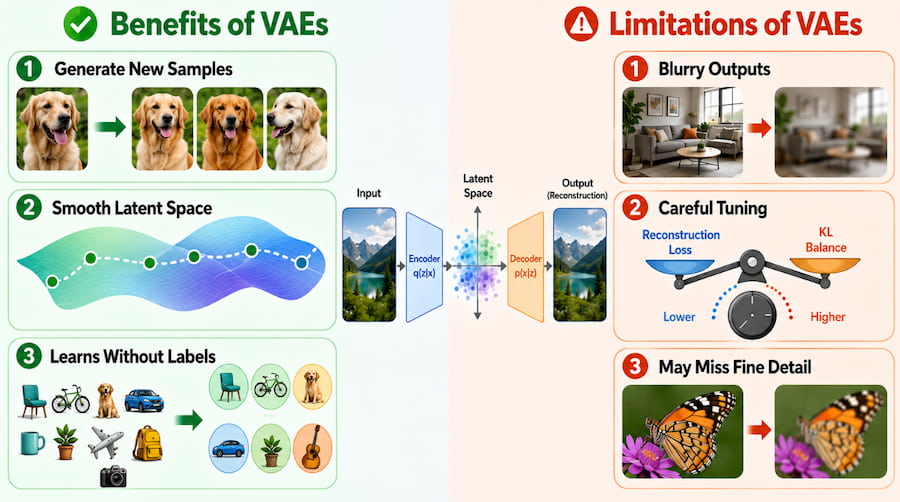
|
Benefits |
Limitations |
|
Can generate new data samples |
Output quality may be lower than some newer generative models |
|
Useful for anomaly detection |
Requires careful tuning |
|
Works with limited labelled data |
Generated outputs need human review |
|
Supports latent space analysis |
Can be hard to explain to non-technical teams |
|
Can support automation workflows |
Needs monitoring in production |
For business use, the main value of VAEs is how well they support practical workflows such as data augmentation, anomaly detection, and AI-powered automation.
Conclusion
Variational Autoencoders help businesses compress data, generate new samples, detect anomalies, and support AI-driven workflows. Their encoder-decoder structure, probabilistic latent space, reparameterization trick, and KL-divergence loss make them more flexible than standard autoencoders.
For businesses in Thailand, VAEs can support marketing automation, model finetuning, synthetic data generation, agentic bots, and workflow automation. They are especially useful for companies that need brand-specific AI outputs, anomaly detection, or training data support without relying only on large labelled datasets.
At AI Thailand, we help businesses understand how advanced AI Services can be applied in practical and commercially useful ways. Whether a company is exploring custom models, agentic bots, workflow automation, or tools for promotional products suppliers, we focus on building AI solutions that match real business goals instead of unnecessary technical complexity.
Frequently Asked Questions
What are Variational Autoencoders?
Variational Autoencoders are generative neural network models that learn probabilistic latent representations of data. They use an encoder to compress input data and a decoder to reconstruct or generate outputs.
How are VAEs different from standard autoencoders?
Standard autoencoders mainly compress and reconstruct data. VAEs learn probability distributions in latent space, which allows them to generate new outputs and support more flexible AI workflows.
What are VAEs used for in image processing?
VAEs can be used for image generation, image denoising, visual data augmentation, and anomaly detection.
Can VAEs be used in natural language processing?
Yes. VAEs can support text generation, topic modelling, sentence embeddings, and controllable text variation.
How do VAEs detect anomalies?
VAEs detect anomalies by measuring reconstruction error. If the reconstructed output is very different from the original input, the data may not match the normal patterns learned during training.
How can businesses use VAEs?
Businesses can use VAEs for synthetic data generation, marketing automation, model finetuning, anomaly detection, agentic bots, and workflow automation.
Are VAEs suitable for every business AI project?
No. VAEs are useful for generation, anomaly detection, and unsupervised learning, but they are not the best model for every task. Businesses should use VAEs only when they match the data type, workflow, and business goal.