
Fine-tuning helps businesses adapt large language models to specific workflows, customer needs, and internal processes. Instead of relying only on a general AI model, companies can train or adapt a model using task-specific examples, brand guidelines, customer service data, or operational documents.
For Thai businesses, fine-tuning can support marketing automation, customer service chatbots, workflow automation, internal knowledge assistants, and agentic bots that understand business context.
Key Takeaways
- Choose a suitable base LLM and prepare high-quality, task-specific datasets before training.
- Use frameworks such as Hugging Face Transformers, PEFT, LoRA, or Axolotl to make fine-tuning more practical.
- Evaluate the model with clear metrics, human review, and real business test cases before deployment.
- Combine fine-tuned models with retrieval augmented generation, or RAG, for more accurate and context-aware responses.
What Is Fine-Tuning for Large Language Models?
Fine-tuning for large language models adapts a pre-trained model to a specific task, industry, brand, or workflow. Instead of building a language model from scratch, businesses use an existing model and train it further with relevant examples.
This can include:
- Supervised fine-tuning using labeled prompt-and-response pairs
- Instruction fine-tuning for better task-following ability
- Parameter-efficient fine-tuning methods such as LoRA or PEFT
- RAG-based systems that retrieve business-specific information during responses
Full fine-tuning updates all or most model parameters, which can require significant computing power. Parameter-efficient fine-tuning, on the other hand, updates a smaller number of trainable parameters, making it more practical for many business use cases.
Fine-tuning is useful for customer service chatbots, legal document analysis, marketing content generation, internal knowledge assistants, and workflow automation. In many cases, businesses combine fine-tuning with prompt engineering and RAG to improve accuracy without overtraining the model.
What Do You Need Before Fine-Tuning an LLM?
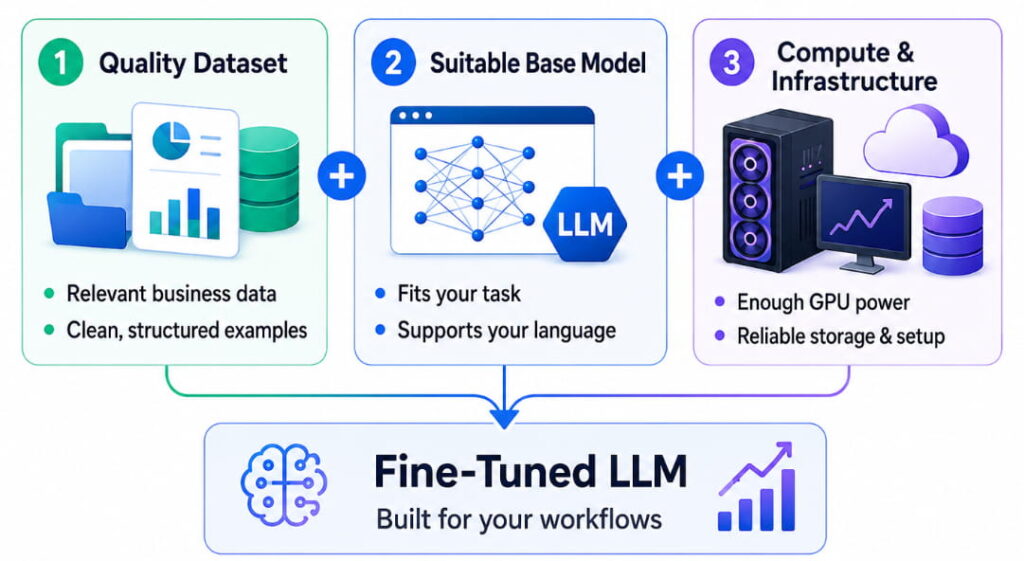
Successful LLM fine-tuning starts with three essentials:
- Clean data
- Suitable hardware
- Clear business objective
High-quality training data is the foundation. The model needs relevant examples that reflect the task it is expected to perform, such as customer conversations, marketing briefs, product descriptions, support tickets, or internal process documents.
A clear scope is also important. Businesses should define what the model should do, what it should not do, and how success will be measured. This helps avoid unnecessary training and keeps the project focused on practical outcomes.
Hardware and Compute Requirements
Fine-tuning LLMs can require strong GPU resources, especially for larger models. Full fine-tuning may need enterprise-grade GPUs, while smaller models and PEFT methods can often be trained with more accessible hardware.
For many businesses, LoRA or QLoRA is a practical starting point because these methods reduce the number of trainable parameters. This lowers memory requirements and makes experimentation easier.
Useful setup considerations include:
- Start with smaller models for testing before scaling up.
- Use cloud platforms when local hardware is limited.
- Monitor memory usage to avoid out-of-memory errors.
- Use LoRA adapters when full model retraining is unnecessary.
- Consider RAG when the model needs updated or document-specific knowledge.
How Do You Prepare Your Dataset for Fine-Tuning?
Dataset preparation involves collecting, cleaning, formatting, and splitting business-specific data. The goal is to give the model examples that match the type of responses or decisions you want it to produce.
For example, a customer service model may need real support questions and ideal responses. A marketing model may need campaign briefs, brand guidelines, product descriptions, and approved content examples.
Start With Relevant Business Data
Collect examples that reflect the final use case. This may include:
- Customer service conversations
- Website FAQs
- Product information
- Sales scripts
- Internal workflow documents
- Marketing copy
- Thai-language business content
- Industry-specific reports or knowledge bases
The data should be accurate, consistent, and safe to use. Remove personal information, confidential data, duplicate entries, and outdated content before training.
Format the Data Clearly
Fine-tuning datasets are often formatted as prompt-and-response pairs. A simple structure may include:
- Instruction: what the user asks
- Context: supporting information
- Response: the ideal answer
Many fine-tuning workflows use JSONL format, where each line contains one training example. This makes the dataset easier to process through common training frameworks.
Split the Dataset for Training and Testing
A standard approach is to divide the dataset into training, validation, and test sets. This allows you to train the model, tune the process, and evaluate performance on examples the model has not seen before.
A common split is:
- 80% for training
- 10% for validation
- 10% for testing
This helps reduce overfitting and gives a clearer view of how the model will perform in real business situations.
Avoid Common Dataset Mistakes
Poor data preparation can weaken the fine-tuning process. Common problems include:
- Data leakage between training and test sets
- Inconsistent response formats
- Too few examples for the intended task
- Overuse of outdated or inaccurate information
- Imbalanced examples across categories
- Prompts that do not match real user behaviour
Cleaning and reviewing the dataset before training saves time later and improves final model performance.
Step-by-Step Fine-Tuning Process
Fine-tuning follows a structured process, from selecting the base model to evaluating and deploying the final system.
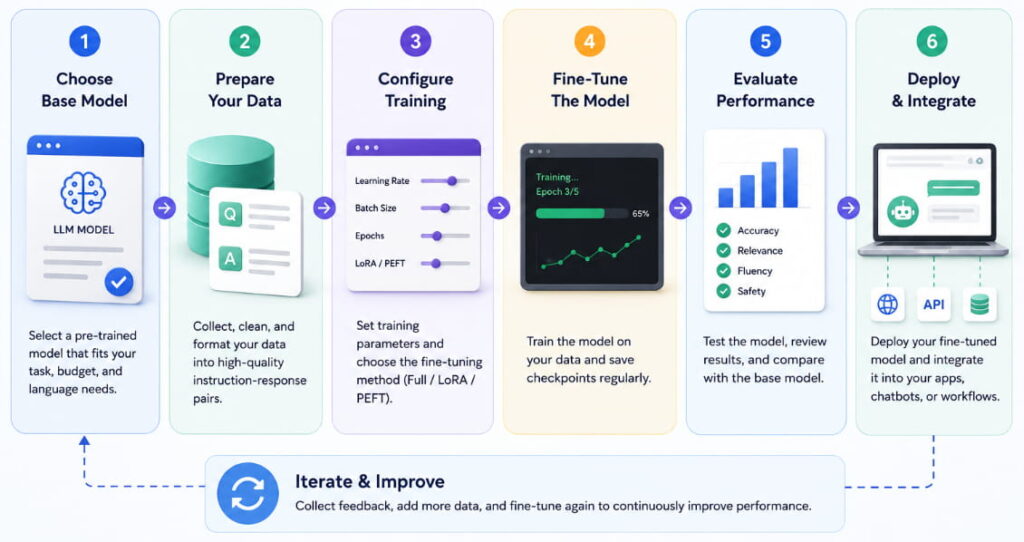
Choose the Right Base Model
The base model should match the task, budget, and technical requirements. Smaller open-source models may be easier to experiment with, while larger proprietary models may perform better for complex reasoning or advanced dialogue.
|
Model Type |
Best For |
Key Consideration |
|
Small open-source models |
Testing, prototypes, focused tasks |
Lower cost and easier experimentation |
|
Multilingual models |
Thai and English business workflows |
Useful for regional use cases |
|
Larger proprietary models |
Complex dialogue and advanced reasoning |
Less control over model internals |
|
Open-weight models |
Custom deployment and fine-tuning |
Requires stronger technical setup |
Before fine-tuning, test the base model with sample prompts. This helps you understand whether fine-tuning is necessary or whether prompt engineering and RAG may be enough.
Load and Tokenize the Dataset
Once the dataset is ready, load it into your training framework. Tools such as Hugging Face Datasets and Transformers are commonly used for this step.
The dataset must be tokenized so the model can process the text. During this stage, set limits such as maximum sequence length and batch size based on the model and available hardware.
Configure Training Parameters
Training parameters affect how the model learns. Important settings include:
- Learning rate
- Batch size
- Number of epochs
- Maximum sequence length
- Evaluation frequency
- Checkpoint saving
- LoRA or PEFT configuration
A smaller learning rate and careful validation can help reduce overfitting. For business projects, it is usually better to start small, evaluate results, and then improve the setup gradually.
Train, Review, and Iterate
Fine-tuning is not usually a one-time process. After training, review the model’s outputs, compare them against expected answers, and identify weak areas.
You may need to:
- Add better examples
- Remove poor-quality data
- Adjust training settings
- Improve prompt formats
- Add RAG for document-based accuracy
- Re-test with real business scenarios
This iteration improves reliability before deployment.
What Tools and Frameworks Should You Use?
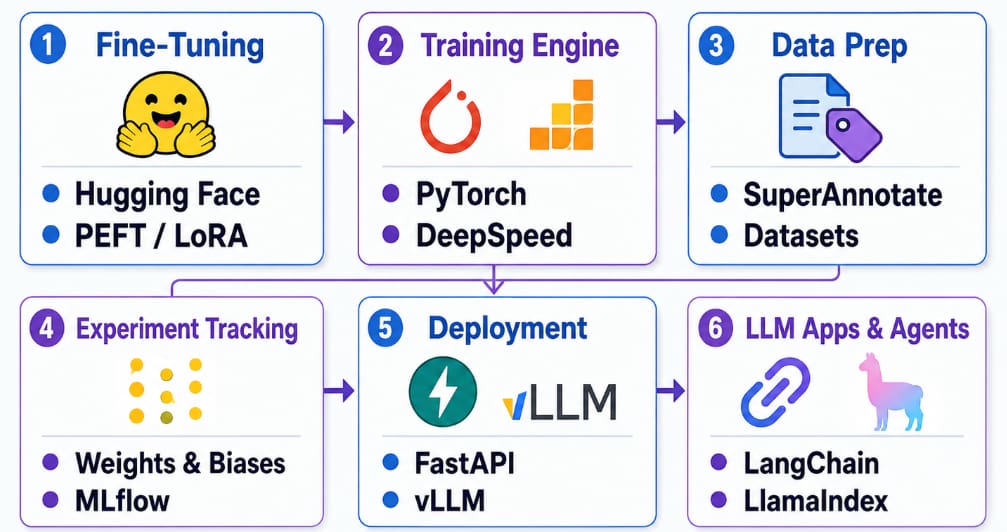
Several tools can support LLM fine-tuning, depending on your technical setup and project goals.
|
Tool |
Key Features |
Best For |
|
Hugging Face Transformers |
Model loading, tokenization, training workflows |
General fine-tuning pipeline |
|
PEFT and LoRA |
Parameter-efficient fine-tuning |
Lower-resource training |
|
PyTorch |
Flexible model training |
Custom training workflows |
|
Axolotl |
Config-based fine-tuning |
Faster experimentation |
|
DeepSpeed |
Distributed training and optimization |
Large-scale model training |
|
SuperAnnotate |
Data labelling and review |
Dataset preparation |
For beginners, Hugging Face Transformers with LoRA is often a practical starting point. It provides access to common model workflows while keeping training more manageable.
For larger business deployments, teams may also use cloud platforms, vector databases, monitoring tools, and orchestration frameworks such as LangChain.
How Do You Evaluate Fine-Tuned Model Performance?
Evaluation checks whether the fine-tuned model performs better than the base model and whether it is reliable enough for business use.
A good evaluation process should include both automated metrics and human review. Automated metrics are useful for summarization, classification, and structured tasks. Human review is essential for tone, accuracy, helpfulness, brand fit, and safety.
Use Automated Metrics Where Relevant
For summarization tasks, ROUGE can help measure overlap between generated summaries and reference summaries. For classification tasks, accuracy, precision, recall, and F1 score may be more useful. For language modelling, perplexity can help assess fluency.
However, automated metrics should not be the only measure. A model may score well but still produce responses that are not suitable for a brand or workflow.
Compare Against the Base Model
Before fine-tuning, test the original base model on the same examples. After fine-tuning, compare both outputs.
This helps answer important questions:
- Did the fine-tuned model improve task accuracy?
- Did it follow business instructions better?
- Did it maintain general language quality?
- Did it lose useful capabilities from the base model?
- Does it handle Thai-language context correctly?
Conduct Human Evaluation
Human review is especially important for customer service, legal analysis, medical-related content, and brand communications.
Reviewers should check:
- Accuracy
- Tone
- Completeness
- Relevance
- Safety
- Brand alignment
- Ability to follow instructions
This is where businesses can identify whether the model is ready for deployment or still needs more data and refinement.
Ready to Deploy Your Fine-Tuned LLM?
Deployment moves the fine-tuned model from testing into real-world use. This can involve hosting the model, creating an API endpoint, connecting it to business systems, and monitoring performance.
Common deployment options include:
- Hugging Face Inference Endpoints
- Cloud platforms such as AWS, Google Cloud, or Azure
- Custom servers
- Internal business applications
- Chatbots or virtual assistants
- Agentic workflow tools
The right deployment method depends on scale, budget, privacy requirements, and the level of control needed.
Technical Setup for Production
Before deployment, optimize the model for inference. This may include quantization, model compression, or exporting to formats that improve speed.
Production setup should consider:
- API endpoint design
- Latency targets
- User authentication
- Logging and monitoring
- Cost control
- Version management
- Fallback responses
- Human escalation paths
For customer-facing tools, response speed and reliability are especially important. Businesses should test the system under realistic traffic before full launch.
Security Best Practices
Security should be planned before deployment, not added later. Fine-tuned models may interact with sensitive business data, customer records, or internal documents.
Best practices include:
- Use API keys and access controls.
- Apply rate limits.
- Validate user inputs.
- Avoid exposing training data.
- Review logs for misuse.
- Separate sensitive databases from model outputs.
- Audit model responses regularly.
For RAG systems, document permissions should be carefully managed so the model only retrieves information each user is allowed to access.
How Can Fine-Tuning Automate Business Workflows?
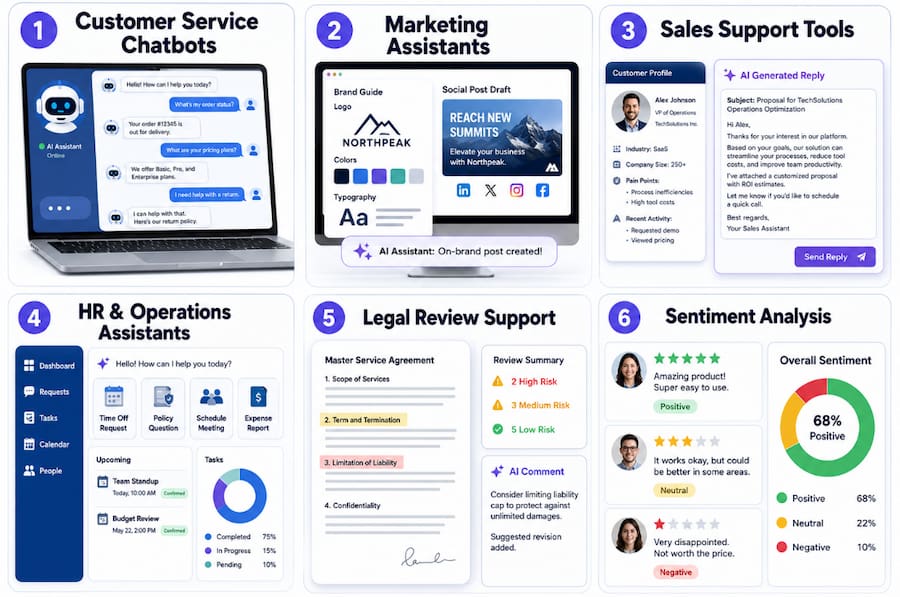
Fine-tuned models can automate repetitive and knowledge-based workflows by learning how a business communicates, classifies information, or handles tasks.
Examples include:
- Customer service chatbots that answer common questions
- Marketing assistants that follow brand guidelines
- Sales support tools that generate tailored replies
- Internal HR or operations assistants
- Legal document review support
- Sentiment analysis for reviews and feedback
- Workflow automation through connected tools and APIs
For example, a business could fine-tune a model on approved customer support responses. The model can then answer common questions in the same tone and structure used by the company.
Another example is marketing automation. A model trained on brand guidelines, campaign examples, and customer personas can produce more consistent first drafts for emails, ads, and website content.
Integrating Fine-Tuned Models with Agentic Bots
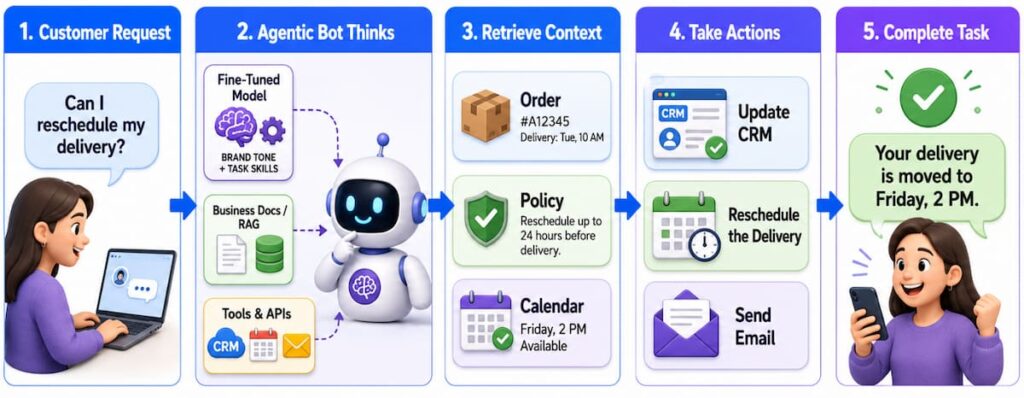
Fine-tuned models become more powerful when connected to agentic bots. These bots can use the model’s language understanding while also calling tools, retrieving documents, and completing multi-step tasks.
For example, an agentic bot may:
- Read a customer query
- Retrieve the relevant business policy
- Generate a response
- Update a CRM
- Create a follow-up task
- Notify the right team member
RAG is useful here because it lets the model access current business information without retraining every time a document changes. Fine-tuning gives the bot the right behaviour, tone, and task understanding, while RAG gives it access to the right information.
Build Context-Aware Virtual Assistants
To create a context-aware virtual assistant, businesses can combine:
- Fine-tuned LLMs
- Business documents
- Vector search
- Prompt engineering
- API integrations
- Workflow automation tools
- Human review checkpoints
This approach allows AI assistants to support customer service, internal operations, sales, marketing, and knowledge management.
Why Partner for AI Advisory and Training?
Partnering with AI Thailand can help businesses move from experimentation to practical AI implementation. Fine-tuning involves data preparation, model selection, evaluation, deployment, and workflow integration. Without a clear process, teams may waste time on the wrong model, poor data, or unnecessary technical complexity.
AI advisory and training can help teams understand:
- Whether fine-tuning is needed
- What data should be prepared
- Which tools and models are suitable
- How to evaluate model quality
- How to deploy AI safely
- How to connect models with business workflows
- How to build agentic bots and virtual assistants
Workshops can also help teams learn prompt engineering, RAG, supervised fine-tuning, LoRA, and workflow automation in a practical business context.
Conclusion
Fine-tuning large language models can help businesses create AI systems that understand their workflows, brand voice, customer needs, and internal knowledge. With the right dataset, model, evaluation process, and deployment plan, fine-tuned LLMs can support customer service, marketing, operations, legal analysis, and agentic automation.
Just as businesses compare promotional products suppliers to find reliable partners for brand visibility, they should also choose AI partners carefully when building long-term automation capabilities. The right support can make the difference between a basic chatbot and a useful AI system that improves daily business operations.
At AI Thailand, we help businesses explore, plan, and implement practical AI Services that fit real workflows. We work with teams to assess whether fine-tuning, RAG, agentic bots, training, or workflow automation is the right approach, then guide the process from strategy to deployment.
Frequently Asked Questions
How Do You Fine-Tune Large Language Models for Custom Business Processes?
To fine-tune large language models for custom business processes, start by collecting business-specific data, preparing a clean dataset, selecting a suitable base model, and training it using tools such as Hugging Face Transformers, LoRA, or PEFT.
The process should be guided by a clear business goal, such as improving customer service, automating marketing tasks, or supporting internal knowledge management.
How Do You Fine-Tune Large Language Models Using Limited Data?
When data is limited, use parameter-efficient methods such as LoRA or QLoRA. These methods reduce computing requirements and allow the model to adapt using smaller, high-quality datasets.
Businesses should focus on carefully curated examples that reflect real user requests, brand tone, and workflow needs.
How Do You Fine-Tune Large Language Models for Marketing Applications?
For marketing applications, gather examples such as campaign copy, brand guidelines, customer personas, product descriptions, and approved social media content.
Fine-tuning can help the model generate more consistent brand-aligned content, while RAG can provide updated product or campaign information during response generation.
How Do You Fine-Tune Large Language Models on Thai Language Data?
To fine-tune large language models on Thai language data, use Thai-language content from business documents, websites, customer conversations, or approved internal materials.
Choose a multilingual or Thai-capable base model, clean the dataset carefully, and test the model for tone, cultural context, and accuracy.
How Do You Fine-Tune Large Language Models for Agentic Bots?
To fine-tune large language models for agentic bots, prepare examples that show multi-step reasoning, business context, tool usage, and ideal task completion.
The fine-tuned model can then be connected with tools, APIs, RAG systems, and workflow automation platforms to create context-aware virtual assistants.
How Do You Fine-Tune and Deploy Large Language Models Efficiently?
After fine-tuning, evaluate the model, optimize it for inference, and deploy it through a suitable platform such as Hugging Face, a cloud provider, or an internal server.
For efficient deployment, monitor latency, response quality, user feedback, security, and cost. Businesses should also keep a clear process for updating the model or connected knowledge base when information changes.