CNN-Based Retail Inventory Monitoring: Technology and Benefits
Retail inventory management is one of the biggest challenges in the retail industry. Inventory management means keeping track of how much stock a business has, where the stock is located, and when more products need to be restocked. Every year, retailers lose large amounts of money due to inventory problems. These include stockouts, where products are unavailable when customers want them, overstock, where too many products are ordered and later discounted or wasted, and shrinkage, which refers to losses caused by theft, damage, human error, or missing records.
Traditional inventory checks are usually done manually. Staff walk around the store or warehouse, count products, and record the results. However, this becomes difficult when a store carries thousands of products in different sizes, colors, flavors, and packaging types.
Artificial intelligence, or AI, offers a faster and more accurate solution. An AI technology called CNN (Convolutional Neural Network), is proficient at understanding images. It can detect visual patterns such as shapes, colors, edges, logos, labels, and packaging designs. In simple terms, CNNs allow computers to “see” and recognise products.
When CNNs are combined with IoT devices, retailers can create automated inventory monitoring systems. IoT,(Internet of Things), refers to physical devices such as cameras, sensors, and scanners that are connected to the internet and can collect or share data.
In retail stores, cameras can be placed around shelves or warehouses. These cameras capture images, and the CNN analyzes whether products are available, running low, misplaced, or out of stock. If there is a problem, the system alerts staff so they can take action quickly.
What Is Retail Inventory Monitoring with CNN?
Retail inventory monitoring with CNN technology uses cameras and AI to automatically track products on shelves and in warehouses.
Instead of relying only on staff to count items, the system uses images to identify:
- What products are on the shelf
- How many products are left
- Which products are running low
- Which items are missing or misplaced
- When restocking is needed
The CNN recognizes products using visual features such as:
|
Visual Feature |
Meaning |
|
Shape |
The outline of the product |
|
Color |
Main colors on the packaging |
|
Logo |
Brand symbol or design |
|
Label design |
Printed layout on the product |
|
Size |
Visible dimensions |
|
Position |
Where the product is placed |
For example, people can recognize a Coca-Cola bottle from its red label, shape, and logo. A CNN works in a similar way, but through image data and pattern recognition. The main advantage is that CNN monitoring works continuously. Traditional stock checks may happen once a day or once a week, but CNN systems can monitor shelves in real time. This means the system can alert staff immediately when products run low.
Key Capabilities of CNN Inventory Monitoring
|
Capability |
Meaning |
Benefit |
|
Product Recognition |
Identifies products by appearance |
Knows what is on the shelf |
|
Stock Counting |
Estimates remaining quantity |
Detects low stock early |
|
Out-of-Stock Detection |
Finds empty shelf spaces |
Helps staff restock faster |
|
Shelf Monitoring |
Checks shelf condition |
Keeps displays neat |
|
Misplacement Detection |
Finds products in wrong locations |
Improves organization |
|
Real-Time Alerts |
Sends automatic notifications |
Speeds up staff response |
This turns cameras from simple recording tools into active inventory management tools.
How Do CNNs Process Images?
A CNN processes images in layers. A layer is a stage of analysis inside the AI model. When a camera captures an image, it is made up of tiny dots called pixels. Each pixel contains color information. The CNN studies these pixels and gradually learns what they represent.
1. Input Reception
The image first enters the CNN as a grid of pixel values. A color image usually contains red, green, and blue channels, also known as RGB channels.
2. Feature Extraction
The CNN then performs feature extraction. A feature is a visual clue, such as an edge, line, color, curve, logo, or texture. The CNN uses filters to scan the image and detect these clues.
3. Pattern Recognition
Deeper layers combine simple features into more meaningful patterns. For example, a combination of colors, shapes, and text may help the CNN identify a specific product.
4. Classification
Finally, the CNN performs classification, which means deciding what product or category the image belongs to. For example, it may identify an item as a cereal box, shampoo bottle, canned drink, or packet of chips. To do this accurately, the CNN must be trained using many images of each product.
Main Applications of CNN Inventory Monitoring
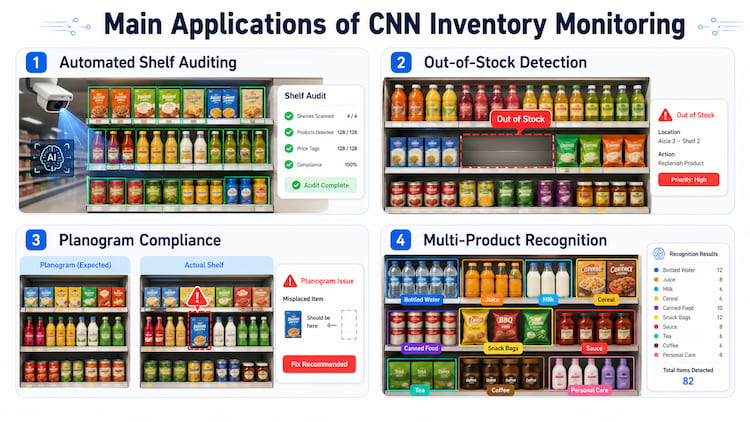
1. Automated Shelf Auditing
A shelf audit checks whether products are available, correctly arranged, and properly displayed. Instead of staff manually checking shelves, CNN systems use cameras to inspect shelves automatically. The AI can check which products are present, how many are visible, whether items are missing, and whether products are placed correctly. This saves time and reduces human error.
2. Out-of-Stock Detection
An out-of-stock situation happens when a product is unavailable for customers to buy. CNN systems can detect empty spaces or gaps on shelves. If a product is missing, the system alerts staff quickly so they can restock before customers are affected.
3. Planogram Compliance Checking
A planogram is a visual plan that shows where products should be placed on shelves. CNN systems can compare the real shelf layout with the planned layout. If products are missing, misplaced, or arranged incorrectly, the system can flag the issue.
4. Multi-Product Recognition
Retail stores carry many different products. Each unique product is called an SKU, which stands for Stock Keeping Unit. CNNs can be trained to recognize many SKUs at once, helping retailers monitor hundreds or thousands of products more efficiently.
The CNN Workflow in Practice
|
Stage |
What Happens |
Simple Explanation |
|
Input Layer |
Shelf image enters the system |
Camera sends photo to AI |
|
Convolutional Filters |
Features are detected |
AI looks for shapes and colors |
|
Pooling |
Extra details are reduced |
AI keeps important information |
|
Classification |
Product is identified |
AI decides what item it is |
|
Output |
Results are produced |
Staff receive alerts |
Pooling means reducing unnecessary image details while keeping the most useful information. This helps the system process images faster.
How CNNs Enable Real-Time Inventory Tracking
CNN systems can monitor inventory in real time because they process images very quickly.
Real-time means the system analyzes information almost immediately after it is captured.
Fast Inference
Inference means the AI is making a prediction from new data. In this case, the CNN looks at a shelf image and predicts what products are present.
Modern CNN systems can often process images in milliseconds, allowing quick stock updates and alerts.
Edge Computing
Edge computing means processing data near where it is collected instead of sending everything to a faraway cloud server. In a store, this could mean using a small AI computer near the cameras. This reduces delay, saves internet bandwidth, improves privacy, and allows the system to keep working even if the internet connection is weak.
Efficient AI Models
Retailers need AI models that are both fast and accurate. YOLO, which stands for You Only Look Once, is commonly used because it can quickly detect and identify objects in images.
Camera Placement Strategy
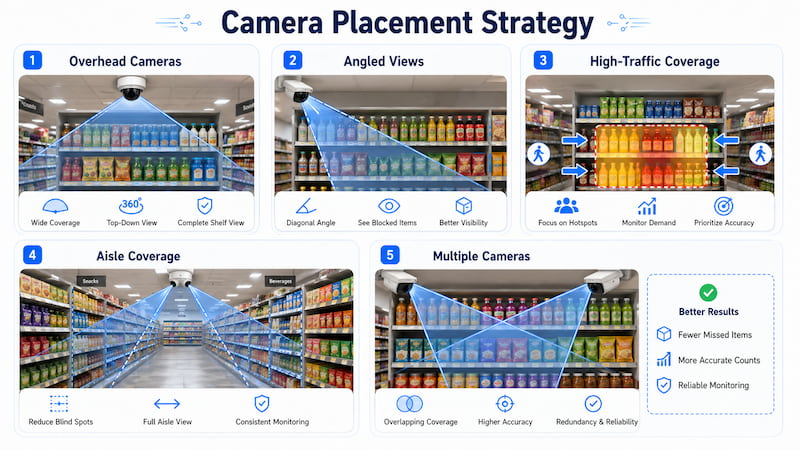
Good camera placement is important because the AI can only analyze what the camera can see.
|
Camera Strategy |
Purpose |
|
Overhead Cameras |
Provide wide shelf coverage |
|
Angled Views |
Help see blocked products |
|
High-Traffic Coverage |
Monitors fast-selling areas |
|
Aisle Coverage |
Reduces blind spots |
|
Multiple Cameras |
Improves accuracy during busy times |
If one camera is blocked by a customer, another camera may still capture the shelf clearly.
Key Technologies Used
|
Component |
Function |
Example |
|
IoT Cameras |
Capture shelf images |
4K IP cameras |
|
CNN Models |
Identify products |
ResNet-50, YOLO |
|
Edge Devices |
Process images locally |
NVIDIA Jetson |
|
RFID Tags |
Track tagged products |
RFID readers |
|
Dashboards |
Display alerts and reports |
Cloud dashboard |
|
APIs |
Connect systems |
REST APIs, OAuth2 |
ResNet-50 is a CNN model that is useful for product classification.
YOLO is useful for fast, real-time object detection.
RFID uses radio signals to track tagged products.
APIs allow different software systems to communicate.
Main Benefits for Retailers
CNN-based inventory monitoring helps retailers improve accuracy, reduce losses, and respond faster.
|
Benefit |
Explanation |
|
Labor Savings |
Less manual counting is needed |
|
Faster Restocking |
Staff are alerted when products run low |
|
Lower Shrinkage |
Continuous monitoring helps detect losses |
|
Better Accuracy |
Stock information is updated more often |
|
Improved Forecasting |
Real-time data supports better ordering |
|
Better Customer Experience |
Customers are more likely to find what they need |
Retailers may reduce manual audit hours, lower stockout incidents, and improve demand forecasting through CNN-based monitoring.
Return on Investment
Return on investment, or ROI, means how long it takes for a business to recover the money spent on a project.
CNN inventory monitoring can create savings from:
- Reduced labor hours
- Lower shrinkage
- Fewer lost sales
- Better ordering decisions
- Less overstock and waste
Although implementation can be costly, many retailers may recover the investment over time through labor savings, fewer stockouts, and better inventory control.
Integration with Existing Retail Systems
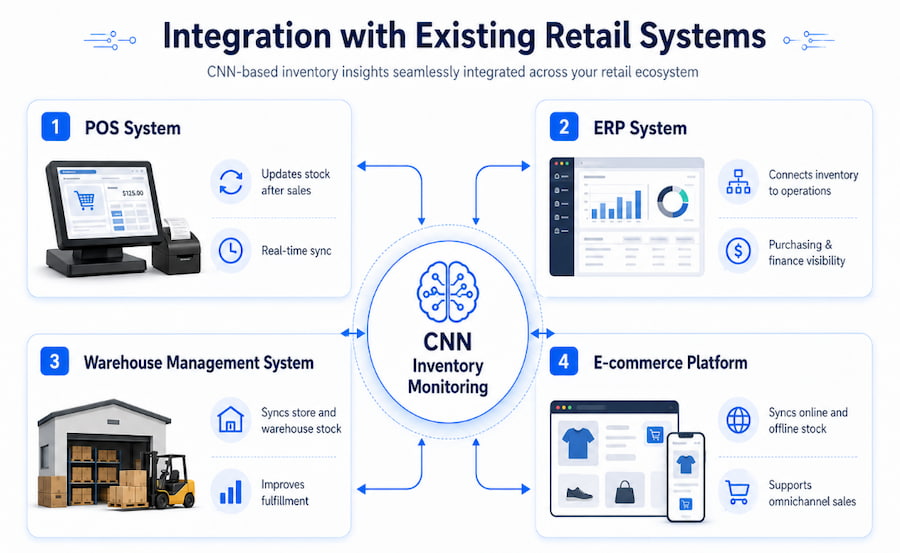
CNN inventory systems usually connect with current retail platforms through APIs.
An API is a software connection that allows different systems to share information.
|
System |
Purpose |
|
POS System |
Updates stock when sales happen |
|
ERP System |
Connects inventory to wider business operations |
|
Warehouse Management System |
Syncs warehouse and store inventory |
|
E-commerce Platform |
Syncs online and offline stock |
A POS system is used at checkout.
An ERP system manages business functions such as finance, purchasing, and inventory.
A warehouse management system helps track products stored in warehouses.
Common Deployment Challenges
|
Challenge |
Problem |
Solution |
|
Lighting Changes |
Products look different under different lighting |
Train AI with varied images |
|
Blocked Camera Views |
Customers may block shelves |
Use multiple camera angles |
|
Similar Packaging |
Products may look alike |
Train with detailed examples |
|
Privacy Concerns |
Cameras may capture customers |
Use edge processing and face blurring |
|
False Positives |
AI may detect a problem incorrectly |
Use human review and confidence checks |
|
Scaling Issues |
Many stores may have different layouts |
Use modular systems and local processing |
A false positive happens when the system detects a problem that is not actually there. For example, it may think a shelf is empty when a customer is simply standing in front of it.
Privacy and Compliance
Retail camera systems may capture customers, so privacy is important.
To reduce privacy risks, retailers can use:
- Edge processing, so images are analyzed inside the store
- Anonymization, such as blurring faces
- Short data storage periods
- Clear signs informing customers about camera use
- Access controls to protect footage
These steps help businesses use AI responsibly.
How AI Advisory Services Help
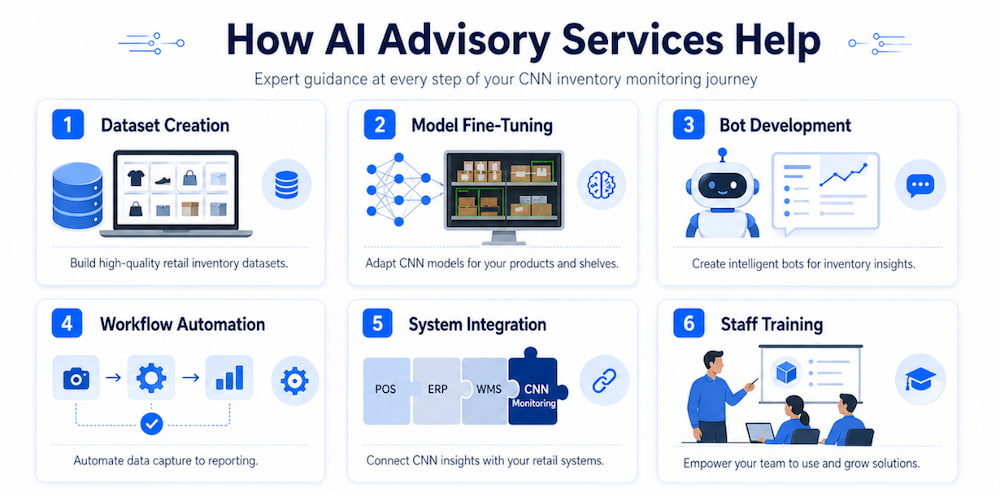
AI advisory services help retailers plan, build, and launch CNN inventory systems. This is useful because many retailers may not have in-house AI experts.
Advisory services can help with:
|
Service |
Value |
|
Dataset Creation |
Collects and labels product images |
|
Model Fine-Tuning |
Adapts AI to the retailer’s products |
|
Bot Development |
Creates automated alerts and actions |
|
Workflow Automation |
Connects AI alerts to business processes |
|
System Integration |
Links CNN tools to POS, ERP, or warehouse systems |
|
Staff Training |
Helps employees use the system properly |
Fine-tuning means adjusting an existing AI model for a specific task instead of building one from scratch.
An agentic bot is an AI-powered tool that can act on system results, such as sending restocking alerts or creating staff tasks.
Typical Implementation Timeline
|
Phase |
Duration |
Outcome |
|
Dataset Curation |
2 weeks |
Product images are collected and labeled |
|
Model Fine-Tuning |
3 weeks |
AI learns the retailer’s products |
|
Bot Development |
2 weeks |
Alerts and automated actions are created |
|
Integration |
1 week |
AI connects with business systems |
|
Monitoring Setup |
1 week |
Dashboards and reports are prepared |
A full professional implementation may take around eight weeks, although the timeline depends on store size, number of products, and system complexity.
Real-World Case Studies
Case Study 1: Regional Retail Chain
A retail chain with 25 locations struggled with stockouts and overstock. It used a CNN system based on YOLOv5, ceiling-mounted cameras, and integration with existing inventory systems.
The results included fewer stockout incidents, better product availability, improved customer satisfaction, and significant annual savings.
Case Study 2: University Store
A university store used a lightweight CNN model called MobileNetV2 with edge deployment and IoT technology.
The system achieved high stock detection accuracy, reduced overstock situations, and improved supply chain visibility.
Case Study 3: Industry 4.0 Hybrid System
An advanced retail operation combined CNN, RFID, sales trend analysis, and automation.
This improved demand forecasting, automated restocking, operational efficiency, transparency, and scalability.
Conclusion
CNN-based retail inventory monitoring is a practical use of AI that helps retailers manage stock more accurately and efficiently. By using cameras and AI, retailers can continuously monitor shelves, detect low stock, identify misplaced products, and alert staff in real time. The idea is simple: the system gives computers the ability to “see” shelves and understand what products are available. The CNN recognizes products by studying visual features such as shape, color, packaging, logo, and shelf position.
The technology offers many benefits, including reduced manual work, fewer stockouts, lower shrinkage, better forecasting, and improved customer experience. Although there are challenges such as lighting issues, privacy concerns, and false alerts, these can be managed with proper planning, good training data, edge processing, and human review.
As retail becomes more competitive, real-time inventory visibility will become increasingly important. CNN-based inventory monitoring gives retailers a smarter and faster way to understand their stock and improve daily operations.
Frequently Asked Questions
What is CNN inventory monitoring?
CNN inventory monitoring uses cameras and AI to automatically track products on shelves and in warehouses. It identifies products, detects low stock, and sends alerts when action is needed.
What does CNN mean?
CNN stands for Convolutional Neural Network. It is a type of AI that understands images by detecting patterns such as shapes, colors, logos, and packaging designs.
How does it help retailers?
It reduces manual counting, detects stockouts faster, improves shelf organization, lowers shrinkage, supports better forecasting, and improves customer satisfaction.
Is it suitable for small retailers?
Yes. Small retailers can start with a smaller setup using a few cameras and basic monitoring, then expand later.
What are the main challenges?
The main challenges include lighting changes, blocked camera views, similar-looking packaging, privacy concerns, setup costs, false alerts, and scaling across many stores.